
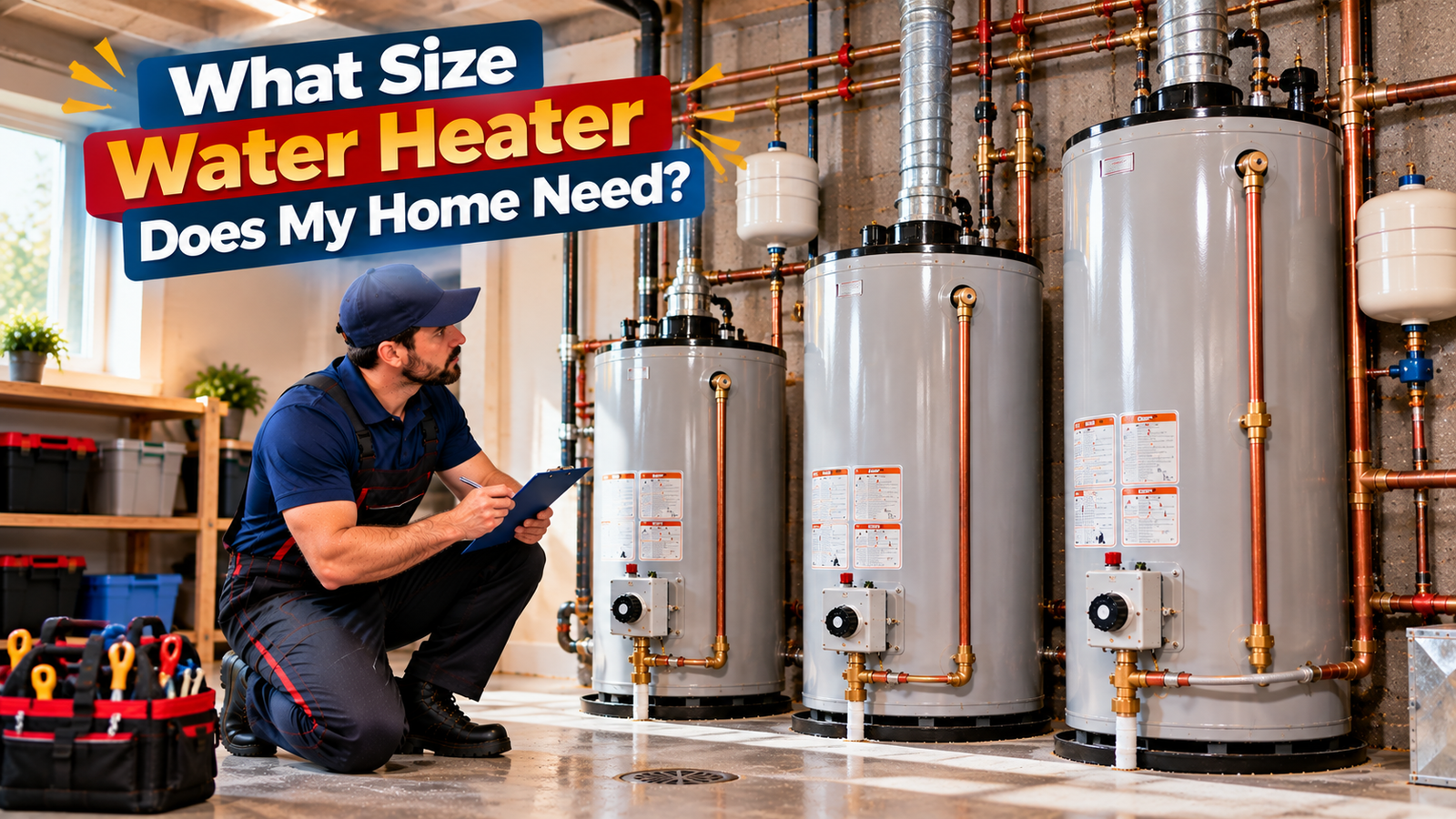
What Size Water Heater Does My Home Need? If your shower suddenly turns cold while someone else is using the kitchen sink, your water heater may not be keeping up with household demand. Choosing the right size involves more than counting bathrooms or purchasing the largest tank available.
For homeowners in Mahogany, Auburn Bay, Cranston, and other Southeast Calgary communities, water heater sizing should account for family size, simultaneous hot water use, and colder incoming water temperatures. Professional water heater installation and plumbing services in Calgary can help determine an appropriate system using actual household requirements.
A conventional storage heater is generally sized using tank capacity and first-hour delivery, while a tankless system is selected according to flow rate and required temperature rise. This guide explains both methods, common sizing mistakes, and practical considerations for Calgary homes.
Many two-person households consider 30–40-gallon storage heaters, while families of three to four often consider 40–50 gallons. Larger households may need 50–80 gallons or more. Actual sizing depends on first-hour rating, simultaneous demand, incoming water temperature, and whether the system is storage or tankless.
What Size Water Heater Do You Need Based on Household Size?
Household size provides a useful starting point when choosing a conventional storage water heater. However, two homes with the same number of occupants can have significantly different hot water requirements.
Morning shower schedules, laundry habits, dishwasher use, bathtub capacity, and the number of fixtures operating together all influence demand.
Water Heater Size for One or Two People
A smaller household with moderate hot water use may find a 30–40-gallon storage heater sufficient. In Canadian measurements, that represents approximately 114–151 litres.
However, a two-person household with a large bathtub or simultaneous showers may require greater delivery capacity than its occupant count suggests.
Water Heater Size for Three or Four People
Many households with three or four occupants consider storage tanks in the 40–50-US-gallon range, approximately 151–189 litres.
The final selection should account for how quickly the heater can recover after hot water is drawn.
For example, a household in McKenzie Towne with two showers running close together may need a higher first-hour rating than another four-person household that uses hot water at different times.
Water Heater Size for Five or More People
Larger households frequently require more substantial hot water delivery. Depending on demand, a 50–80-gallon storage system or another suitable configuration may be considered.
High-demand homes should be assessed using fixture usage and recovery performance rather than relying solely on a large tank.
Is a 40-Gallon or 50-Gallon Water Heater Enough?
A 40-gallon tank can serve many smaller or moderately sized households, while a 50-gallon unit may provide additional stored capacity.
Nevertheless, two heaters with identical tank volumes may deliver different amounts of usable hot water during the first hour.
Heating input, recovery rate, and first-hour rating are essential when comparing models.
| Household Size | Illustrative Storage Capacity | Important Consideration |
|---|---|---|
| 1–2 people | 30–40 US gallons (114–151 L) | Daily usage and fixture demand |
| 3–4 people | 40–50 US gallons (151–189 L) | Morning peak usage and recovery rate |
| 5–6 people | 50–80 US gallons (189–303 L) | Simultaneous showers and laundry |
| Large or high-demand households | Demand-based professional sizing | First-hour rating and system configuration |
These are broad starting points, not final sizing recommendations. Capacities use US gallons; equipment sold in Canada may also be labelled in litres or imperial gallons.
Does the Number of Bathrooms Determine Tank Size?
Bathroom count matters because it indicates potential simultaneous demand, but it does not directly determine the correct tank capacity.
A three-bathroom home occupied by two people may use less hot water than a two-bathroom home occupied by six people.
Actual fixture usage provides a more reliable sizing basis.
Should You Buy a Larger Tank for Future Family Growth?
Future occupancy can be considered when replacing a water heater. A household expecting greater demand may benefit from additional delivery capacity.
However, buying the largest available unit is not always economical. Oversizing can increase equipment costs and may introduce unnecessary standby losses in some storage systems.
A balanced design should meet realistic peak demand without excessive capacity.
Quick sizing insight: Household size helps establish a starting range, but the correct storage heater must also satisfy your busiest period of hot water use. Compare first-hour ratings, not tank volume alone.
For local company location information, consult the Calgary Electrical and Plumbing Google Maps listing.
How Do You Calculate the Right Water Heater Capacity?
Proper sizing begins by estimating the amount of hot water a household needs during its busiest period. This is more useful than calculating total daily consumption because the heater must keep up when demand is concentrated.
What Is a Water Heater First-Hour Rating?
The first-hour rating, often abbreviated FHR, estimates how much hot water a storage heater can deliver during one hour starting with a fully heated tank.
It reflects both stored water and the heater’s ability to produce additional hot water as the tank refills.
Two 50-gallon heaters can have different first-hour ratings because their heating input and recovery performance differ.
How to Estimate Peak-Hour Hot Water Demand
Consider the busiest hour of the day, such as the period when several household members shower and breakfast dishes are washed.
Estimate the hot water required by the activities that realistically occur during that hour.
Actual demand varies with fixture flow rates, shower duration, mixed-water temperature, and appliance design.
Example: A Four-Person Calgary Household
Imagine a family in Cranston where three people shower during the morning, a kitchen tap is used, and the dishwasher operates.
For a simplified illustration, suppose the estimated hot water draw is 12 gallons per shower, 5 gallons for kitchen activities, and 6 gallons for dishwasher use.
Three showers would represent 36 gallons. Adding the kitchen and dishwasher estimates produces approximately 47 gallons of hot water demand during the busiest hour.
This example is illustrative. Actual hot-water draw can differ substantially, and the calculation must distinguish heated tank water from mixed water delivered at fixtures.
Illustrative calculation: Three showers at 12 gallons each, plus 5 gallons for kitchen use and 6 gallons for a dishwasher, equals approximately 47 gallons of estimated peak-hour hot water draw. Select equipment using verified first-hour delivery and actual household conditions.
Why Recovery Rate Matters
Recovery rate describes how quickly a heater can replenish hot water after stored water is used.
A heater with faster recovery may meet substantial demand without requiring the largest available tank.
Recovery performance depends on the equipment’s heating capacity and the temperature increase required.
Does Water Heater Fuel Type Affect Sizing?
Gas, electric resistance, and heat pump storage heaters may have different recovery characteristics.
For example, two units with the same nominal storage capacity may have different first-hour delivery because their heating systems operate differently.
Compare manufacturer performance specifications rather than assuming that equal tank sizes provide equal service.
How Does a Large Bathtub Change Requirements?
Deep soaking tubs and oversized bathtubs can create substantial demand within a short period.
A home with a large bathtub may require a greater usable hot water supply even when only two or three people live there.
The tub’s actual fill volume and desired water temperature should be considered during sizing.
Can Showerheads Reduce Hot Water Demand?
Water-efficient fixtures can reduce the volume of mixed water used during showers and other activities.
However, hot water demand also depends on shower duration and the proportion of hot water required to reach a comfortable temperature.
Efficiency improvements can help, but equipment should still be sized for realistic usage.
How Do You Know If Your Existing Heater Is Undersized?
Consistently running out of hot water during predictable peak periods can indicate inadequate capacity.
However, declining performance may also result from sediment, faulty heating components, or other service issues.
Before installing a larger unit, have the existing heater assessed to determine whether it is operating correctly.
Why Calgary Water Conservation Matters
Efficient hot water use can reduce both water consumption and the energy needed to heat water.
Homeowners can review the City of Calgary’s official water bylaws and water-use information when considering responsible household water practices.
Water efficiency is valuable, but it should not replace proper equipment sizing.
Storage sizing rule: Estimate the household’s peak-hour hot water requirement, then compare that demand with the manufacturer’s first-hour rating. Tank capacity alone does not describe the full delivery capability of a water heater.
For additional local business information, see this Calgary plumbing service map reference.
Request a water heater sizing and installation estimate in Calgary in just a few clicks.
Get My Free Estimate
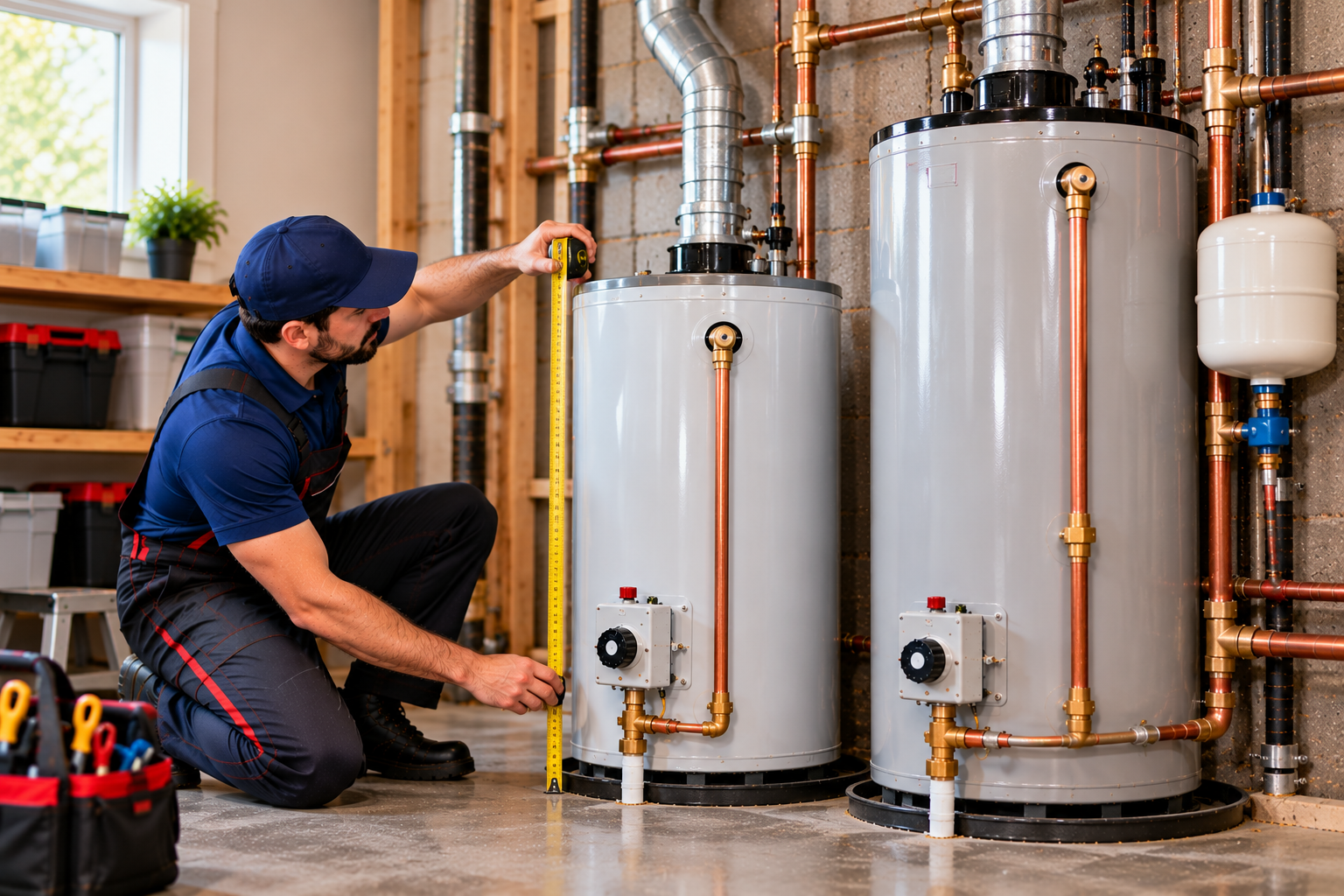
What Size Tankless Water Heater Does a Calgary Home Need?
Tankless water heaters are sized differently from conventional storage tanks. Rather than selecting a fixed volume of stored water, homeowners must consider how much heated water the appliance can deliver at the same time.
The key factors are flow rate and the temperature increase required between incoming cold water and the desired outlet temperature.
How Many Gallons Per Minute Should a Tankless Heater Deliver?
Tankless flow rate is commonly expressed in gallons per minute, or GPM. In Canada, specifications may also use litres per minute.
A household operating one shower may need considerably less flow than a home running two showers and a kitchen tap simultaneously.
Manufacturer ratings must be checked at the required temperature rise because maximum advertised flow rates may be based on warmer incoming water.
Typical Household Fixture Flow Rates
The following figures illustrate possible mixed-water flow rates at household fixtures. Actual fixtures can vary considerably.
| Fixture | Illustrative Flow Rate | Sizing Consideration |
|---|---|---|
| Standard shower | 1.5–2.5 GPM | Duration and desired temperature |
| Bathroom faucet | 0.5–1.5 GPM | Actual hot water fraction |
| Kitchen faucet | 1.0–2.2 GPM | Concurrent use with showers |
| Bathtub faucet | 3.0–6.0+ GPM | Fill speed and tub volume |
These are illustrative mixed-water fixture flows, not guaranteed hot-water flow requirements. Tankless sizing must account for the hot-water fraction and the manufacturer’s performance at the design temperature rise.
Example: Two Showers Running Simultaneously
Suppose two showers each operate at 2.0 GPM, and a kitchen faucet runs at 1.5 GPM.
The combined mixed-water flow is approximately 5.5 GPM.
That does not automatically mean the heater must supply 5.5 GPM of fully heated water. The actual required hot-water flow depends on incoming water temperature and the desired mixed-water temperature.
How Does Calgary’s Winter Water Temperature Affect Sizing?
Incoming cold water can be substantially colder during winter, requiring a greater temperature increase to produce usable hot water.
As the required temperature rise increases, the maximum flow rate of a tankless heater generally decreases.
This is particularly important in Calgary, where a unit sized using mild-weather conditions may not deliver the same flow during colder periods.
What Is Temperature Rise?
Temperature rise is the difference between incoming water temperature and the target heated-water temperature.
For example, if incoming water is 5°C and the heater is expected to produce water at 49°C, the required temperature rise is 44°C.
This is an illustrative calculation, not a statement of Calgary’s actual current incoming water temperature or a universal recommended heater setting.
Why Advertised Tankless Flow Rates Can Be Misleading
A tankless heater may advertise a high maximum GPM rating, but that rating may correspond to a relatively modest temperature rise.
At a larger temperature rise, the same unit may deliver less water per minute.
Compare the manufacturer’s performance chart at the design conditions relevant to your home.
Can One Tankless Heater Serve a Large Calgary Home?
Some tankless systems can serve larger households when appropriately sized. Other properties may require a different configuration to meet simultaneous demand.
High-flow showers, large bathtubs, and multiple bathrooms can create substantial peak requirements.
Professional sizing helps determine whether a single unit is suitable or whether another arrangement should be considered.
Does Tankless Mean Unlimited Hot Water?
Tankless equipment can provide continuous heating while operating within its rated capacity, but it cannot deliver unlimited flow.
If simultaneous demand exceeds the heater’s capability, outlet temperature or delivery performance may be affected.
Continuous operation also depends on available energy input and proper equipment functioning.
What About Gas and Electric Tankless Models?
Gas-fired and electric tankless heaters have different energy supply and installation requirements.
Whole-home electric tankless equipment can require substantial electrical capacity, while gas-fired models have fuel supply and venting considerations.
The available infrastructure should be assessed before selecting a model.
Installation safety: Tankless water heaters can involve high electrical loads, gas connections, combustion venting, and pressurized hot water. Equipment selection and installation should be handled by appropriately qualified professionals. Do not attempt unauthorized electrical or gas modifications.
Should You Size for Every Fixture Running at Once?
Not necessarily. The design should reflect realistic simultaneous use rather than an unlikely scenario in which every fixture operates at maximum flow.
However, frequent combinations such as two showers and kitchen use should be considered.
A qualified installer can help establish a practical design flow rate.
Tankless sizing rule: Identify realistic simultaneous fixture demand, calculate the required temperature rise, and verify the heater’s rated output at those conditions. A maximum advertised GPM figure alone is not sufficient.
Homeowners can also consult the Calgary Electrical and Plumbing shared Google business profile for additional local company information.
How Do You Choose the Best Water Heater for Your Calgary Home?
Choosing the right water heater means balancing sufficient hot water delivery with installation requirements, energy use, maintenance, and long-term costs.
The largest system is not automatically the best option. A correctly sized heater should meet realistic household demand while operating within its intended performance range.
Should You Choose Storage or Tankless?
Storage heaters maintain a reservoir of heated water and can be practical for many households, especially when replacing an existing tank with a compatible model.
Tankless systems heat water on demand and may offer longer potential service life, but they require careful flow-rate sizing and may involve additional installation work.
Both approaches can be suitable when properly designed.
Does Water Heater Size Affect Energy Costs?
Water heating energy consumption depends on the volume of hot water used, required temperature increase, equipment efficiency, and heat losses.
An oversized storage tank may have unnecessary standby losses, while an undersized heater can create comfort and performance problems.
Choosing appropriate capacity helps avoid both extremes.
What Role Does Water Heater Efficiency Play?
Efficiency ratings help compare how effectively different systems convert energy into useful hot water.
However, a high-efficiency model still needs sufficient capacity for the household’s peak demand.
Equipment selection should consider both delivery performance and expected operating costs.
Should You Replace an Aging Heater With the Same Size?
Not automatically. Your household’s needs may have changed since the original heater was installed.
A home in New Brighton that once housed two occupants may now accommodate a larger family, increasing peak demand.
Conversely, a household with fewer occupants may not require the same capacity as before.
Our related guide, How Long Do Water Heaters Last in Calgary?, explains how equipment age and condition can influence replacement planning.
Does Calgary’s Hard Water Affect Equipment Selection?
Hardness minerals can contribute to scale accumulation in both storage and tankless systems.
Tankless heat exchangers and storage-tank heating surfaces have different maintenance needs, so water conditions should be considered during equipment selection.
Appropriate manufacturer-recommended servicing remains important regardless of system type.
Can a Water Heater Be Too Large?
Yes. Oversizing may increase upfront equipment costs and, in some storage systems, standby energy losses.
It can also require more installation space than necessary.
However, capacity should not be reduced so far that the system cannot meet realistic peak demand.
What About Installation Space?
Storage heaters require sufficient room for the tank, connections, service access, and applicable clearances.
Tankless models are generally more compact, but they still need appropriate space for installation, maintenance, and any required venting or electrical components.
Existing utility-room conditions can influence which equipment is practical.
How Much Does Water Heater Installation Cost in Calgary?
Installation costs vary with the type and capacity of equipment, existing connections, site accessibility, and required system modifications.
A straightforward compatible tank replacement may involve less work than converting from storage to tankless equipment.
The following amounts are illustrative budgeting ranges, not verified current Calgary market prices or company quotations.
| Equipment or Service | Illustrative Cost (CAD) | Major Cost Factors |
|---|---|---|
| Water heater sizing assessment | $100–$250+ | Inspection scope and household requirements |
| Standard storage water heater installation | $1,500–$3,500+ | Tank capacity, equipment, and labour |
| Tankless water heater installation | $3,000–$6,500+ | Equipment, venting, and utility modifications |
| Hybrid heat pump water heater installation | $3,000–$6,000+ | Equipment, electrical work, and space requirements |
Pricing disclaimer: These figures are illustrative, nonbinding CAD ranges. Actual Calgary installation estimates may be higher or lower depending on equipment, labour, taxes, permits, materials, and site conditions.
Do Water Heater Installations Require Permits?
Permit requirements depend on the work involved and whether plumbing, gas, or electrical systems are being modified.
Homeowners should confirm applicable requirements with the appropriate Calgary authority and qualified contractor before installation.
Compliance and proper equipment installation are essential considerations alongside capacity and price.
What Should You Ask Before Choosing a Water Heater?
- What is the household’s estimated peak hot water demand?
- What first-hour rating is required for a storage system?
- What tankless flow rate is available at Calgary winter design conditions?
- Is the existing fuel or electrical supply suitable?
- Will the system fit the available installation space?
- What maintenance does the manufacturer recommend?
- Are permits or equipment modifications required?
- What is included in the written installation estimate?
Why Professional Sizing Matters
Professional assessment brings together fixture demand, equipment performance, incoming water conditions, and installation requirements.
This is especially useful for larger Southeast Calgary homes with multiple bathrooms, oversized tubs, or simultaneous hot water demands.
Rather than selecting equipment solely by tank volume or advertised GPM, a qualified installer can evaluate whether a specific model meets the household’s needs.
Calgary homeowner recommendation: For homes in Mahogany, Copperfield, Riverbend, Douglasdale, and Lake Bonavista, water heater selection should reflect the household’s actual peak demand and existing utility infrastructure—not neighbourhood, square footage, or bedroom count alone.
Planning for Long-Term Household Needs
A well-chosen system should meet current demand while allowing for reasonably anticipated changes in household usage.
Consider whether family occupancy, bathroom use, or appliance requirements are likely to change in the coming years.
Balancing these factors can help avoid premature upgrades and unnecessary oversizing.
Final sizing principle: The best water heater is not necessarily the largest. It is the system that can meet your household’s realistic peak demand at the required temperature rise while fitting the home’s installation and operating requirements.
For additional discussions and information about the company, visit the Calgary Electrical and Plumbing Quora profile.
Request a water heater sizing and installation estimate in Calgary in just a few clicks.
Get My Free Estimate
Choose a Water Heater That Matches Your Home
The right water heater size depends on household demand, first-hour delivery, fixture flow rates, incoming water temperature, and the equipment’s heating capacity. Storage and tankless systems require different sizing methods, making accurate assessment essential.
A local calgary plumber can evaluate your household requirements and recommend suitable options. Call Calgary Electrical and Plumbing at (403) 421-1991 to discuss professional water heater sizing and installation.
Frequently Asked Questions about Water Heater Sizing
What size water heater does a family of four need in Calgary?
Many four-person households consider a 40–50-US-gallon storage water heater, but the correct size depends on peak-hour demand and first-hour rating. Homes with simultaneous showers, large bathtubs, or heavy laundry use may require greater delivery capacity or a different system configuration.
Is a 40-gallon water heater enough for a three-bedroom house?
A 40-gallon water heater may be sufficient for some three-bedroom homes, depending on occupancy and hot water usage. Bedroom count alone is not a reliable sizing method. Compare the heater’s first-hour rating with the household’s busiest hour of hot water demand.
How do I size a tankless water heater for Calgary winters?
Tankless sizing requires calculating realistic simultaneous hot water flow and the temperature rise between incoming cold water and the desired heated-water temperature. Calgary’s colder winter inlet water can reduce available flow, so manufacturer performance data should be checked at appropriate design conditions.
Is a 50-gallon water heater better than a 40-gallon model?
Not necessarily. A 50-gallon tank provides more stored capacity, but overall hot water delivery also depends on recovery rate and first-hour rating. A properly selected 40-gallon model may meet one household’s needs, while another home may require greater capacity.
Can an oversized water heater increase energy costs?
An unnecessarily large storage water heater may increase equipment costs and standby heat losses, depending on its design and efficiency. However, undersizing can cause frequent hot water shortages. Professional sizing helps balance adequate peak-hour delivery with practical energy and installation considerations.
Choose the right capacity before replacing your water heater.
Call (403) 421-1991 Now
Contact Our Calgary Plumbing Team