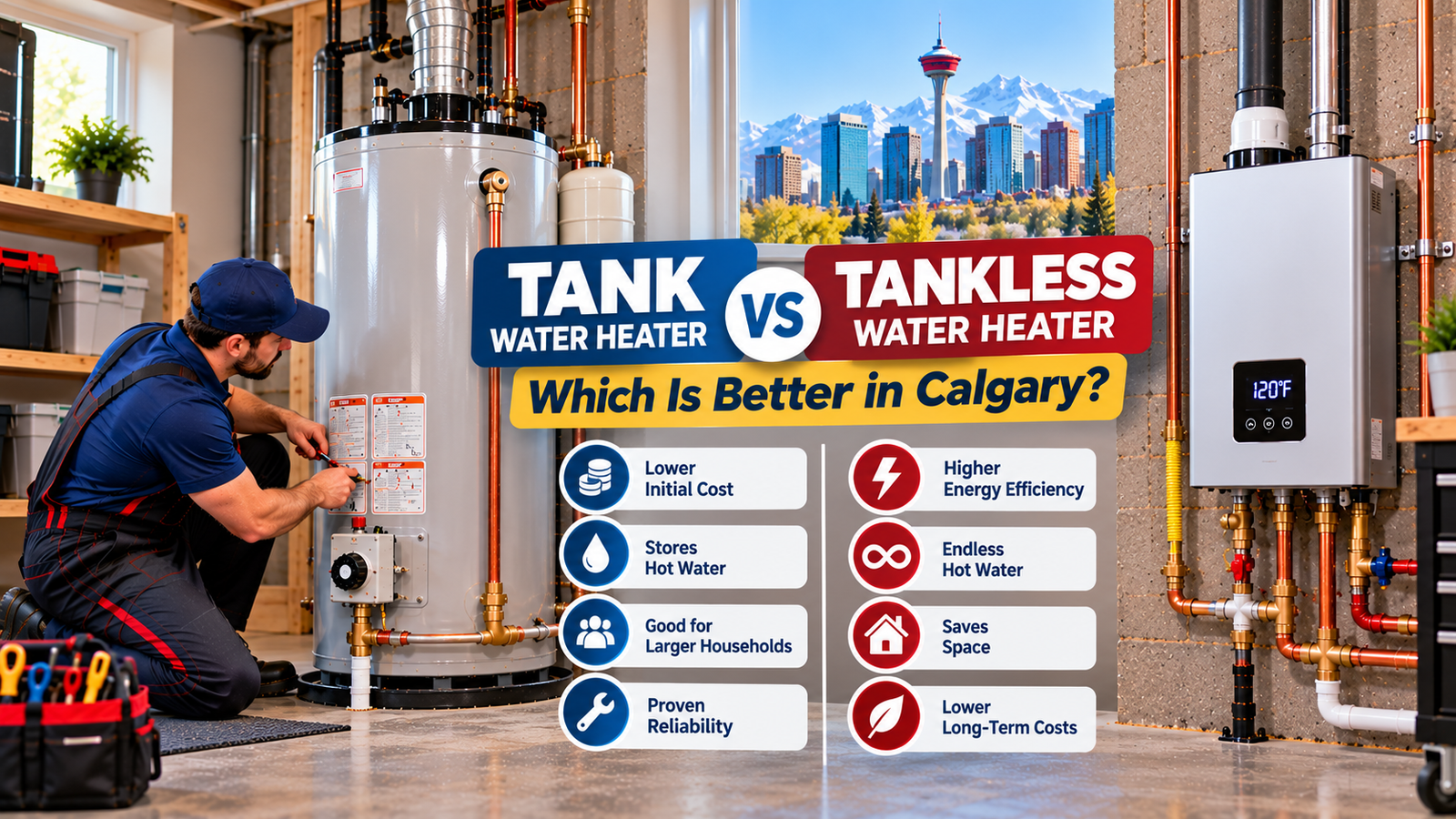

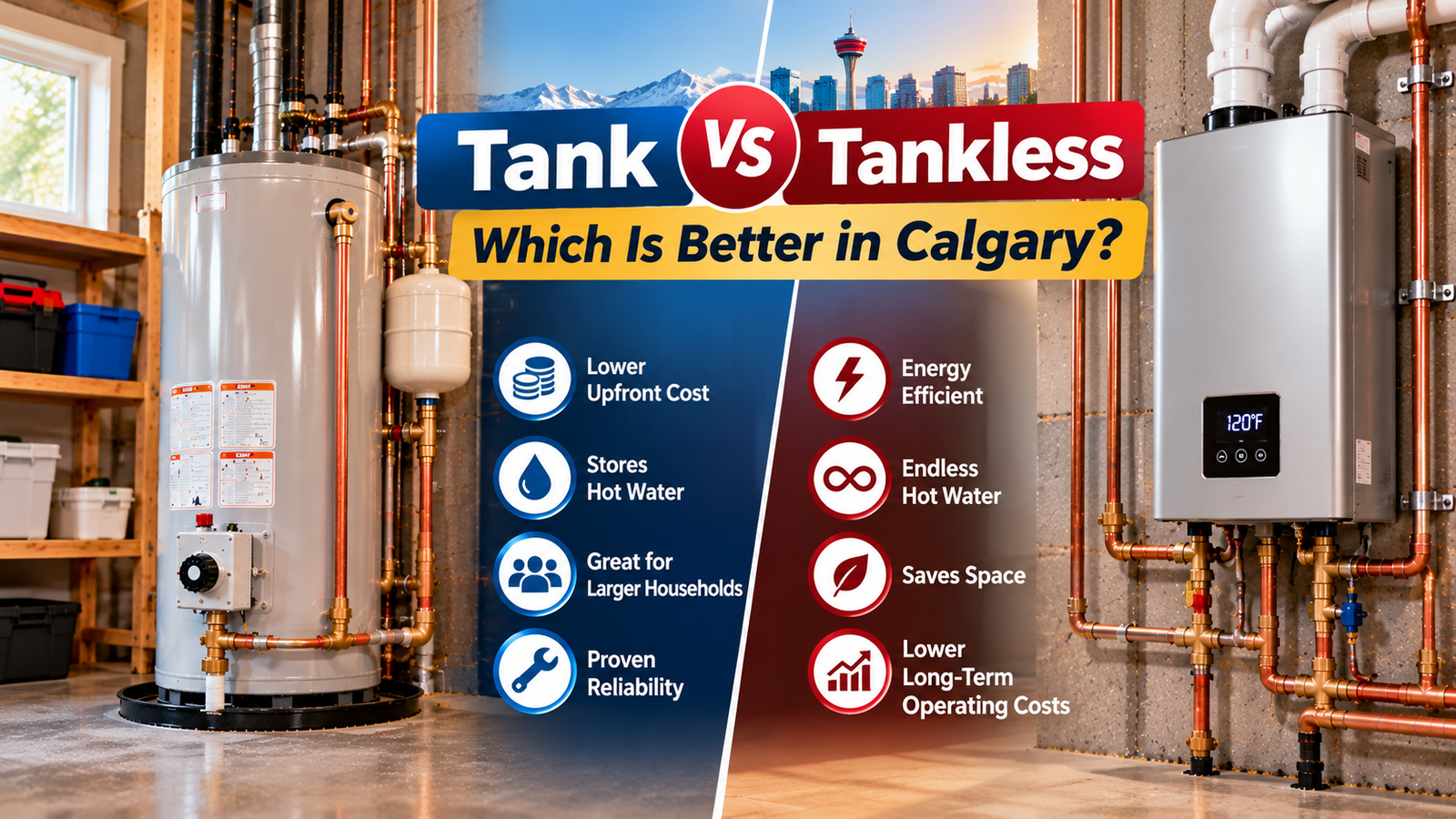
Tank vs. Tankless Water Heater: Which Is Better in Calgary? If your current hot water tank is approaching replacement age, you may be wondering whether to install another conventional storage heater or upgrade to a modern tankless system. Both options can supply reliable hot water, but their costs, performance, and installation requirements differ.
For homeowners in Mahogany, Auburn Bay, Cranston, and Seton, choosing the right system involves more than comparing equipment prices. Professional water heater installation and plumbing services in Calgary can help evaluate household demand, available utility connections, water quality, and the performance required during colder months.
Traditional hot water tanks remain a practical choice for many properties, while tankless heaters appeal to homeowners interested in compact equipment and on-demand heating. Understanding the differences can help you select a system that suits your home rather than paying for features you may not need.
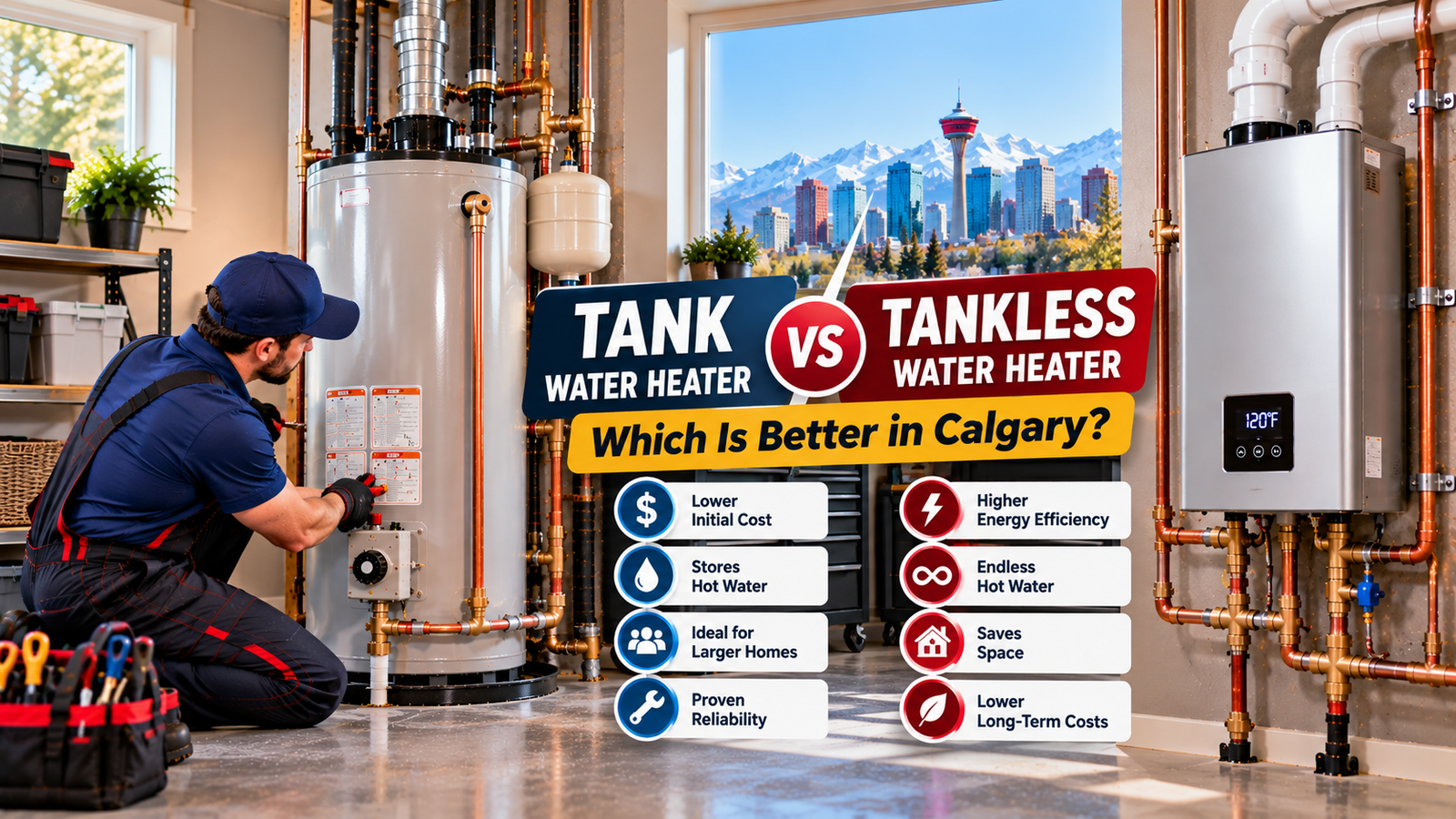
Tank water heaters generally cost less to install and provide stored hot water, making them practical for many Calgary homes. Tankless heaters offer compact designs, reduced standby heating losses, and potentially longer service lives. The better choice depends on household demand, winter water temperatures, installation requirements, and total ownership costs.
How Do Tank and Tankless Water Heaters Work?
The fundamental difference between these systems is how they produce and deliver hot water. A traditional tank stores heated water, while a tankless heater heats water as it flows through the appliance.
Both systems can serve Calgary households effectively when properly sized and installed.
How Does a Traditional Hot Water Tank Operate?
A conventional storage heater maintains a reservoir of hot water, commonly ranging from approximately 30 to 80 US gallons in residential applications.
When a hot water tap opens, heated water leaves the tank and cold water enters to replace it. The heater then works to restore the stored water to its intended temperature.
This design allows the household to draw from an existing supply of heated water, even during periods of substantial demand.
How Does a Tankless Water Heater Operate?
A tankless heater detects water flow and activates its heating system when hot water is requested.
Water passes through a heat exchanger and is heated before travelling to the fixture. The system generally stops heating when the demand ends.
For a general technical overview, see this explanation of tankless water heating technology.
Does Tankless Mean Instant Hot Water?
Not necessarily. Tankless heaters begin heating on demand, but water still needs to travel through the home’s plumbing.
A bathroom far from the heater may experience a noticeable wait before hot water arrives.
Tankless systems can also have activation thresholds and operating characteristics that affect low-flow performance.
Which System Handles Multiple Showers Better?
Both can handle multiple showers if properly sized, but their limitations differ.
A storage heater can deliver substantial flow from its stored supply, although the tank may eventually run low.
A tankless heater can continue producing hot water within its rated output, but simultaneous flow may be limited by the unit’s heating capacity.
What Happens When Hot Water Demand Exceeds Capacity?
With a storage heater, available hot water gradually decreases as the stored supply is depleted.
With a tankless heater, excessive simultaneous demand may reduce delivery temperature or cause performance limitations, depending on the model.
Correct sizing is therefore important for both technologies.
Are Gas and Electric Versions Available?
Yes. Conventional storage heaters are available in gas and electric configurations, while tankless systems also use different energy sources.
Gas-fired tankless equipment may require substantial fuel input and suitable venting. Whole-home electric tankless systems can require significant electrical capacity.
The home’s existing infrastructure can strongly influence which option is practical.
Key difference: A tank heater stores a limited supply of hot water and replenishes it as needed. A tankless heater produces hot water continuously within its rated flow and heating capacity, without maintaining a large storage reservoir.
Homeowners seeking local service information can consult the Calgary Electrical and Plumbing Google Maps listing.
What Are the Pros and Cons of Tank vs. Tankless Water Heaters?
Choosing between tank and tankless equipment requires comparing more than the purchase price. Installation complexity, available hot water, operating efficiency, maintenance, and expected service life all matter.
Advantages of Conventional Storage Water Heaters
Traditional tanks often have lower initial equipment and installation costs, particularly when replacing an existing compatible unit.
They can also provide substantial short-term flow because heated water is already stored.
Storage heaters are familiar to many homeowners and service professionals, with replacement options available in different capacities.
Disadvantages of Conventional Storage Tanks
Stored hot water is finite. Heavy use can exhaust the available supply until the heater recovers.
Storage systems also experience standby heat losses, although modern insulation can reduce them.
Over time, tank corrosion may eventually require replacement of the entire appliance.
Advantages of Tankless Water Heaters
Tankless systems avoid maintaining a large heated reservoir and generally occupy less space than conventional tanks.
Many models offer longer potential service lives when maintained according to manufacturer requirements.
They can also provide extended hot water delivery when demand remains within their rated capacity.
Disadvantages of Tankless Water Heaters
Tankless equipment often costs more to purchase and install, especially when converting from a storage system.
Existing gas lines, electrical service, or venting arrangements may require modification.
Mineral scaling and specialized component servicing can also affect maintenance costs.
Are Tankless Water Heaters More Energy Efficient?
Tankless systems can reduce standby heating losses because they do not continuously maintain a large tank of hot water.
However, actual energy savings depend on equipment efficiency, hot water consumption, fuel type, and household operating patterns.
Comparing a high-efficiency storage model with a tankless model is more meaningful than assuming every tankless system automatically uses less energy.
Which Water Heater Lasts Longer?
Conventional storage heaters commonly have expected service lives of approximately 8–12 years, while many tankless systems may operate for 15–20 years or longer.
These are broad planning ranges, not guarantees.
Water quality, maintenance, installation, usage, and component condition can substantially influence longevity.
Which System Requires More Maintenance?
Both systems need appropriate maintenance, but their service requirements differ.
Storage tanks may require attention to sediment accumulation, corrosion protection, and related components.
Tankless systems may require heat exchanger descaling, filter maintenance, and manufacturer-specific inspections.
Tank vs. Tankless Water Heater Comparison
| Feature | Storage Tank | Tankless |
|---|---|---|
| Heating method | Stores heated water | Heats water on demand |
| Initial installation cost | Often lower | Often higher |
| Typical lifespan | Approximately 8–12 years | Approximately 15–20+ years |
| Hot water availability | Limited by stored supply and recovery | Limited by flow and heating capacity |
| Standby heat loss | Generally present | Generally lower |
| Space requirements | Requires room for tank | Usually more compact |
| Maintenance focus | Sediment and corrosion protection | Scale and heat exchanger servicing |
| Conversion complexity | Often simpler when replacing like-for-like | May require utility and venting upgrades |
Which Is Better for a Household on a Budget?
For homeowners prioritizing a lower upfront expense, replacing a conventional tank with a compatible storage heater may be the more practical choice.
Tankless equipment may offer long-term advantages, but the initial investment should be evaluated against realistic energy savings and expected maintenance costs.
Calgary homeowner insight: A family in Copperfield replacing a conventional gas tank may face different installation costs from a homeowner in Seton converting to a tankless system. Existing utility connections and installation conditions often matter as much as equipment price.
Which System Offers Better Value Over Time?
Long-term value depends on total ownership cost rather than purchase price alone.
Consider installation, expected energy use, maintenance, repairs, potential equipment life, and any required infrastructure upgrades.
A tankless system is not automatically the most economical option for every household.
Practical comparison: Storage heaters often win on initial affordability and straightforward replacement. Tankless heaters may offer advantages in space savings, standby energy use, and potential longevity. Neither system is universally better.
Additional local business details are available through this Calgary plumbing location reference.
Request a tank or tankless water heater installation estimate in Calgary in just a few clicks.
Get My Free Estimate
How Do Calgary Winters and Water Conditions Affect Both Systems?
Calgary’s climate and municipal water characteristics can influence water heater performance and maintenance requirements.
Cold incoming water increases the energy needed to produce hot water, while hardness minerals can contribute to sediment and scaling.
Do Tankless Water Heaters Work Well in Calgary Winters?
Yes. Appropriately sized and installed tankless heaters can operate effectively during Calgary winters.
However, colder incoming water requires a greater temperature increase, which can reduce the maximum flow rate a tankless heater can deliver.
Manufacturer performance data should be checked at realistic winter design conditions.
Why Incoming Water Temperature Matters
A water heater must raise incoming water to the required delivery temperature.
For example, raising water from 5°C to 49°C requires a 44°C temperature increase.
This is an illustrative calculation, not a statement of Calgary’s current incoming water temperature or a universal recommended thermostat setting.
Do Storage Tanks Perform Differently in Winter?
Storage tanks can continue supplying their heated reserve during cold weather, but colder incoming water can affect recovery time.
After a substantial hot water draw, the heater may need more time or energy to restore the stored supply.
Tank capacity and recovery performance should therefore reflect winter demand.
Can Tankless Heaters Support Multiple Bathrooms?
Yes, provided the system has enough heating capacity at the required temperature rise.
A home in Mahogany with three bathrooms may need a different tankless model from a smaller property in Riverbend.
The important measurement is realistic simultaneous hot water flow, not the number of bathrooms alone.
How Does Calgary’s Hard Water Affect Tankless Heaters?
Calgary’s municipal water contains naturally occurring hardness minerals that can contribute to scale buildup.
In tankless equipment, mineral deposits may accumulate on heat exchanger surfaces and affect heating performance.
Manufacturer-recommended maintenance can help manage scaling, but servicing requirements vary by model and water conditions.
Does Hard Water Also Affect Storage Tanks?
Yes. Storage heaters may accumulate sediment as minerals precipitate during heating.
Significant sediment buildup can contribute to noise and may affect performance.
Storage tanks also have corrosion-related considerations that differ from those of many tankless systems.
Which System Handles Hard Water Better?
Neither technology is completely unaffected by hardness minerals.
Tankless systems may require attention to heat exchanger scaling, while storage tanks can experience sediment accumulation and corrosion-related deterioration.
The best approach is to evaluate water conditions and follow the manufacturer’s maintenance guidance.
Can Water Treatment Help?
Appropriate water treatment may reduce certain mineral-related maintenance concerns, depending on the system and water characteristics.
However, treatment equipment introduces its own installation, maintenance, and operating considerations.
Recommendations should be based on actual water conditions and equipment specifications rather than assuming every Calgary home requires the same solution.
Calgary-specific consideration: For homes in Auburn Bay, McKenzie Towne, New Brighton, and Douglasdale, the combination of cold winter inlet water and mineral-related maintenance needs makes accurate sizing and appropriate servicing important for both tank and tankless systems.
Can Tankless Water Heaters Freeze?
Tankless equipment and connected plumbing can be vulnerable to freezing if installed in unsuitable conditions.
Some models include freeze-protection features, but these may depend on electrical power and have operating limitations.
Installation location, insulation, manufacturer requirements, and protection of exposed piping should be evaluated professionally.
What Happens During a Power Outage?
Most modern tankless heaters require electricity for controls and operation, even when gas supplies the heating energy.
Many modern storage heaters also rely on electrical components, although specific designs differ.
Homeowners should review the actual model’s power requirements rather than assuming that all gas-fired equipment operates without electricity.
Does Calgary’s Climate Make Tankless a Bad Choice?
No. Climate alone does not make tankless heating unsuitable.
The main requirement is selecting a model that delivers adequate flow at the necessary winter temperature rise.
An undersized tankless unit may disappoint during peak demand, while a correctly selected system can provide reliable performance.
Safety consideration: Gas-fired water heaters require appropriate combustion air, venting, and fuel connections. Electric systems have specific electrical requirements. Installation, vent modifications, and utility upgrades should be performed by qualified professionals rather than attempted as unapproved household projects.
How Often Should Each System Be Inspected?
Inspection and maintenance intervals depend on the manufacturer’s instructions, equipment design, and operating conditions.
Tankless heat exchangers may require descaling, while storage heaters may require checks involving sediment, corrosion protection, and safety-related components.
A professional can help establish a suitable maintenance schedule for the installed model.
Winter performance takeaway: Both tank and tankless heaters can work in Calgary. Tankless models must be sized for cold incoming water, while storage systems need adequate capacity and recovery performance to meet winter hot water demand.
Homeowners can find additional company information through the Calgary Electrical and Plumbing shared Google business listing.
Which Water Heater Is the Better Investment for Calgary Homeowners?
The best investment depends on how long you expect to use the equipment, the home’s existing infrastructure, and your household’s hot water needs.
A tankless system may offer longer potential service life, but the higher initial cost does not guarantee lower total ownership expenses.
How Much Does Tank vs. Tankless Installation Cost in Calgary?
Installation prices vary with equipment capacity, efficiency, fuel type, accessibility, and any necessary modifications.
Replacing a conventional tank with a compatible model may be relatively straightforward. Converting to tankless equipment can require changes to gas supply, venting, or electrical systems.
The following amounts are illustrative planning ranges rather than verified current Calgary market prices.
| Water Heater Option | Illustrative Installed Cost (CAD) | Major Cost Considerations |
|---|---|---|
| Conventional storage tank replacement | $1,500–$3,500+ | Capacity, equipment, labour, removal |
| High-efficiency storage system | $2,000–$4,500+ | Efficiency features and installation conditions |
| Tankless water heater installation | $3,000–$6,500+ | Equipment, fuel supply, venting, labour |
| Complex tank-to-tankless conversion | $4,500–$8,000+ | Utility upgrades and extensive modifications |
Pricing disclaimer: These are illustrative, nonbinding CAD ranges, not confirmed Calgary averages or Calgary Electrical and Plumbing quotations. Actual estimates may differ substantially. Taxes, permits, equipment, materials, labour, and property-specific requirements affect final pricing.
How Do You Compare Lifetime Costs?
Start with equipment and installation costs, then consider estimated energy use, maintenance, repairs, and expected service life.
For a meaningful comparison, use actual local utility rates and manufacturer efficiency specifications.
Be cautious of fixed savings claims that do not account for your household’s consumption.
Can Tankless Energy Savings Offset Installation Costs?
Possibly, but the payback period varies considerably.
Homes with different usage patterns may experience different operating savings, even when installing identical equipment.
A higher installation cost may take many years to recover through reduced energy consumption, and some households may not achieve a financial payback within their ownership period.
Is Tankless Better for Small Homes?
Tankless equipment can be attractive where space is limited because it does not require a large storage vessel.
However, a smaller home does not automatically need a tankless heater.
Installation cost, utility capacity, and hot water usage should guide the decision.
Is a Storage Tank Better for Large Families?
Storage heaters can be effective for larger families when tank capacity and recovery rate match peak demand.
Tankless systems can also serve larger households, provided their rated flow and heating capacity are sufficient.
Large families should compare actual performance rather than choosing solely by technology.
How Important Is Water Heater Sizing?
Correct sizing is essential for either system.
A storage tank must provide enough first-hour delivery, while a tankless heater must meet simultaneous flow requirements at the necessary temperature rise.
For a more detailed explanation, read What Size Water Heater Does My Home Need?.
When Does Replacing a Tank With Tankless Make Sense?
Conversion may be worth considering when the existing tank is nearing replacement, available space is limited, or the homeowner values on-demand heating and potential longevity.
However, the installation should be evaluated for suitable gas or electrical capacity, venting, water conditions, and realistic hot water demand.
Conversion is not automatically an upgrade in every respect.
When Is Another Storage Tank the Smarter Choice?
A compatible storage replacement may be preferable when minimizing upfront cost is the main priority.
It can also make sense when the existing installation is suitable, hot water demand is predictable, and the homeowner does not require the specific benefits of tankless equipment.
A properly sized modern storage heater remains a reasonable option for many Calgary properties.
Do Water Heater Installations Require Permits?
Permit requirements depend on the installation scope and whether plumbing, gas, or electrical systems are modified.
Homeowners should confirm applicable requirements with the relevant local authority and qualified installer.
Proper installation and code compliance should be considered part of the total project cost.
What Questions Should You Ask Before Installation?
- What is the household’s realistic peak hot water demand?
- Which system offers sufficient capacity during Calgary winters?
- Will existing gas, electrical, or venting infrastructure need changes?
- What are the equipment’s efficiency and warranty terms?
- Which maintenance services will be required?
- Are permits or inspections necessary?
- What is included in the written installation estimate?
- How do estimated long-term costs compare?
Should You Replace a Working Water Heater?
Not simply because tankless technology is available.
If the existing heater is operating reliably, replacement should be weighed against its condition, expected remaining life, operating costs, and household needs.
Planning ahead is useful, but premature replacement may not provide sufficient financial benefit.
Local planning tip: Whether your home is in Lake Bonavista, Cranston, Copperfield, or New Brighton, compare a compatible storage replacement against a properly sized tankless installation using the same household demand assumptions and a complete written scope of work.
Which Option Would a Professional Recommend?
A responsible recommendation should follow an assessment of the existing system, household demand, utility capacity, installation conditions, and budget.
For some homeowners, the lower upfront cost of a storage tank will be decisive.
Others may place greater value on compact equipment, reduced standby losses, and the potential for longer service life.
Final recommendation: Choose a conventional tank when straightforward replacement and initial affordability are priorities. Consider tankless when space savings, on-demand heating, and long-term ownership goals justify the additional installation expense. Proper sizing matters more than choosing the newest technology.
For additional company updates, visit the Tumblr dashboard, where you can access the platform and explore relevant home-maintenance content.
Request a tank or tankless water heater installation estimate in Calgary in just a few clicks.
Get My Free Estimate
Make the Right Water Heater Choice for Your Calgary Home
Both tank and tankless water heaters can provide reliable hot water when correctly selected and installed. Conventional tanks often offer lower initial costs, while tankless systems may provide space savings, reduced standby losses, and longer potential service life.
A local calgary plumber can assess your home’s hot water requirements and explain the practical differences. Call Calgary Electrical and Plumbing at (403) 421-1991 to discuss the most suitable replacement options for your property.
Frequently Asked Questions about Tank vs. Tankless Water Heaters
Are tankless water heaters worth the extra cost in Calgary?
Tankless water heaters may be worthwhile for homeowners who value compact equipment, reduced standby heat losses, and potentially longer service life. However, higher installation costs and maintenance requirements should be compared with realistic energy savings, household demand, and the expected ownership period.
Do tankless water heaters work properly during Calgary winters?
Yes. Properly sized tankless heaters can operate effectively during Calgary winters. Colder incoming water increases the required temperature rise and can reduce available flow, so equipment should be selected using manufacturer performance data for realistic winter conditions and household demand.
Which lasts longer, a tank or tankless water heater?
Conventional storage heaters commonly last approximately 8–12 years, while many tankless models may operate for 15–20 years or longer. Actual lifespan depends on water quality, maintenance, installation, usage, and component condition. These ranges are planning estimates rather than guarantees.
Can a tankless water heater supply two showers at once?
Yes, if the tankless system is sized to deliver sufficient hot water flow at the required temperature rise. Two simultaneous showers may exceed the capacity of a smaller model, particularly during winter. Professional sizing should consider actual fixture flow rates and household usage.
Is it cheaper to replace a hot water tank or install tankless?
Replacing an existing storage tank with a compatible model is often less expensive initially than converting to tankless equipment. Tankless installation may require gas, electrical, or venting modifications. Total value should also account for energy consumption, maintenance, equipment lifespan, and household needs.
Choose a water heater that suits your home’s needs and budget.
Call (403) 421-1991 Now
Contact Our Calgary Plumbing Team