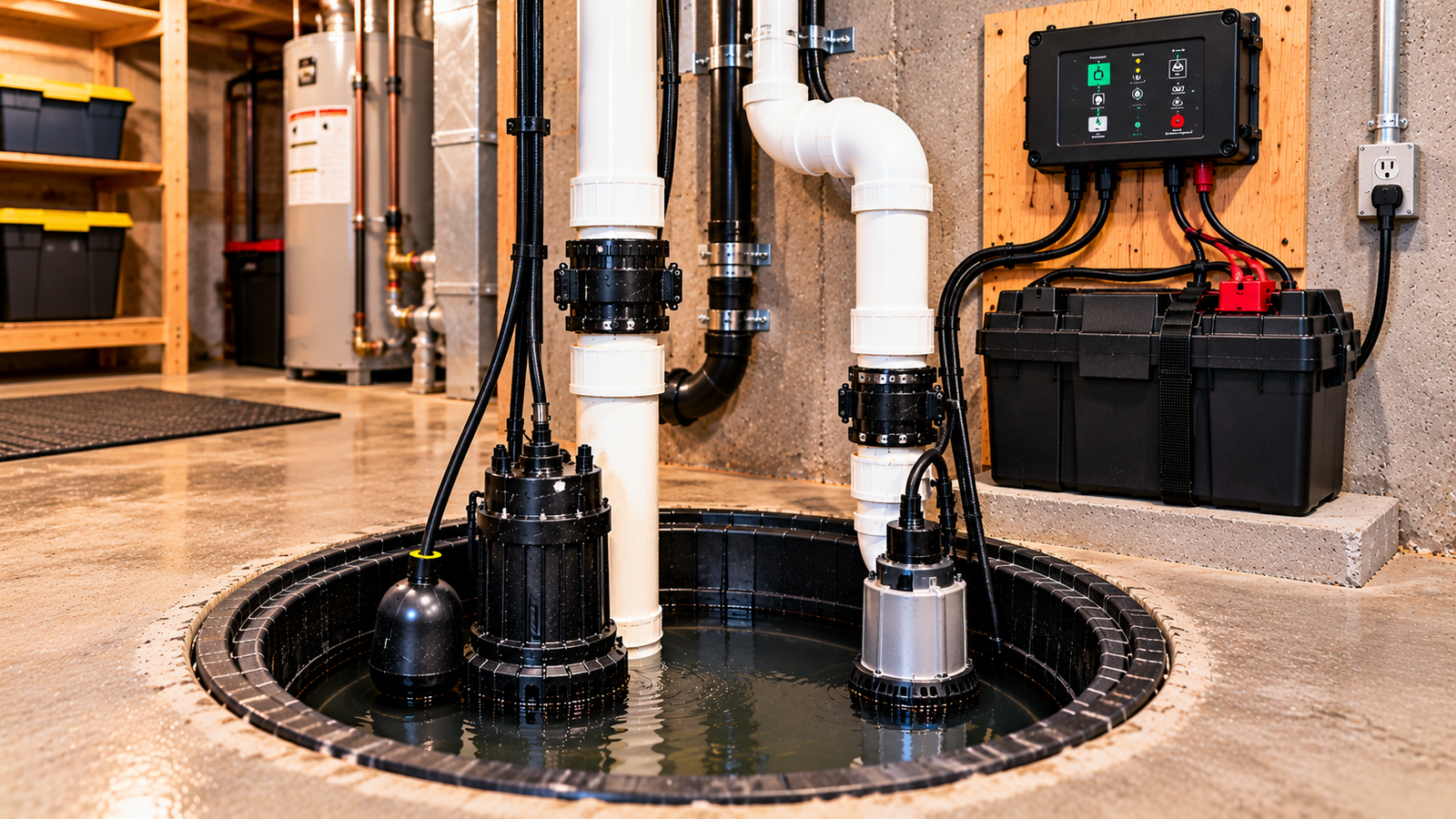

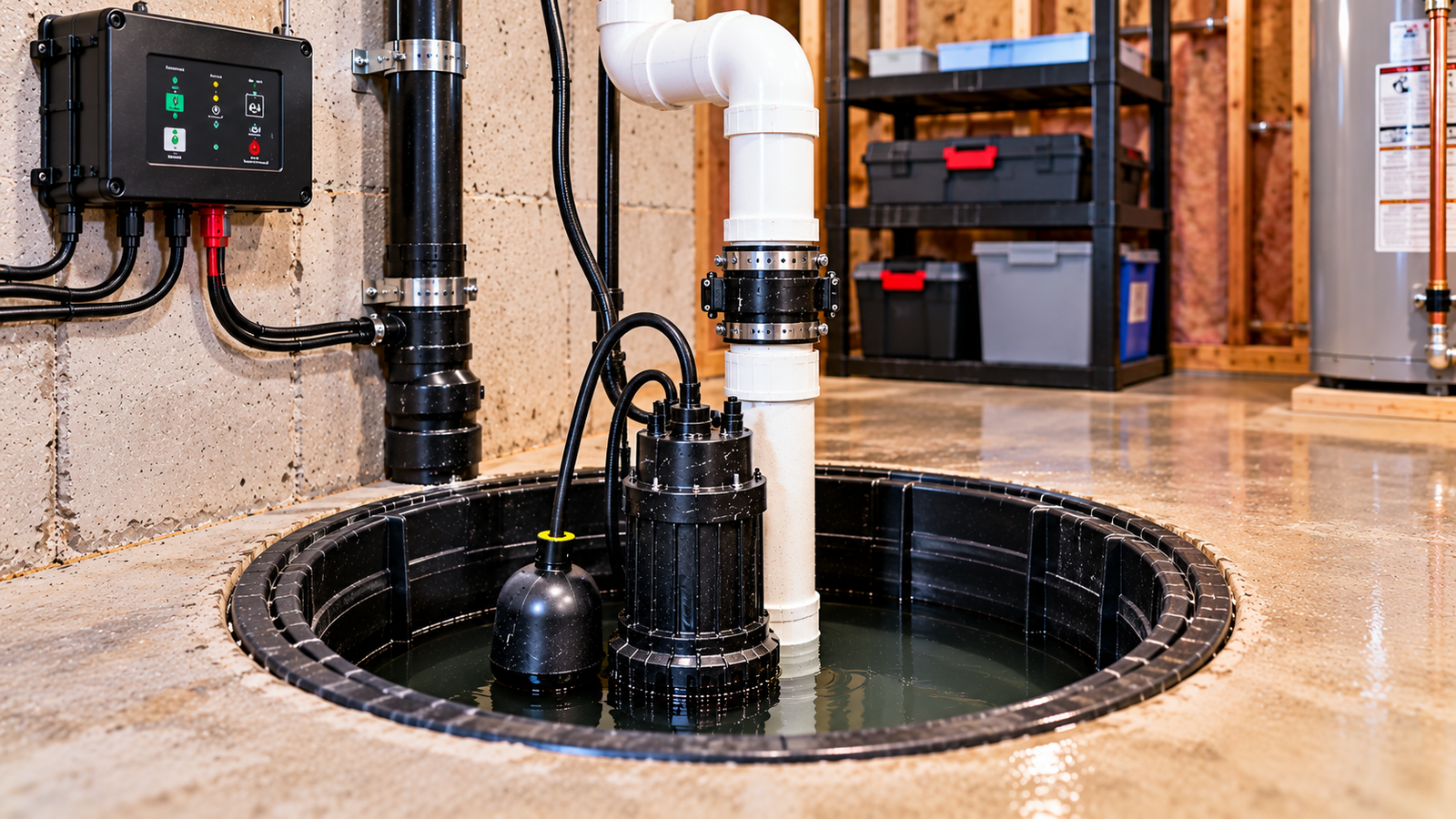
What Size Sump Pump Does Your Basement Need? If your basement sump pit fills quickly during Calgary’s spring thaw, choosing the wrong pump can leave you with repeated cycling, inadequate drainage, or unnecessary equipment wear. The right pump must remove incoming water efficiently under your home’s actual conditions.
Homeowners in Mahogany, Auburn Bay, Cranston, Seton, and other Southeast Calgary communities may encounter different groundwater and foundation drainage conditions. Understanding proper pump sizing is an important part of planning professional sump pump installation and plumbing services in Calgary.
Although residential sump pumps are commonly described by horsepower, motor size alone does not determine how much water reaches the discharge outlet. Pumping capacity, vertical lift, pipe friction, and expected water inflow must all be considered before selecting suitable equipment.
Many residential basements use 1/3 HP or 1/2 HP sump pumps, but the correct size depends on water inflow, total dynamic head, and the manufacturer’s pump performance curve. A properly sized pump must remove incoming water at the actual discharge height without excessive cycling or inadequate capacity.
Why Does Choosing the Right Sump Pump Size Matter?
A sump pump’s purpose is to remove collected drainage water before the sump pit overflows. Selecting the correct equipment requires understanding how much water enters the pit and how difficult it is to move that water outside.
An undersized pump may fail to keep pace with incoming water. An unnecessarily powerful pump may create operational problems when the pit and controls are not suited to its output.
What Happens When a Sump Pump Is Too Small?
An undersized pump may run for extended periods without lowering the water level sufficiently. During heavy inflow, the pit may continue filling even while the motor operates.
This can increase wear and leave the basement vulnerable to overflow.
Can a Sump Pump Be Too Powerful?
Yes. A pump with excessive output for a small sump pit may empty the pit rapidly and restart frequently as water returns.
This is called short cycling. Frequent starts can contribute to switch and motor wear, although actual effects depend on pump design and operating conditions.
Does Basement Square Footage Determine Pump Size?
Not by itself. A large basement with limited groundwater inflow may require less pumping capacity than a smaller basement receiving substantial drainage water.
Foundation drainage design, site grading, soil conditions, and discharge arrangements are often more important than floor area.
What Do 1/4 HP, 1/3 HP, 1/2 HP, and 3/4 HP Mean?
Horsepower describes motor power, not the exact volume of water a pump will move once installed.
Common residential ratings include 1/4 HP, 1/3 HP, 1/2 HP, and 3/4 HP. Higher ratings can support greater pumping capability, but actual performance varies by manufacturer and model.
Two pumps with identical horsepower may deliver different flow rates at the same discharge height.
Is a 1/3 HP Sump Pump Enough for Most Homes?
A 1/3 HP pump is common in residential applications and may be suitable for homes with moderate drainage demand.
However, it should not be selected solely because it is widely used. The manufacturer’s performance curve must match the home’s required flow and discharge conditions.
When Might a 1/2 HP Pump Be Appropriate?
A 1/2 HP pump may be considered when greater pumping capacity or more demanding discharge conditions are present.
For example, a property with higher inflow or additional discharge resistance may benefit from a model that maintains sufficient output under those conditions.
Does More Horsepower Always Mean Better Flood Protection?
No. Greater horsepower does not correct a blocked discharge pipe, faulty float switch, poorly designed sump pit, or inadequate foundation drainage.
The best system balances appropriate pumping capacity with reliable controls and suitable installation conditions.
Calgary example: Two homes in Cranston may have similar basement sizes but very different sump pump requirements. One pit fills slowly during spring thaw, while the other receives water rapidly. Choosing pumps based only on basement square footage could produce unsuitable results.
Key point: Correct sump pump sizing means selecting equipment that can remove expected water inflow at the actual discharge height. Horsepower is only one specification. Flow rate, sump pit dimensions, discharge resistance, and operating conditions determine whether a pump is suitable.
Homeowners seeking local assistance can consult the Calgary Electrical and Plumbing Google Maps listing.
How Do You Calculate the Sump Pump Capacity Your Basement Needs?
Sump pump capacity is commonly expressed in gallons per hour or gallons per minute. The required capacity depends on how quickly water enters the pit and the resistance encountered as water travels through the discharge system.
A reliable sizing decision combines an estimate of incoming water with the pump’s performance at the installed total dynamic head.
How Can You Estimate Water Entering Your Sump Pit?
One practical approach is to observe how quickly the water level rises over a measured distance when the pump is not operating.
The pit’s internal dimensions determine how much water that rise represents.
For a rectangular pit, volume can be estimated from length, width, and water-level change. For a round pit, use the cylinder volume formula.
How Do You Calculate Water Volume in a Round Sump Pit?
For a cylindrical pit, use:
Volume in cubic feet = π × radius² × water-level rise
Multiply cubic feet by approximately 7.48 to convert the result to US gallons. Divide by the measured time in minutes to estimate gallons per minute.
For example, a round pit with an internal diameter of 18 inches has a radius of 0.75 feet. If water rises 6 inches, or 0.5 feet, the added volume is approximately 0.88 cubic feet.
That equals roughly 6.6 US gallons. If the rise occurs over two minutes, estimated inflow is about 3.3 gallons per minute.
This is an illustrative calculation, not a complete pump-sizing recommendation.
Why Should Water Inflow Be Measured During Wet Conditions?
Water entering a sump pit during dry weather may be much lower than during heavy rainfall or spring snowmelt.
Measurements taken during low-demand conditions can underestimate the flow a pump must handle during more challenging periods.
Professional sizing should account for expected peak demand and appropriate capacity allowance.
Safety warning: Do not disconnect, disable, or bypass an operating sump pump during active flooding to perform a measurement. Never place hands in an energized sump pit or handle electrical connections near standing water. A qualified technician can assess inflow safely.
Why Does Discharge Height Affect Pump Performance?
As a sump pump pushes water upward, it works against gravity. Greater vertical lift generally reduces the flow rate a particular pump can deliver.
Discharge piping also introduces friction losses, especially when pipes are narrow, long, or contain multiple fittings.
These factors contribute to total dynamic head, commonly abbreviated as TDH.
What Is Total Dynamic Head?
Total dynamic head represents the overall resistance the pump must overcome, expressed as an equivalent height of water.
It includes vertical lift and friction losses through the discharge arrangement.
For sump pump selection, the manufacturer’s flow-versus-head performance curve is more useful than a maximum flow figure measured under ideal conditions.
Do Elbows and Check Valves Affect Pump Capacity?
Yes. Pipe fittings and check valves can add resistance to water movement.
A properly installed check valve helps reduce water flowing back into the pit after the pump stops, but its resistance should still be considered during sizing.
Pipe diameter and routing can significantly affect overall performance.
Why Is the Manufacturer’s Pump Curve Important?
A pump curve shows how much water a particular model can move at different discharge heights.
For example, a pump advertised with a high maximum flow rate may deliver substantially less water when lifting through several feet of piping.
The relevant figure is its output at the home’s actual operating head.
Should You Include Extra Capacity?
Some allowance for changing drainage conditions can be sensible, but excessive oversizing may cause frequent cycling.
The appropriate margin depends on expected peak inflow, pump characteristics, sump pit volume, and manufacturer guidance.
A professional assessment helps balance those factors.
Calgary example: A homeowner in Copperfield measures relatively modest water inflow but has a discharge pipe that rises through the basement and continues a considerable distance outside. Selecting a pump based only on inflow could overlook the additional resistance created by the discharge route.
Do Alberta Plumbing Requirements Affect Installation?
Yes. Pump discharge arrangements and related plumbing work should comply with applicable requirements.
Homeowners can review the Government of Alberta’s plumbing codes and standards information for regulatory context.
Local discharge requirements should also be checked before altering piping or outlet locations.
Sizing method: Estimate realistic peak water inflow, determine discharge height and piping resistance, then select a pump whose performance curve provides adequate flow at that operating head. Verify that the sump pit and controls support the chosen pump’s cycling behaviour.
Additional business location details are available through this Calgary plumbing service map reference.
Request a sump pump sizing and installation estimate in Calgary in just a few clicks.
Get My Free Estimate
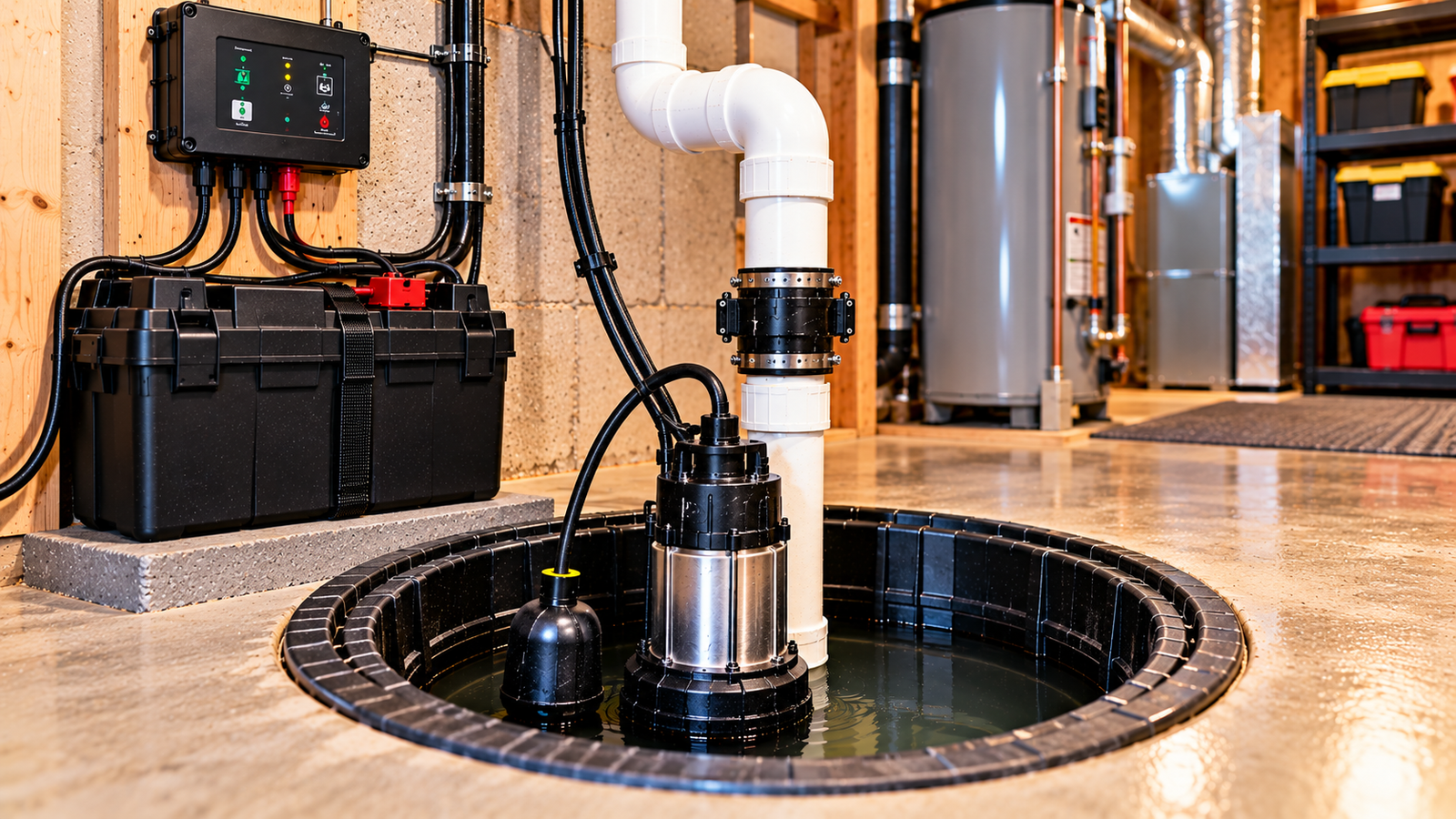
Which Sump Pump Size Is Suitable for Different Calgary Basements?
Residential sump pump requirements vary from one property to another. A home with modest drainage inflow may need a different pump than a property where the pit fills rapidly during wet weather.
Horsepower categories provide a useful starting point, but they do not replace proper performance calculations.
When Might a 1/4 HP Sump Pump Be Suitable?
A 1/4 HP pump may be appropriate for some low-demand applications with manageable discharge conditions.
However, capacity varies by model, and some properties require greater output.
The pump curve should confirm that the selected equipment can handle expected inflow at the installed discharge height.
When Is a 1/3 HP Sump Pump a Practical Choice?
A 1/3 HP pump is a common residential option and may suit moderate drainage demand.
It can be appropriate when expected water inflow and discharge resistance fall within the model’s performance range.
Actual suitability must be established through installation-specific assessment.
When Should You Consider a 1/2 HP Sump Pump?
A 1/2 HP pump may provide useful additional capacity for homes with greater inflow or more demanding discharge conditions.
However, the larger motor rating does not automatically make it the best choice.
Pit dimensions, float settings, and cycling behaviour must also be considered.
Are 3/4 HP Sump Pumps Necessary for Residential Basements?
Some higher-demand installations may benefit from equipment in this category.
Nevertheless, a 3/4 HP pump may be unnecessary for a basement with modest water inflow.
Using excessive capacity without considering pit storage and controls can contribute to short cycling.
Residential Sump Pump Horsepower Comparison
| Motor Rating | Possible Application | Important Consideration |
|---|---|---|
| 1/4 HP | Some lower-demand drainage applications | Confirm sufficient flow at actual discharge height |
| 1/3 HP | Many moderate-demand residential installations | Check peak inflow and manufacturer pump curve |
| 1/2 HP | Some higher-inflow or more demanding discharge arrangements | Verify pit volume and cycling suitability |
| 3/4 HP | Selected higher-demand residential applications | Avoid unnecessary oversizing and excessive cycling |
Important: These are general application descriptions, not fixed sizing rules. Different pumps with the same horsepower can have substantially different performance curves.
Does a Finished Basement Require a Larger Pump?
Not automatically. Basement finishes affect the consequences of flooding but do not directly determine the required pumping capacity.
A finished basement may justify additional protection, such as a backup pump or high-water alarm.
The primary pump should still be sized according to drainage demand.
Should Homes With Frequent Pump Cycling Use Larger Equipment?
Frequent cycling can have several causes, including high inflow, a small sump pit, incorrect float settings, or discharge water returning through a faulty check valve.
Installing a larger pump without identifying the cause may make cycling worse.
The complete system should be inspected first.
Can Two Smaller Pumps Be Better Than One Large Pump?
In some applications, multiple pumps provide useful redundancy or staged pumping capacity.
However, installation design becomes more complex and requires suitable controls, space, and discharge arrangements.
A dual-pump configuration should be selected according to actual drainage requirements.
Should You Add a Battery Backup Pump?
A battery backup provides secondary protection if the primary pump loses power or fails.
Its capacity and runtime must also be evaluated carefully.
Our related guide explains whether a battery backup sump pump is worthwhile for Calgary homes.
Do Different Calgary Neighbourhoods Need Different Pump Sizes?
Homes in Mahogany, Seton, McKenzie Towne, New Brighton, Riverbend, Douglasdale, and Lake Bonavista may have different drainage conditions.
However, neighbourhood location alone cannot determine the correct pump rating.
Foundation drainage, water inflow, discharge routing, and property-specific conditions remain essential.
Local example: A homeowner in Auburn Bay has a sump pit that fills rapidly during wet periods. Instead of automatically choosing a 3/4 HP pump, a technician evaluates peak inflow, discharge height, pipe resistance, and pit volume before comparing suitable models.
Does Pump Construction Matter as Much as Horsepower?
Materials, impeller design, switch quality, and manufacturer specifications can affect long-term performance.
Submersible and pedestal pumps also have different installation characteristics.
Equipment should be selected for the intended application rather than motor rating alone.
Selection guidance: A 1/3 HP or 1/2 HP sump pump may suit many residential installations, but no horsepower rating is universally correct. The best choice is the model that delivers adequate flow at the actual operating head while cycling appropriately within the available sump pit.
For company updates and service information, visit the Calgary Electrical and Plumbing shared Google business profile.
How Can You Avoid Common Sump Pump Sizing Mistakes?
Sump pump problems are not always caused by insufficient horsepower. Poor installation, unsuitable controls, and discharge restrictions can make an otherwise capable pump perform badly.
Evaluating the entire drainage arrangement helps prevent unnecessary equipment replacement.
Why Should You Avoid Choosing a Pump by Horsepower Alone?
Horsepower does not indicate the exact flow a pump will deliver through a specific discharge system.
Two 1/2 HP pumps may have different performance characteristics.
Always compare manufacturer flow curves at the expected total dynamic head.
What Happens When the Sump Pit Is Too Small?
A small pit provides limited storage between pump cycles.
If a powerful pump empties it quickly, the float may activate repeatedly as new water arrives.
Appropriate pit volume and control settings help support suitable operating cycles.
Can Incorrect Float Settings Cause Problems?
Yes. A float that activates too frequently may contribute to excessive cycling.
A float that activates too late can allow water to rise unnecessarily high.
Settings must remain within the manufacturer’s recommendations and the physical limits of the sump pit.
Can a Narrow Discharge Pipe Reduce Pump Performance?
Yes. Restrictive piping increases friction losses and can reduce actual flow.
Pipe diameter, length, fittings, and outlet conditions should match the pump’s requirements.
Installing a more powerful pump without correcting restrictive piping may not resolve the problem.
Does a Check Valve Affect Sump Pump Operation?
A properly functioning check valve helps prevent discharged water from returning to the sump pit when the pump stops.
A failed or incorrectly installed valve can contribute to repeated cycling.
Check valve selection and placement should follow equipment requirements.
Can Frozen Discharge Piping Make a Pump Appear Undersized?
Yes. Ice or other restrictions can prevent water from leaving the discharge line effectively.
The pump may continue running while the water level remains high.
Increasing horsepower does not solve a frozen or blocked outlet.
Should You Replace an Old Pump With the Same Horsepower?
Not automatically. The previous pump may have been incorrectly sized, or drainage conditions may have changed.
Before replacement, compare actual performance requirements with current manufacturer specifications.
This can help avoid repeating an existing sizing problem.
What Are the Signs of an Undersized Pump?
- The water level continues rising while the pump runs.
- The pump operates for long periods during heavy inflow.
- The pit approaches overflow despite normal electrical supply.
- Discharge flow appears insufficient after restrictions are ruled out.
- The pump cannot keep pace with measured drainage demand.
These symptoms can also indicate blockages or mechanical faults, so diagnosis should precede replacement.
What Are the Signs of an Oversized Pump?
Very short pumping cycles and frequent motor starts may indicate excessive output relative to pit storage.
However, short cycling can also result from float problems, a faulty check valve, or water returning through the discharge line.
Identifying the cause is more useful than assuming the pump is too powerful.
When Should a Calgary Plumber Assess Your Sump Pump?
Professional assessment is advisable when the pump runs continuously, cycles excessively, struggles during wet weather, or requires replacement.
A technician can inspect the sump pit, estimate inflow, evaluate discharge piping, and compare equipment performance.
This approach supports more informed sizing decisions.
What Does a Professional Sizing Assessment Include?
An assessment may consider sump pit dimensions, water-level changes, expected peak inflow, discharge height, pipe resistance, pump controls, and existing equipment condition.
The installer can then compare appropriate models using manufacturer performance information.
Electrical supply and applicable plumbing requirements may also need review.
Should You Consider Backup Protection During Replacement?
Yes. Pump replacement is an opportunity to evaluate whether secondary protection is appropriate.
A compatible battery backup and high-water alarm may reduce dependence on a single pump.
However, backup equipment should be sized and maintained according to its own specifications.
How Often Should You Review Sump Pump Performance?
Follow the manufacturer’s maintenance recommendations and inspect the system when operating behaviour changes.
Reviewing pump performance before spring thaw is particularly sensible for homes with seasonal drainage demand.
Routine checks can identify developing problems before they become emergencies.
Important: Never work on sump pump electrical connections while standing in water. If the pit is overflowing, electrical equipment is submerged, or wiring appears damaged, avoid contact and arrange qualified assistance. Do not bypass float switches or electrical safety devices.
Calgary example: A homeowner in New Brighton assumes the existing 1/3 HP pump is too small because it starts repeatedly. Inspection reveals a faulty check valve returning water to the pit. Correcting the valve problem resolves the cycling issue without automatically requiring a larger motor.
What Is the Best Long-Term Sump Pump Strategy?
Choose a pump based on measured or reasonably estimated drainage demand and actual discharge conditions.
Maintain suitable pit dimensions, functioning controls, and clear discharge piping.
Where appropriate, consider backup protection and high-water alarms as additional safeguards.
Final sizing recommendation: Do not select a sump pump solely by horsepower or basement square footage. A properly sized system must provide adequate flow at the installed total dynamic head while operating reliably within the sump pit’s available volume and control arrangement.
For additional company information, explore this Calgary Electrical and Plumbing video and the company’s Medium publication.
Request a sump pump sizing and installation estimate in Calgary in just a few clicks.
Get My Free Estimate
Choose the Right Sump Pump Capacity for Reliable Basement Drainage
The right sump pump is not necessarily the one with the largest motor. Reliable basement drainage depends on matching pump capacity to incoming water, discharge height, pipe resistance, and sump pit conditions. Correct sizing helps reduce the risk of overflow and unnecessary cycling.
An experienced local calgary plumber can assess your existing system and recommend suitable equipment. Call Calgary Electrical and Plumbing at (403) 421-1991 to discuss sump pump sizing, installation, or replacement for your home.
Frequently Asked Questions about Sump Pump Sizing
Is a 1/3 HP sump pump enough for a Calgary basement?
A 1/3 HP sump pump may be suitable for many residential basements with moderate drainage demand. However, the correct size depends on water inflow, discharge height, and pipe resistance. Check the manufacturer’s performance curve rather than selecting equipment based on horsepower alone.
Should I choose a 1/2 HP sump pump instead of a 1/3 HP model?
A 1/2 HP pump may be appropriate when greater flow capacity or more demanding discharge conditions are present. However, unnecessary oversizing can contribute to frequent cycling. The best choice is the pump that meets expected inflow requirements at the actual operating head.
Can a sump pump be too powerful for my basement?
Yes. A pump with excessive output for a small sump pit may empty the pit rapidly and restart frequently. This can increase wear on controls and equipment. Proper sizing considers pit volume, float settings, water inflow, and the manufacturer’s operating recommendations.
Does basement size determine the horsepower of a sump pump?
No. Basement square footage alone does not determine the required horsepower. A smaller basement with substantial groundwater inflow may need more pumping capacity than a larger basement with limited drainage demand. Water inflow, discharge height, and piping resistance are more useful sizing factors.
How can I tell whether my existing sump pump is undersized?
An undersized pump may struggle to lower the water level during heavy inflow or run for extended periods without keeping pace. However, similar symptoms can result from blocked piping or mechanical faults. A professional assessment can identify the actual cause before replacement.
Get professional guidance on pump capacity, installation, and basement drainage requirements.
Call (403) 421-1991 Now
Residential Sump Pump Sizing, Installation, and Replacement Services in Calgary