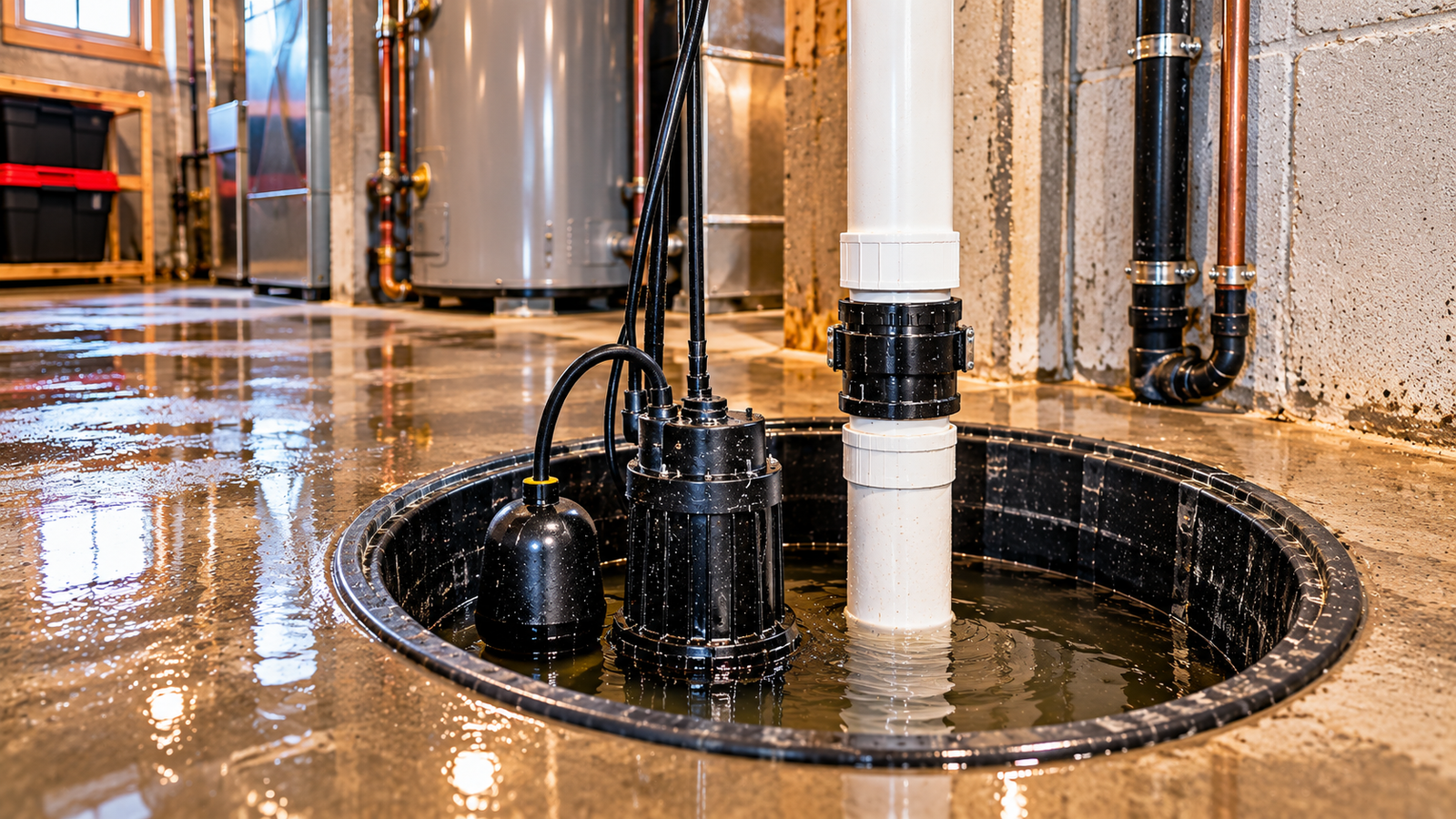

What Happens When a Sump Pump Stops Working? Imagine walking into your Calgary basement after heavy rainfall and discovering that the sump pit is full, the pump is silent, and water is beginning to spread across the floor. A failed sump pump can quickly change from a maintenance concern into a serious basement drainage problem.
Homes in Mahogany, Auburn Bay, Cranston, and other Southeast Calgary communities can experience changing drainage conditions during spring snowmelt and periods of heavy rain. Understanding how sump pump failures develop, and when to seek professional sump pump repair and plumbing services in Calgary, can help homeowners respond before additional damage occurs.
The consequences depend on how much water enters the sump pit, how long the pump remains inactive, and whether backup protection is available. Recognizing early warning signs, protecting occupants from electrical hazards, and identifying the underlying cause are essential steps toward restoring reliable drainage.
When a sump pump stops working, water can accumulate in the sump pit and eventually overflow into the basement. Possible consequences include damaged flooring, wet insulation, electrical hazards, and mould growth. The urgency depends on incoming water volume, backup protection, and whether flooding has already started.
What Happens Inside Your Basement When a Sump Pump Fails?
A sump pump normally removes water collected by a property’s drainage system before it can accumulate around the basement.
When the pump stops operating, incoming water may continue entering the pit without being discharged.
If the water level rises beyond the pit’s capacity, overflow can occur.
Does Water Immediately Flood the Basement?
Not necessarily. A sump pump failure does not automatically cause immediate flooding.
If little water is entering the pit, the system may remain inactive without an immediate overflow.
However, heavy groundwater inflow or spring snowmelt can make the situation much more urgent.
How Quickly Can a Sump Pit Overflow?
There is no universal timeframe.
Overflow depends on the pit’s available storage volume, incoming water rate, and whether another pump is operating.
During substantial drainage inflow, water may rise rapidly. During dry conditions, it may rise slowly or not at all.
What Happens When Water Reaches the Top of the Sump Pit?
Once the pit is full, additional water can spill onto the surrounding basement floor.
The extent of flooding depends on floor layout, water volume, and whether drainage continues entering the pit.
Water may spread beneath stored belongings, flooring materials, or finished basement components.
Can Sump Pump Failure Damage Basement Flooring?
Yes. Water can affect carpeting, underlay, laminate flooring, wood products, and other moisture-sensitive materials.
Some surfaces may be recoverable after prompt drying, while others may require removal.
The extent of damage depends on exposure duration, water contamination, and material construction.
Can Water Damage Drywall and Insulation?
When water reaches finished walls, moisture may enter drywall, baseboards, and insulation.
These materials can retain moisture even after visible standing water has been removed.
Proper assessment and drying are important to prevent concealed moisture problems.
Does a Failed Sump Pump Increase Mould Risk?
Persistent dampness can create conditions favourable to mould growth.
Risk increases when wet materials remain untreated or moisture becomes trapped behind finished surfaces.
Restoring drainage and arranging appropriate drying are important parts of recovery.
Can Basement Flooding Affect Electrical Safety?
Yes. Water near outlets, extension cords, appliances, electrical panels, or other energized equipment can create serious hazards.
Occupants should avoid entering potentially energized floodwater.
Electrical isolation and restoration should be handled by qualified personnel when flooding affects electrical equipment.
Can Water Damage Stored Belongings?
Furniture, cardboard boxes, documents, electronics, and stored household items may be damaged by basement flooding.
Items placed directly on the floor are particularly exposed.
Storage shelves can reduce some exposure, but they do not replace reliable drainage protection.
Calgary example: During rapid spring snowmelt, a homeowner in Mahogany discovers that the sump pump has stopped. Water continues entering the pit, and the level approaches the rim. The immediate concern is preventing overflow while avoiding electrical hazards around the affected area.
Will Every Calgary Home Experience the Same Consequences?
No. Basement construction, soil conditions, drainage arrangements, and incoming water volume vary between properties.
Even neighbouring houses may experience different water levels during the same weather event.
The condition of the pump and availability of backup protection also affect the outcome.
Important distinction: A failed sump pump creates a risk of flooding when water continues entering the sump pit. The urgency depends on how quickly the water rises, whether a backup system operates, and whether water has already reached finished areas or electrical equipment.
Homeowners seeking local business details can consult the Calgary Electrical and Plumbing Google Maps listing.
What Causes a Sump Pump to Stop Working?
Sump pumps can fail because of electrical problems, mechanical wear, blocked components, or faults in their automatic controls.
Understanding the possible causes helps explain why a pump may remain silent, run without removing water, or stop unexpectedly.
Can a Power Outage Stop a Sump Pump?
Yes. Most standard residential sump pumps depend on household electricity.
When power is interrupted, the primary pump cannot operate unless the system has an appropriate backup power arrangement.
Power interruptions during severe weather can be especially concerning when drainage demand is high.
Can a Tripped Breaker Cause Pump Failure?
A tripped breaker or electrical supply fault may interrupt power to the pump.
However, repeatedly resetting a breaker without identifying the cause can be unsafe.
If electrical protection trips repeatedly, qualified electrical assessment is appropriate.
Can a Faulty Float Switch Stop a Sump Pump?
Yes. The float switch activates the pump when water reaches a specified level.
If the float becomes obstructed or the control fails, the motor may not start even when the pit is full.
Debris, restricted movement, and component deterioration are possible contributing factors.
What Happens When the Sump Pump Motor Fails?
A failed motor may prevent the pump from starting or operating effectively.
Possible warning signs include unusual noises, overheating, repeated electrical faults, or declining pumping performance.
Some failures occur gradually, while others happen without an obvious warning.
Can a Blocked Impeller Stop Water Removal?
Yes. The impeller is responsible for moving water through the pump.
Debris can interfere with its movement, potentially reducing flow or preventing effective pumping.
Internal inspection should follow manufacturer procedures and appropriate electrical isolation.
Can a Frozen Discharge Pipe Cause Failure?
Frozen or obstructed discharge piping can prevent water from leaving the sump system.
The motor may run while the water level remains high.
Cold-weather discharge problems are particularly relevant when exposed piping is not appropriately protected.
Can an Old Sump Pump Stop Without Warning?
Yes. Mechanical and electrical components deteriorate over time.
Many residential pumps have an approximate service life of seven to ten years, although actual longevity varies with usage, installation, and maintenance.
Age alone does not prove failure, but older equipment deserves closer monitoring.
Can Incorrect Installation Contribute to Failure?
Improper pump sizing, restricted float movement, inadequate pipe support, or unsuitable discharge arrangements can affect performance.
Some installation problems become apparent only during heavy drainage demand.
A complete assessment should consider the surrounding system rather than the pump alone.
| Possible Failure | Common Symptom | Professional Assessment |
|---|---|---|
| Power interruption | Pump remains silent during rising water | Evaluate electrical supply and backup protection |
| Faulty float switch | Pump does not activate automatically | Inspect controls and float movement |
| Motor failure | Pump does not start or operates abnormally | Evaluate motor condition and replacement options |
| Blocked impeller | Motor hums but little water moves | Inspect internal pumping components |
| Discharge restriction | Pump operates but pit remains full | Check piping and outlet conditions |
| Undersized equipment | Water rises despite continuous pumping | Review capacity and drainage demand |
Can Unusual Noise Warn of an Approaching Failure?
Grinding, rattling, squealing, or sudden changes in motor noise may indicate developing mechanical problems.
However, some noises originate from piping or check valves rather than the motor.
For more information, read Why Is My Sump Pump Making a Loud Noise?.
Does a Failed Check Valve Stop the Pump?
A defective check valve does not necessarily stop the motor.
Instead, it may allow discharged water to return to the pit, causing repeated pumping cycles.
Over time, excessive cycling can contribute to wear and increase maintenance requirements.
Local scenario: A homeowner in McKenzie Towne notices that the sump pit is full even though the pump motor is humming. A blocked impeller or discharge restriction could be preventing water removal. Replacing the float switch alone would not necessarily correct the problem.
Additional service location information is available through this Calgary plumbing service map reference.
Request a sump pump failure diagnosis and repair estimate in Calgary in just a few clicks.
Get My Free Estimate
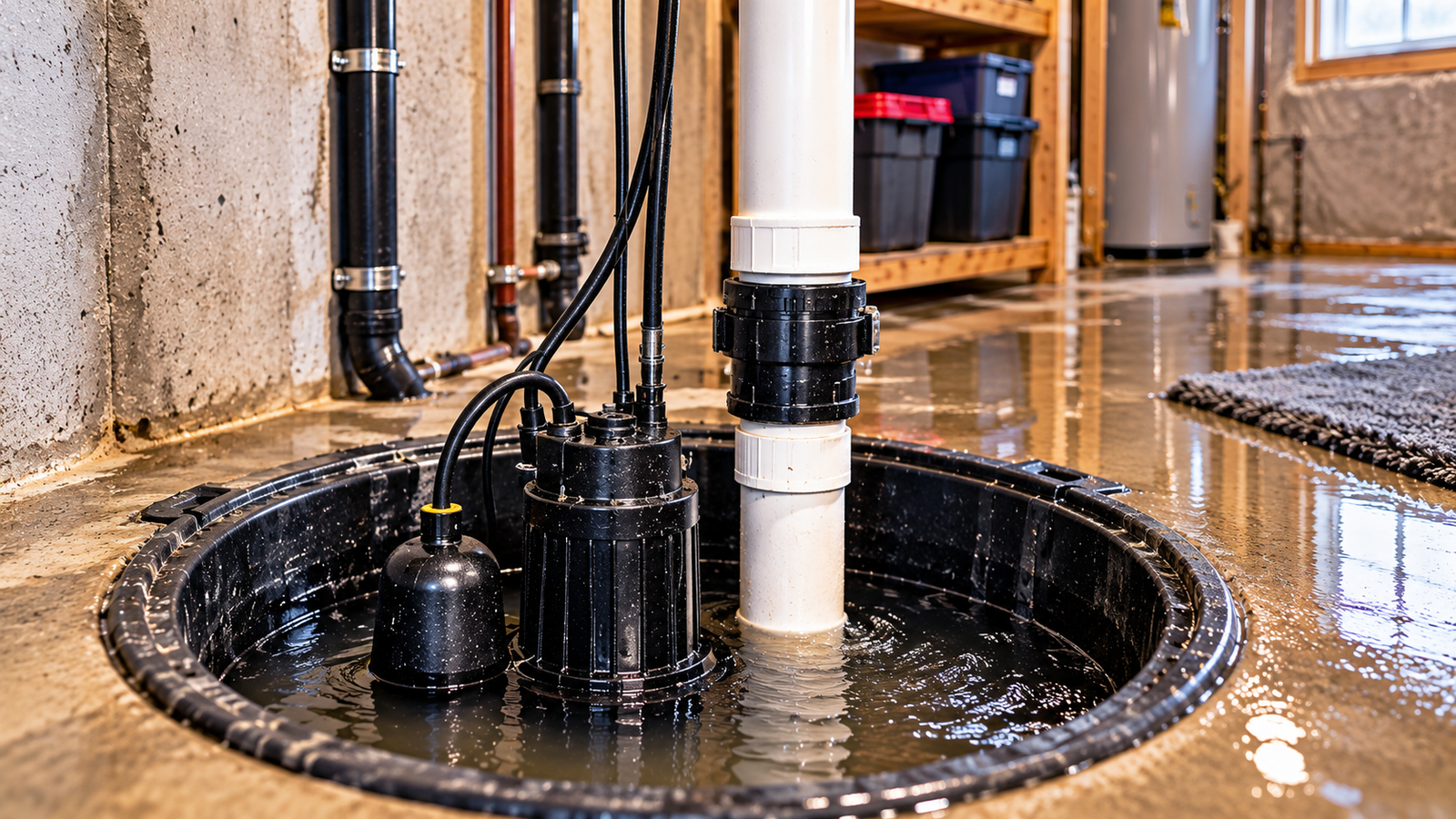
What Should You Do Immediately When Your Sump Pump Stops Working?
A failed sump pump requires a response based on the water level and immediate safety conditions.
The priority is protecting occupants from electrical hazards while determining whether water is actively accumulating.
First, Assess the Situation From a Safe Location
Observe whether the sump pit is full and whether water has reached the basement floor.
Do not step into standing water near electrical equipment.
If flooding is already present, avoid entering the affected area until electrical safety has been assessed.
Check Whether Water Is Still Rising
If the area is dry and safe to observe, monitor whether the water level continues increasing.
Rapidly rising water indicates that incoming drainage may exceed the remaining storage capacity.
A stable level may provide more time to arrange appropriate assistance.
What If Water Is Approaching Electrical Equipment?
Keep away from the affected area.
Do not touch outlets, extension cords, appliances, pump connections, or electrical panels while standing in water.
Contact qualified electrical assistance to determine how the area can be made safe.
Critical safety warning: Floodwater may be electrically energized. Never enter standing water to unplug a sump pump, reset a breaker, or retrieve belongings. If electrical equipment is affected, stay clear and seek qualified assistance. Electrical isolation should only be attempted from a safe location by someone competent to do so.
Should You Try Resetting the Pump?
Repeatedly resetting equipment without identifying the cause may worsen an electrical or mechanical problem.
If the pump has stopped because of a fault, professional diagnosis is preferable to repeated attempts to restart it.
Do not handle electrical connections in wet conditions.
Can You Remove Water Manually?
Manual water removal may be possible in limited situations where the area is dry, safe, and accessible.
However, removing water from a sump pit may not keep pace with substantial drainage inflow.
Do not use household electrical equipment in flooded conditions or enter potentially energized water.
Should You Move Belongings Away From the Basement Floor?
If the area remains dry and safe, moving vulnerable items to higher storage can reduce potential losses.
Prioritize documents, electronics, and moisture-sensitive belongings.
Never enter a flooded area or approach electrical hazards to retrieve property.
What If the Basement Has Already Flooded?
Keep occupants away from unsafe water and electrical equipment.
Professional water removal, moisture assessment, and drying may be necessary after the area is made electrically safe.
Contaminated water or sewage requires additional precautions and appropriate remediation.
Should You Contact Your Insurance Provider?
If damage has occurred, review your insurance policy and notify your insurer according to its reporting requirements.
Coverage for sump pump failure or sewer backup varies by policy and endorsement.
Document visible damage from a safe location, but do not delay urgent safety measures.
How Can You Document a Sump Pump Failure?
Photographs, videos, and written observations can help establish the sequence of events.
Record when the failure was discovered, whether water entered the basement, and any visible equipment problems.
Only collect documentation where conditions are safe.
When Should You Call a Professional Plumber?
Arrange professional assistance when the pump does not activate, cannot remove water, or shows signs of mechanical failure.
A rapidly rising pit level requires timely attention.
Electrical hazards or significant flooding may also require qualified electrical and water-damage professionals.
Immediate response: Stay clear of electrical hazards, assess rising water from a safe location, protect accessible belongings only when safe, and arrange professional diagnosis. Do not reach into the sump pit or repeatedly reset malfunctioning equipment.
Homeowners can explore this Calgary Electrical and Plumbing video resource for additional company information.
How Can You Repair, Replace, and Prevent Future Sump Pump Failures?
Restoring reliable drainage requires identifying why the pump stopped and confirming that the repaired system can manage expected water inflow.
Replacing the pump without checking surrounding components may leave an underlying problem unresolved.
Is It Better to Repair or Replace a Failed Sump Pump?
The answer depends on the fault, equipment age, and condition of the motor and pumping components.
A serviceable float switch or check valve may be repairable.
Severe motor deterioration or repeated failures may make replacement more practical.
Can a Failed Float Switch Be Replaced?
Some pump models allow compatible switches or control components to be replaced separately.
Others use integrated designs that may require a different repair approach.
A technician can determine whether the switch is defective, obstructed, or incorrectly positioned.
What If the Motor Has Completely Failed?
Motor failure may require replacing the pump, especially when internal repairs are not economical or supported by the manufacturer.
The replacement should be selected according to actual drainage demand and installation requirements.
Simply choosing the largest available model is not necessarily appropriate.
Should the Discharge Pipe Be Inspected During Repairs?
Yes. A blocked or damaged discharge pipe can prevent a new pump from removing water effectively.
Check valve condition, piping arrangement, and exterior discharge routing may also affect performance.
A complete inspection helps avoid repeating the same problem.
How Do Professionals Select a Replacement Sump Pump?
Selection should consider incoming water volume, vertical discharge lift, pipe resistance, pit dimensions, and manufacturer performance specifications.
The pump must also be compatible with the existing drainage arrangement.
Proper sizing helps support effective water removal and suitable operating cycles.
Can a Battery Backup Sump Pump Prevent Basement Flooding?
A properly installed battery backup can provide additional pumping capability during certain power interruptions or primary pump failures.
However, backup systems have capacity and runtime limits.
They reduce risk but cannot guarantee protection against every flooding situation.
What Is the Benefit of a High-Water Alarm?
A high-water alarm alerts occupants when the sump pit reaches an abnormal level.
Some systems offer audible notifications, while others support remote alerts.
An alarm does not remove water, but it can provide valuable warning before overflow occurs.
How Often Should You Test a Sump Pump?
Testing frequency should follow the manufacturer’s instructions and the property’s drainage needs.
Many homeowners choose to check operation before spring thaw and other periods of expected heavy water inflow.
Any test should follow safe, model-specific procedures.
Can Regular Maintenance Extend Pump Life?
Maintenance may help identify debris, switch problems, check valve faults, and changes in pumping performance.
It cannot eliminate all failures or prevent unexpected power interruptions.
Combining maintenance with backup protection and early warning systems provides a more comprehensive approach.
Should You Replace an Aging Pump Before It Fails?
Preventive replacement may be reasonable when a pump is older, heavily used, or showing signs of declining reliability.
However, age alone does not establish that replacement is necessary.
Equipment condition, operating history, and the consequences of failure should guide the decision.
Can Exterior Drainage Improvements Reduce Pump Demand?
Appropriate grading, roof drainage arrangements, and discharge routing can help manage water around a property.
However, changes must suit the site’s drainage design and applicable local requirements.
A professional assessment can determine whether exterior drainage conditions contribute to excessive sump pump operation.
What Should a Professional Sump Pump Inspection Include?
- Reviewing the pump’s model, age, and operating history.
- Assessing float-switch activation and automatic shutoff.
- Evaluating motor and impeller performance.
- Checking discharge piping for restrictions or damage.
- Inspecting check valve operation.
- Reviewing electrical supply concerns where appropriate.
- Assessing pump capacity relative to drainage demand.
- Discussing backup pumps and high-water alarms.
- Explaining suitable repair or replacement options.
Do Different Calgary Neighbourhoods Require Different Solutions?
Homes in Seton, Copperfield, New Brighton, Riverbend, Douglasdale, and Lake Bonavista may have different foundation drainage arrangements and sump pump installations.
Neighbourhood location alone does not determine the correct equipment.
Individual property conditions and actual system performance are more important.
Practical example: A homeowner in Cranston replaces a failed sump pump but discovers that water still does not leave the pit efficiently. Inspection identifies a restriction in the discharge piping. Correcting the restriction is necessary for the replacement pump to operate as intended.
Why Is Professional Diagnosis Important After a Failure?
A failed sump pump may be the result of a single defective component or a broader system problem.
Accurate diagnosis helps prevent unnecessary replacement and identifies conditions that could damage new equipment.
It also provides an opportunity to evaluate backup protection before the next period of heavy drainage demand.
Long-term protection: Reliable sump pump performance depends on a functioning pump, suitable discharge piping, correct controls, appropriate capacity, and regular maintenance. Backup equipment and high-water alarms can provide additional protection, but no system eliminates every flooding risk.
For additional company information, visit the Calgary Electrical and Plumbing shared business profile and its Reddit community profile.
Request a sump pump failure diagnosis and repair estimate in Calgary in just a few clicks.
Get My Free Estimate
Restore Sump Pump Protection Before Water Damage Escalates
When a sump pump stops working, the immediate concern is whether incoming drainage water will overflow into the basement. Electrical safety, water level monitoring, and accurate fault diagnosis should guide the response. Repairing the underlying problem and reviewing backup protection can help reduce future risks.
An experienced local calgary plumber can assess the pump, discharge system, and available repair options. Call Calgary Electrical and Plumbing at (403) 421-1991 to discuss a failed sump pump and suitable next steps.
Frequently Asked Questions about Sump Pump Failure
Will my basement flood if my sump pump stops working?
Not necessarily. Flooding depends on how much water enters the sump pit and whether backup protection is available. During heavy rainfall or spring snowmelt, water may rise quickly. If the pit overflows, surrounding basement areas can become wet and require professional attention.
How long can a sump pump be broken before flooding starts?
There is no fixed timeframe. Overflow depends on the pit’s available capacity and the rate of incoming water. During substantial drainage inflow, flooding may develop rapidly. During dry conditions, the pit may remain stable for much longer. Rising water should be monitored only from a safe location.
What should I do first if my sump pump stops working?
Check the water level from a safe, dry location and avoid touching electrical equipment near water. If flooding or electrical hazards are present, stay clear of the area. Arrange qualified assistance to identify the failure and restore drainage before water damage becomes more extensive.
Can a sump pump stop working because of a power outage?
Yes. Most standard sump pumps require household electricity and cannot operate during an outage without suitable backup power. A properly installed battery backup may provide temporary pumping capability, but capacity and runtime vary. Backup equipment should be maintained and tested according to manufacturer instructions.
Should I repair or replace a sump pump that has stopped working?
The decision depends on the cause, pump age, and equipment condition. Some float-switch or valve problems may be repairable, while severe motor failure or repeated breakdowns may justify replacement. Professional inspection helps identify the underlying fault and determine the most practical solution.
Identify the problem before rising water threatens your basement.
Call (403) 421-1991 Now
Professional Sump Pump Inspection, Repair, and Replacement Services in Calgary