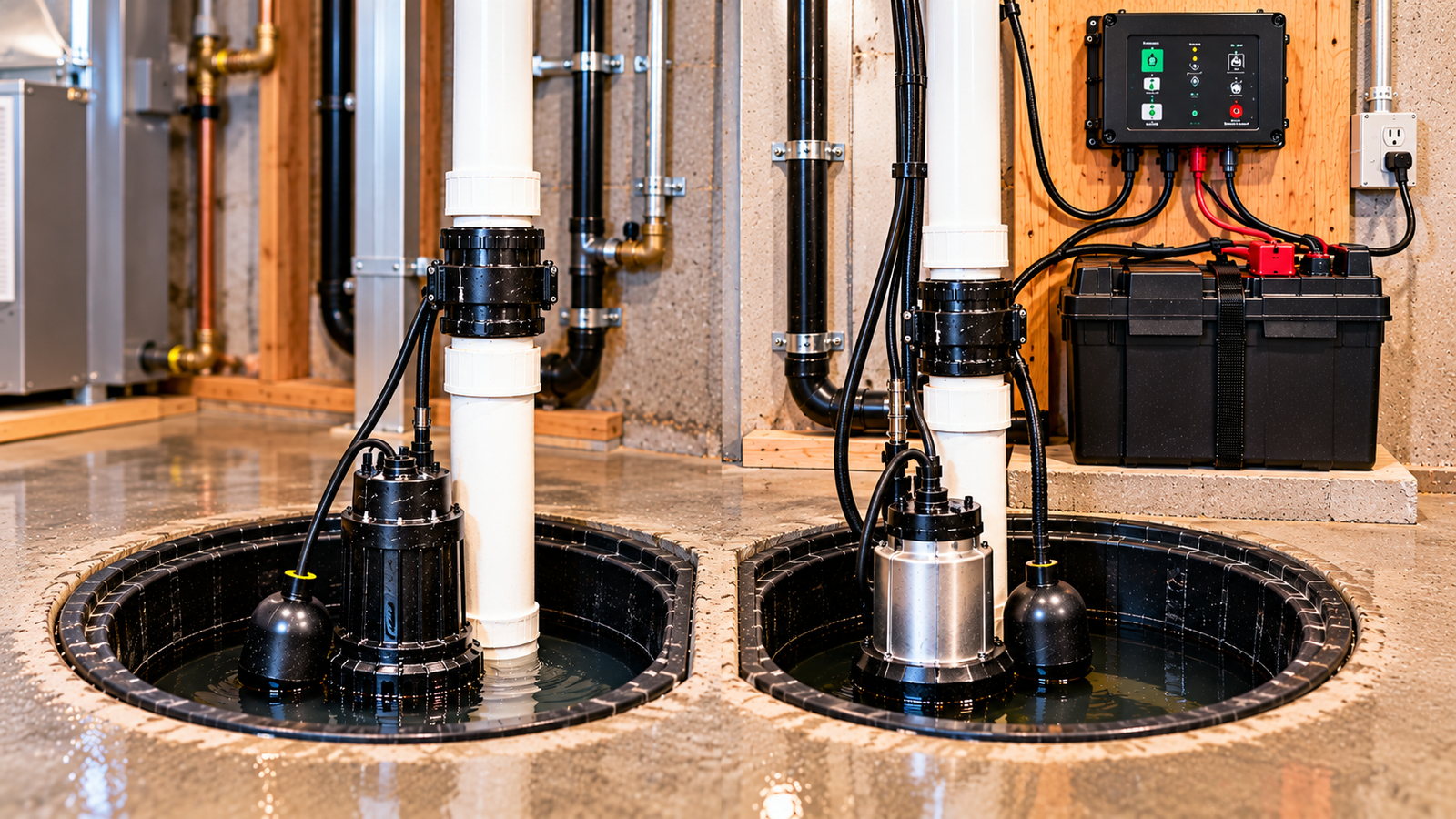

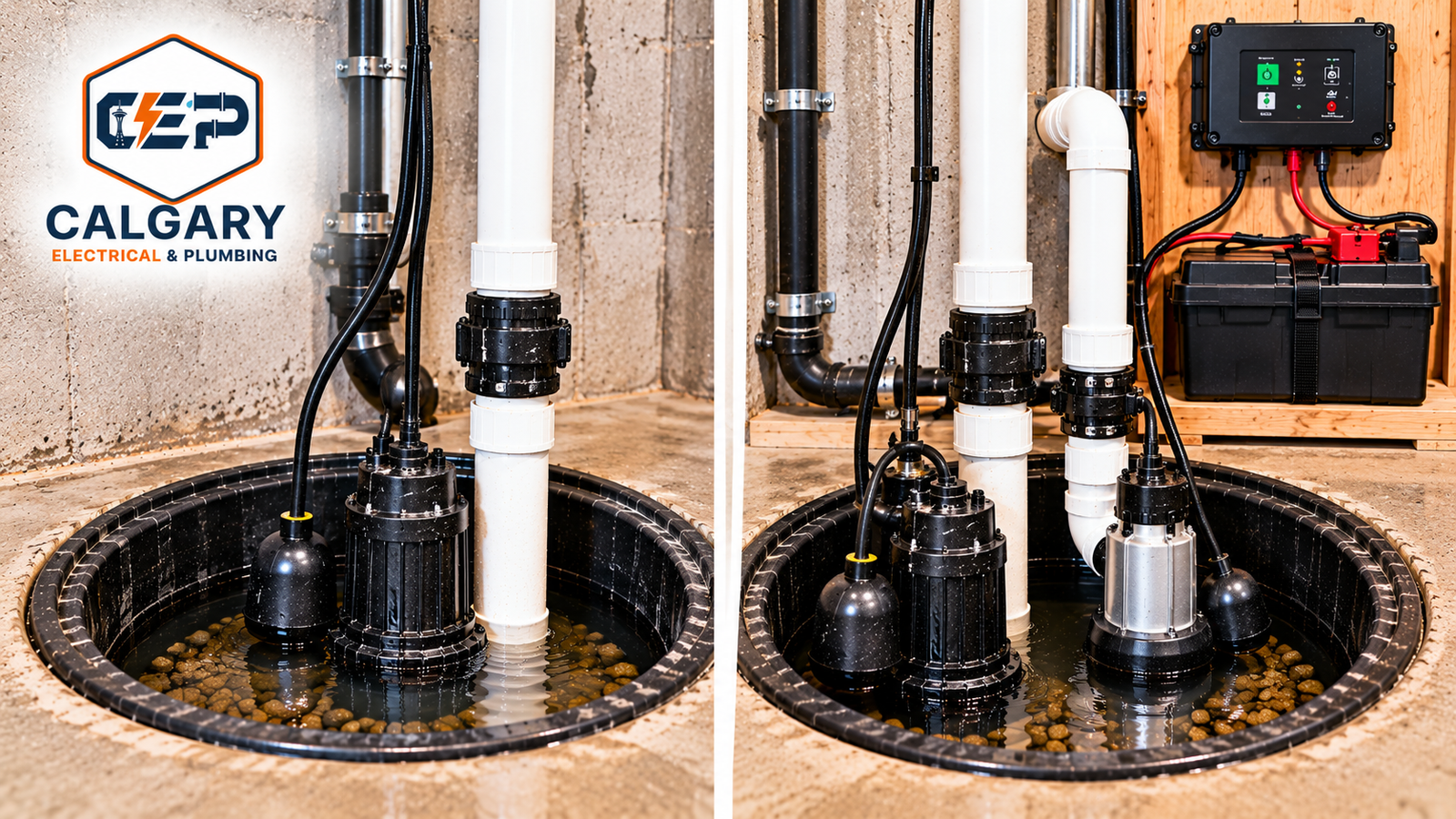
Primary vs. Battery Backup Sump Pumps: which system offers better protection for your Calgary basement? Many homeowners assume that installing a standard sump pump is enough to manage groundwater. However, a power outage or mechanical breakdown can leave the basement vulnerable precisely when drainage demand is highest.
In Southeast Calgary communities such as Mahogany, Auburn Bay, Cranston, and Seton, spring snowmelt and heavy rainfall can increase the importance of reliable basement drainage. Understanding how these systems operate helps homeowners make informed decisions about sump pump installation and plumbing services in Calgary.
A primary sump pump and a battery backup pump are not identical products designed to perform the same job. One normally handles everyday water removal, while the other provides an additional layer of protection under specific failure conditions. Comparing their power sources, capacity, maintenance requirements, and limitations reveals why many homes benefit from having both.
A primary sump pump uses household electricity to remove water during normal operation. A battery backup sump pump provides additional pumping when the primary system fails or loses power. The strongest protection usually comes from a properly sized primary pump supported by a compatible, maintained backup system.
How Does a Primary Sump Pump Work in a Calgary Home?
A primary sump pump is the main water-removal device installed in a residential sump pit. Its purpose is to discharge collected drainage water away from the foundation before the pit overflows.
Most residential primary pumps operate automatically using a float switch or another water-level sensor.
What Activates a Primary Sump Pump?
Water enters the sump pit through the property’s drainage arrangement. As the level rises, the pump’s control system activates the motor.
The impeller moves water through the discharge pipe, and the pump stops when the water reaches its designated lower level.
This process repeats as drainage conditions change.
Does a Primary Sump Pump Require Electricity?
Yes. Most residential primary sump pumps rely on household electrical power.
When electricity is available and the equipment is functioning correctly, the pump can operate automatically without manual intervention.
However, a standard primary pump cannot continue operating during a power outage unless a suitable alternative power source is provided.
What Are the Main Types of Primary Sump Pumps?
Two common residential designs are submersible and pedestal sump pumps.
Submersible pumps sit inside the sump pit and are designed to operate while submerged in water.
Pedestal pumps position the motor above the pit while the pumping mechanism extends into the water.
Both designs can be effective when appropriately selected and installed.
How Much Water Can a Primary Pump Remove?
Pumping capacity varies by model, discharge height, pipe resistance, and installation conditions.
Manufacturers typically provide performance information showing how much water a pump can move at different discharge heights.
A pump’s advertised maximum capacity should not be confused with its actual installed performance.
Why Is Proper Pump Sizing Important?
An undersized pump may struggle during periods of heavy water inflow.
An unsuitable oversized installation can also contribute to short cycling or other operating concerns.
Professional sizing considers the pit, discharge arrangement, and expected drainage demand rather than horsepower alone.
What Happens When a Primary Pump Stops Working?
If drainage water continues entering the pit, the water level may rise until overflow occurs.
The consequences depend on incoming water volume, available storage, and whether another pump can take over.
Our related guide explains what happens when a sump pump stops working and how homeowners can respond safely.
What Are the Advantages of a Primary Sump Pump?
- Designed for routine drainage water removal.
- Automatic operation when the system is functioning correctly.
- Available in different capacities and configurations.
- Can handle frequent pumping when properly sized.
- Works with suitable discharge piping and check valves.
- Can be paired with a separate backup system.
What Are the Limitations of a Primary Pump?
The most important limitation is dependence on electrical power.
A primary pump can also fail because of motor wear, a faulty float switch, debris, or discharge restrictions.
Even well-maintained equipment cannot guarantee uninterrupted operation.
Calgary example: A homeowner in Auburn Bay has a primary sump pump that operates regularly during spring thaw. The pump removes water effectively while household power is available. However, a neighbourhood power interruption could leave the system inactive despite continued groundwater inflow.
Is a Primary Sump Pump Enough for Every Home?
Not always. Some properties experience limited water inflow, while others depend heavily on continuous pumping during wet conditions.
Homes with finished basements, valuable stored belongings, or a history of drainage problems may benefit from additional protection.
The appropriate arrangement depends on individual risk rather than neighbourhood location alone.
Primary pump summary: A primary sump pump handles everyday basement drainage using household electricity. It is essential for many properties, but its dependence on power and mechanical components means it cannot provide complete protection against every interruption or equipment failure.
Homeowners can find local service information through the Calgary Electrical and Plumbing Google Maps listing.
How Does a Battery Backup Sump Pump Protect Your Basement?
A battery backup sump pump provides a secondary method of removing water when the primary pump cannot meet the drainage demand or stops operating.
Most systems include a separate pump, battery, charging equipment, and automatic controls.
When Does a Battery Backup Pump Activate?
A properly configured backup system activates when water rises to its designated backup level.
This may happen because the primary pump loses power, experiences mechanical failure, or cannot remove incoming water quickly enough.
The exact activation arrangement depends on the equipment design.
Can a Battery Backup Pump Work During a Power Outage?
Yes. This is one of its main purposes.
The battery supplies electrical energy to the backup pump when household power is unavailable.
However, the system can only operate while sufficient usable battery capacity remains.
How Long Does a Backup Sump Pump Battery Last?
Runtime varies considerably.
Important factors include battery capacity, battery condition, pump power consumption, discharge height, and how frequently the pump operates.
A backup system running intermittently may operate longer than one pumping continuously.
Manufacturer runtime specifications should be reviewed under conditions relevant to the actual installation.
What Type of Battery Does a Backup System Use?
Battery backup systems may use compatible lead-acid or lithium-based batteries, depending on the manufacturer’s design.
Different battery technologies have different charging, maintenance, temperature, and safety requirements.
For general background on how batteries store and supply electrical energy, see this overview of battery technology.
Does the Battery Recharge Automatically?
Many backup systems include a charger that maintains the battery when household electricity is available.
However, charging performance depends on the charger, battery condition, and manufacturer requirements.
A connected charger does not guarantee that an aging or damaged battery can deliver adequate runtime.
Can a Backup Pump Replace the Primary Pump?
Battery backup pumps are generally intended as secondary protection rather than permanent replacements for a properly sized primary pump.
Some models have lower pumping capacity or limited battery runtime.
Using a backup pump continuously may exhaust its available energy and leave the basement unprotected.
Can a Backup Pump Handle Heavy Water Inflow?
Performance depends on the specific pump and installation.
Some systems can manage substantial water volumes for limited periods, while others are intended for lower-demand backup operation.
The backup must be evaluated against the property’s actual drainage requirements.
What Are the Advantages of Battery Backup Protection?
- Additional pumping capability during certain power outages.
- Secondary protection if the primary pump fails.
- Automatic activation when correctly configured.
- Potential high-water alerts on compatible systems.
- Reduced dependence on a single pumping device.
- Additional protection for finished basement spaces.
What Are the Limitations of a Battery Backup Pump?
Battery capacity is finite, and runtime decreases as stored energy is consumed.
Batteries also deteriorate with age and may require replacement.
A backup system can fail if its battery, charger, controls, or pump are defective.
Does a Backup System Require Maintenance?
Yes. Maintenance should follow the manufacturer’s instructions.
Depending on the design, this may include inspecting battery condition, reviewing charger indicators, testing alarms, and verifying backup pump operation.
Some battery types require additional maintenance, while sealed systems have different requirements.
Can a Battery Backup System Send Alerts?
Some models include audible alarms, status indicators, or remote monitoring capabilities.
These features can help homeowners recognize power loss, high water levels, or battery-related problems.
Not every system includes remote notifications, so available features should be confirmed before purchase.
Battery safety: Use only batteries and charging equipment approved for the backup system. Improper charging, damaged wiring, incorrect battery chemistry, or unsuitable installation conditions can create electrical and fire hazards. Battery work should follow manufacturer instructions and applicable electrical requirements.
Local scenario: A homeowner in Copperfield experiences a power interruption during heavy rainfall. The primary pump stops, but the battery backup activates when water reaches its control level. The backup provides temporary drainage protection while usable battery capacity remains.
Backup pump summary: A battery backup sump pump adds protection when the primary system cannot operate. Its effectiveness depends on battery condition, available runtime, pumping capacity, and correct installation. It is a valuable secondary safeguard, not a guarantee against every basement flood.
Additional local business details are available through this Calgary plumbing service location reference.
Request a primary and battery backup sump pump installation estimate in Calgary in just a few clicks.
Get My Free Estimate
Primary vs. Battery Backup Sump Pumps: What Are the Key Differences?
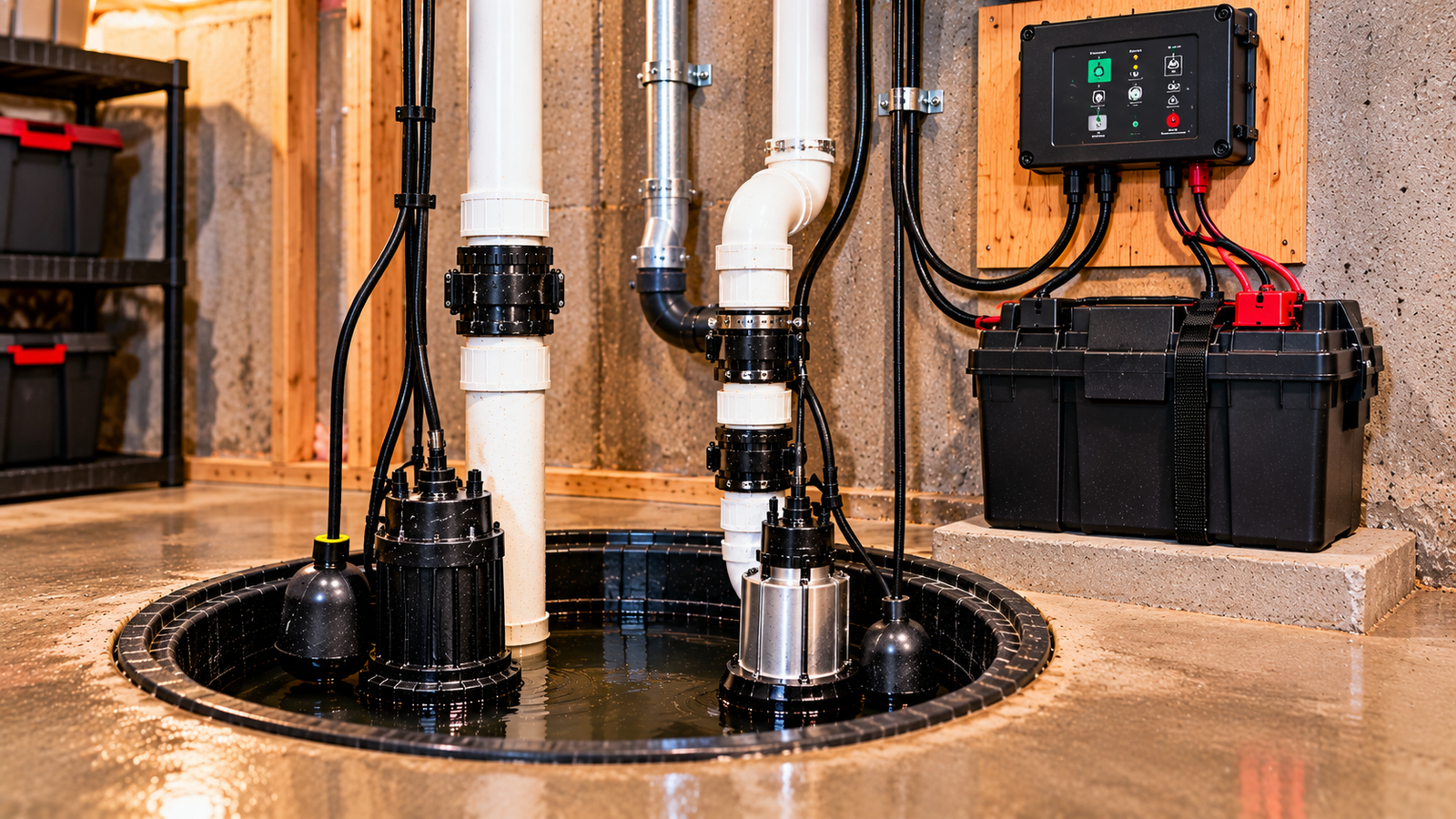
Although both systems move water away from the foundation, their operating roles differ.
A primary pump is designed to handle normal drainage demand. A battery backup provides an alternative pumping method when the primary system is unavailable or insufficient.
How Do Their Power Sources Compare?
A standard primary pump normally uses household electricity.
A battery backup draws energy from a battery when needed.
This difference is important because power interruptions can occur during the same weather conditions that increase drainage demand.
Which Pump Usually Has Greater Capacity?
Many primary pumps are designed for greater sustained pumping demand than typical battery backup models.
However, performance varies by product.
Capacity should be compared using manufacturer performance curves at the expected discharge height rather than relying on general assumptions.
Which System Can Operate Longer?
A primary pump can continue cycling while electrical power is available and the equipment remains functional.
A battery backup is limited by available stored energy.
Long outages combined with heavy water inflow can exhaust battery capacity before electricity returns.
Which System Is More Reliable?
Neither system is immune to failure.
Primary pumps can experience mechanical or electrical faults, while backup systems depend on battery condition and additional controls.
Using two properly maintained pumps reduces dependence on a single device, although both may share discharge-related vulnerabilities.
| Feature | Primary Sump Pump | Battery Backup Sump Pump |
|---|---|---|
| Main purpose | Routine drainage water removal | Secondary pumping protection |
| Power source | Household electricity | Stored battery energy |
| Power outage operation | Stops without alternative power | Can operate while battery capacity remains |
| Typical activation | Normal sump pit water level | Higher backup activation level |
| Operating duration | Dependent on electrical supply and equipment condition | Limited by battery capacity and pumping demand |
| Maintenance focus | Motor, switch, impeller, and discharge system | Battery, charger, controls, and backup pump |
| Primary limitation | Power loss or mechanical failure | Finite runtime and battery deterioration |
| Best application | Main basement drainage system | Additional protection against interruption |
Is a Battery Backup More Expensive to Maintain?
A backup system introduces additional components that require inspection and eventual replacement.
Battery replacement is an important ongoing consideration.
Actual maintenance costs depend on the system design, battery technology, usage, and manufacturer requirements.
Does Installing Two Pumps Double the Protection?
Two pumps provide redundancy, but protection does not increase in a simple mathematical proportion.
Both pumps may depend on the same sump pit or discharge arrangement.
A blocked common discharge pipe could affect both systems unless the installation is specifically designed to address that risk.
Can Both Pumps Run at the Same Time?
Some configurations allow the backup to activate when water rises beyond the primary pump’s normal operating level.
This may happen during unusually high inflow or inadequate primary performance.
Whether simultaneous operation is supported depends on the equipment and installation design.
Does a Backup Pump Eliminate the Need for a High-Water Alarm?
No. A high-water alarm provides a separate warning function.
Even with two pumps, an alarm can alert occupants when water reaches an abnormal level.
Some backup systems include alarms, but features and notification methods vary.
Can Either Pump Prevent Every Type of Basement Flooding?
No. Sump pumps primarily address water collected by the drainage system serving the sump pit.
They cannot necessarily prevent flooding caused by burst pipes, sewer backups, surface water entering through doors, or other unrelated sources.
Effective basement protection may require several different measures.
Are Both Systems Suitable for Finished Basements?
Yes, when correctly designed and installed.
Finished basements may contain flooring, drywall, furniture, electronics, and other moisture-sensitive materials.
Backup protection can be particularly valuable where even a relatively small water intrusion could cause substantial damage.
Calgary example: A homeowner in New Brighton has a finished basement used as a family room. The primary pump manages ordinary groundwater inflow, while a battery backup offers additional protection during certain power interruptions. A high-water alarm provides another warning if drainage performance becomes inadequate.
Which System Offers Better Value?
Value depends on the property’s exposure to water intrusion and the consequences of pump failure.
A primary pump provides the essential drainage function.
A backup system adds equipment and maintenance costs but may reduce vulnerability to certain interruptions.
Key comparison: The primary sump pump provides everyday pumping capacity, while the battery backup adds redundancy. They are complementary systems rather than direct substitutes. For many Calgary homes, combining both provides a more resilient arrangement than relying on either alone.
Homeowners can view the company’s shared Google business information for additional local service details.
Which Sump Pump Setup Is Best for Your Calgary Basement?
The most suitable sump pump arrangement depends on drainage demand, basement use, available space, and the homeowner’s tolerance for water damage risk.
A professional assessment can help determine whether the existing primary pump is adequate and whether additional backup protection is appropriate.
When Is a Primary Pump Alone Reasonable?
A properly sized primary pump may provide adequate routine drainage for some properties.
However, relying on one pump means the system remains vulnerable to power interruptions and mechanical failure.
Homeowners should understand that limitation before deciding against backup protection.
When Should You Consider a Battery Backup?
Backup protection deserves consideration when a basement has experienced previous water intrusion, relies heavily on pumping, or contains valuable finished spaces.
It may also be useful where occupants are frequently away from home.
The decision should reflect actual drainage conditions and equipment requirements.
Can a Battery Backup Be Added to an Existing Sump Pit?
Often, yes, but compatibility must be assessed.
The pit needs sufficient space for the additional pump and controls.
Discharge routing, electrical arrangements, battery placement, and maintenance access also matter.
Should the Backup Pump Use a Separate Discharge Line?
A separate discharge arrangement may reduce some shared-system vulnerabilities, depending on the installation.
However, routing must comply with applicable requirements and suit the property’s drainage design.
A qualified installer can evaluate whether shared or separate discharge piping is appropriate.
How Important Is Battery Placement?
Battery placement affects safety, accessibility, and equipment longevity.
The battery should be installed according to manufacturer requirements, including any ventilation, temperature, enclosure, and moisture-protection provisions.
Improvised placement near standing water or unsuitable electrical connections should be avoided.
What Should You Ask Before Buying a Backup System?
- What pumping capacity does the backup provide at the installed discharge height?
- How is the backup activated if the primary pump fails?
- What battery chemistry and capacity are required?
- What runtime is expected under realistic pumping conditions?
- Does the system include a high-water or low-battery alarm?
- How often must the battery be inspected or replaced?
- Is the equipment compatible with the existing sump pit?
- What maintenance and testing procedures does the manufacturer require?
Should You Consider a Backup During Primary Pump Replacement?
Yes. Replacing an aging primary pump creates an opportunity to review the entire drainage system.
A technician can assess whether the pit accommodates a backup, whether the discharge arrangement is suitable, and whether an alarm would be beneficial.
Planning both systems together may simplify installation decisions.
How Can Homeowners Maintain Both Pumps?
Maintenance should follow the instructions for each pump and the backup battery system.
Common inspection areas include float movement, visible debris, discharge performance, battery condition, charger indicators, and alarm functionality.
Testing should be completed safely without reaching into energized water or bypassing protective controls.
Should Sump Pumps Be Checked Before Spring Snowmelt?
Yes. Reviewing system operation before periods of expected high drainage demand can help identify problems early.
Calgary’s spring thaw is a practical time to consider pump performance, backup readiness, and exterior discharge conditions.
However, maintenance may also be needed at other times based on usage.
Do Calgary Neighbourhoods Have Different Drainage Needs?
Homes in Mahogany, Cranston, Copperfield, McKenzie Towne, Riverbend, Douglasdale, and Lake Bonavista can have different foundation drainage arrangements and groundwater conditions.
Neighbourhood location alone does not establish whether a backup is required.
Individual property conditions should guide equipment selection.
Can a Backup Pump Protect Against Extended Outages?
It can provide temporary protection, but the available runtime depends on battery capacity and pumping demand.
During an extended outage, a heavily used backup may exhaust its stored energy.
Homeowners should understand the system’s limitations and consider appropriate contingency planning.
Is Professional Installation Important?
Yes. Correct installation affects pump capacity, activation levels, discharge performance, battery safety, and future maintenance.
A backup system that activates incorrectly or cannot discharge water effectively may offer little practical protection.
Professional assessment helps ensure the equipment is appropriate for the property.
What Does a Professional Sump Pump Assessment Include?
A technician may evaluate the primary pump, sump pit dimensions, water inflow, discharge piping, float controls, and electrical supply.
For backup systems, the assessment may also consider battery capacity, charging equipment, alarm features, and installation space.
The goal is to recommend a suitable arrangement rather than simply adding equipment.
Practical example: A homeowner in Seton plans to finish the basement and wants additional protection for the new flooring and furniture. A professional assessment confirms that the primary pump is appropriately sized and identifies a compatible battery backup system with a high-water alarm.
What Is the Best Long-Term Protection Strategy?
A resilient drainage system combines appropriate pumping capacity, regular inspection, suitable discharge routing, and awareness of potential failure conditions.
Where appropriate, battery backup equipment and alarms provide additional safeguards.
Exterior drainage maintenance and a household response plan can further reduce risk.
Recommendation: For homes that depend on sump pumping, a properly sized primary pump supported by a compatible battery backup and high-water alarm is often a sensible approach. Final equipment selection should reflect actual drainage demand, installation conditions, and manufacturer specifications.
For more company information, view this Calgary Electrical and Plumbing video or the company’s Tumblr platform, which may require an account to access.
Request a primary and battery backup sump pump installation estimate in Calgary in just a few clicks.
Get My Free Estimate
Choose Sump Pump Protection That Matches Your Home’s Drainage Needs
A primary sump pump handles routine water removal, while a battery backup adds protection when the main system cannot operate. Neither eliminates every flooding risk, but a properly designed combination can reduce dependence on a single pump or power source.
An experienced local calgary plumber can assess your sump pit, drainage requirements, and suitable backup options. Call Calgary Electrical and Plumbing at (403) 421-1991 to discuss the right sump pump arrangement for your home.
Frequently Asked Questions about Primary and Battery Backup Sump Pumps
Do I need both a primary and battery backup sump pump?
Not every home requires the same arrangement, but having both provides additional protection. The primary pump handles routine drainage, while the backup can operate during certain power interruptions or primary pump failures. The decision should consider water inflow, basement use, and individual flooding risk.
Will a battery backup sump pump work when the electricity goes out?
Yes. A properly installed battery backup can operate without household electricity while sufficient battery capacity remains. Runtime depends on battery condition, pump demand, and discharge conditions. Extended outages or continuous pumping can exhaust the battery, so backup systems should be maintained and tested regularly.
Can a battery backup sump pump replace my primary sump pump?
Battery backup pumps are generally designed as secondary protection rather than permanent replacements for primary equipment. They may have lower sustained capacity and limited operating time. A properly sized primary pump should handle routine drainage, while the backup provides additional protection when needed.
How often should a sump pump backup battery be replaced?
Replacement intervals vary by battery chemistry, manufacturer, charging conditions, and usage. Some batteries require replacement after several years, while others may last longer. Follow the manufacturer’s guidance and monitor battery condition rather than relying on age alone to determine whether replacement is necessary.
Can I add a battery backup pump to my existing Calgary sump pit?
Often, yes, but compatibility must be confirmed. The pit needs adequate space, suitable discharge routing, and appropriate electrical and battery arrangements. A professional can assess the existing installation, recommend compatible equipment, and determine whether modifications are required for reliable backup operation.
Protect your basement with equipment suited to your property’s drainage needs.
Call (403) 421-1991 Now
Primary Sump Pump and Battery Backup Installation Services in Calgary