
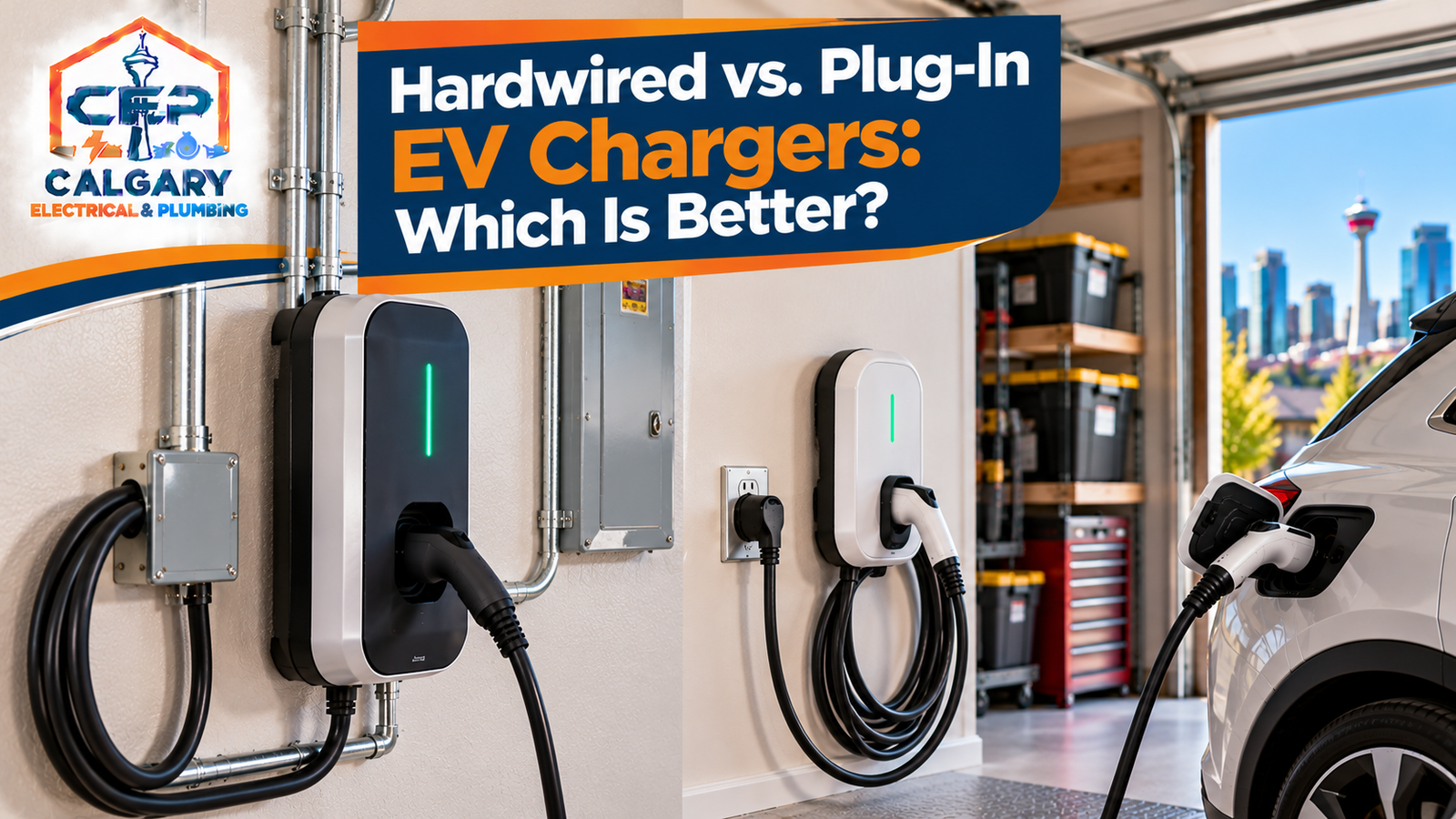
Hardwired vs. Plug-In EV Chargers: Which Is Better? If you are preparing to install a Level 2 electric vehicle charger in your Calgary garage, this is one of the most important decisions you will make. Both options can provide convenient home charging, but they differ in electrical connections, installation requirements, portability, and available charging capacity.
Homeowners in Mahogany, Auburn Bay, Cranston, and other Southeast Calgary communities often consider home charging when purchasing an electric vehicle or upgrading from a standard household outlet. Before selecting equipment, it is important to understand how residential electrical installation services in Calgary relate to charger compatibility, dedicated circuits, and electrical panel capacity.
The better choice depends on your vehicle, charging habits, existing electrical infrastructure, and long-term plans. Understanding the differences between permanent hardwired connections and receptacle-based plug-in installations can help you choose a safe, practical charging arrangement without paying for unnecessary features.
Hardwired EV chargers are generally better for permanent installations and higher charging currents, while plug-in chargers offer easier removal and relocation. Both can charge an electric vehicle effectively when properly installed. The best choice depends on circuit capacity, charger specifications, electrical code requirements, and homeowner preferences.
What Is the Difference Between Hardwired and Plug-In EV Chargers?
The primary difference is how each charger connects to your home’s electrical system. Both are electric vehicle supply equipment, commonly called EVSE, and both can provide Level 2 charging using a suitable 240-volt electrical supply.
However, the connection method influences installation design, maintenance considerations, and maximum supported charging current.
What Is a Hardwired EV Charger?
A hardwired EV charger connects directly to a dedicated electrical branch circuit through an approved wiring arrangement.
Instead of plugging into a receptacle, the charger becomes part of the property’s fixed electrical installation.
Hardwired chargers are commonly selected for permanent garage installations, outdoor charging locations, and applications requiring higher charging currents.
How Does a Plug-In EV Charger Work?
A plug-in Level 2 charger uses a manufacturer-approved power cord and a compatible electrical receptacle.
In residential installations, a NEMA 14-50 receptacle is a common option, although other configurations exist depending on the equipment.
The receptacle must be supplied by an appropriately designed circuit, and the charger must be configured within the circuit’s permitted continuous-load capacity.
Do Both Chargers Provide Level 2 Charging?
Yes. Both hardwired and plug-in equipment can provide Level 2 charging when designed for the appropriate voltage and current.
The vehicle’s onboard charging equipment determines how much alternating-current power it can accept.
A charger capable of delivering more power will not necessarily charge a vehicle faster if the vehicle has a lower charging limit.
Can You Move a Plug-In EV Charger to Another Property?
Portability is one of the main advantages of a plug-in charger.
A compatible unit can generally be unplugged and relocated without disconnecting permanent electrical wiring.
However, the destination property must have a suitable receptacle and electrical circuit. A compatible-looking outlet does not automatically establish that the installation is safe.
Can a Hardwired Charger Be Removed or Replaced?
Yes. Hardwired equipment is not permanently attached beyond removal.
A qualified electrician can disconnect the existing charger and install a compatible replacement after verifying the circuit and manufacturer’s requirements.
Because the wiring is fixed, removal requires more electrical work than unplugging a portable unit.
Which Installation Looks Better in a Garage?
Hardwired chargers often provide a cleaner appearance because they do not require a visible receptacle and supply plug.
Plug-in chargers may have additional visible components, including the receptacle enclosure and power cord.
Actual appearance depends on equipment design, cable management, mounting position, and garage layout.
| Feature | Hardwired EV Charger | Plug-In EV Charger |
|---|---|---|
| Electrical connection | Direct connection to a dedicated circuit | Approved plug and compatible receptacle |
| Portability | Requires electrical disconnection | Generally easier to relocate |
| Charging current | Can support higher currents where equipment and infrastructure permit | Limited by plug, receptacle, circuit, and charger ratings |
| Appearance | Often cleaner fixed installation | Visible plug and receptacle |
| Installation requirements | Dedicated circuit and approved permanent connection | Dedicated circuit and suitable receptacle installation |
| Typical suitability | Long-term residential charging | Homeowners prioritizing equipment portability |
Does Every Calgary Garage Support Both Options?
No. Existing wiring, panel capacity, available circuit space, and garage construction can affect installation feasibility.
Some properties may require new wiring or electrical infrastructure improvements before either type can be installed.
For business location information, homeowners can consult the Calgary Electrical and Plumbing Google Maps listing.
Calgary example: A homeowner in Mahogany has a garage with no existing 240-volt charging circuit. Choosing a plug-in charger does not eliminate the need for electrical installation. Both options require assessment of the electrical supply and a properly designed circuit.
Are Hardwired EV Chargers Faster, Safer, and More Reliable?
Hardwired charging can offer practical advantages, but the connection method alone does not determine charging speed or safety.
Correct circuit sizing, approved equipment, installation quality, and vehicle charging capability are more important than simply choosing one connection style.
Are Hardwired EV Chargers Faster Than Plug-In Models?
Hardwired chargers can support higher charging currents when the equipment and electrical installation are designed for them.
For example, a 48-amp hardwired charger can deliver approximately 11.5 kilowatts at 240 volts.
A typical 40-amp plug-in charger operating through a suitable 50-amp circuit can deliver approximately 9.6 kilowatts.
However, a 32-amp hardwired charger and a 32-amp plug-in charger provide essentially the same charging power at the same voltage.
Why Does Circuit Capacity Matter?
EV charging is generally treated as a continuous electrical load.
For common installations using an 80% continuous-load allowance, a 40-amp charging setting requires a 50-amp circuit, while a 48-amp setting requires a 60-amp circuit.
The applicable Canadian Electrical Code requirements, equipment ratings, and installation conditions must be verified rather than assuming these examples apply universally.
How Much Driving Range Can Each Charger Add?
Charging range depends on vehicle efficiency, onboard charger capacity, battery conditions, and electrical power delivery.
As an illustration, a vehicle consuming approximately 20 kWh per 100 kilometres could theoretically receive about 48 kilometres of driving energy per hour from 9.6 kW before accounting for charging losses.
Actual range recovery will be lower or higher depending on the vehicle and operating conditions.
Are Hardwired EV Chargers Safer?
Both configurations can be safe when listed or certified for Canadian use and installed according to applicable requirements.
Hardwired connections eliminate the detachable supply plug and receptacle interface, reducing one potential location for poor contact or overheating.
However, hardwired equipment still requires correct terminations, overcurrent protection, conductor sizing, and installation practices.
Can Plug-In EV Chargers Overheat?
Yes. Overheating can occur when a receptacle is damaged, improperly installed, worn, or unsuitable for sustained charging loads.
Loose electrical connections can increase resistance and generate heat.
Using an appropriate receptacle and following manufacturer instructions are essential. Extension cords and unauthorized adapters should not be used for EV charging.
Electrical safety warning: Never assume that an existing 240-volt receptacle is suitable for continuous EV charging. Receptacle condition, circuit wiring, breaker protection, equipment certification, and installation requirements should be evaluated by a qualified electrician before use.
Does a Plug-In Charger Need GFCI Protection?
Ground-fault protection requirements depend on the applicable electrical code, receptacle configuration, installation location, and charging equipment.
Some plug-in installations require additional circuit-level protection, while EV charging equipment may also contain internal protective features.
A qualified electrician should determine the appropriate arrangement under the requirements applicable to the Calgary installation.
Which Charger Performs Better During Calgary Winters?
Both types can operate during Calgary’s cold weather when installed within their manufacturer’s specified environmental ratings.
Cold temperatures may reduce vehicle charging efficiency because the battery management system can use energy to condition the battery.
Outdoor installations require equipment rated for the environment, suitable cable management, and protection from snow, ice, and moisture.
Are Hardwired Chargers More Reliable Over Time?
A properly installed hardwired connection avoids wear associated with repeated plugging and unplugging.
Nevertheless, overall reliability depends on charger quality, electrical installation, environmental exposure, and maintenance.
A professionally installed plug-in charger can also provide years of satisfactory operation.
Can Either Charger Damage an Electrical Panel?
An improperly designed charging installation can overload electrical infrastructure or expose existing electrical deficiencies.
The risk is related to the electrical load and installation, not simply whether the charger is hardwired.
For additional guidance, read Can My Electrical Panel Support a Level 2 EV Charger?.
Performance comparison: Hardwired chargers can provide higher charging currents when supported by the electrical system. At equal voltage and current, hardwired and plug-in chargers deliver comparable charging power. Proper installation and equipment compatibility are essential for both.
Additional local service information is available through this Calgary electrical service map reference.
Request an EV charger installation estimate in Calgary in just a few clicks.
Get My Free Estimate
How Much Does Hardwired vs. Plug-In EV Charger Installation Cost in Calgary?
Installation costs depend on much more than the charger’s connection method.
The distance from the electrical panel, circuit amperage, wiring route, existing infrastructure, and any required upgrades can substantially affect the final price.
Is a Plug-In EV Charger Cheaper to Install?
Not necessarily. A plug-in installation requires a compatible receptacle, suitable enclosure, and properly designed electrical circuit.
Where no dedicated circuit exists, installing the receptacle may involve much of the same wiring work required for a hardwired charger.
In some circumstances, a hardwired installation may cost less because it avoids purchasing and installing a high-quality receptacle.
What Does a Hardwired Installation Include?
A typical installation involves evaluating electrical capacity, selecting an appropriate circuit, routing conductors, mounting equipment, and completing approved electrical connections.
Additional work may include installing conduit, upgrading protective devices, or modifying the wiring route.
Testing and verification are important before the charger is placed into service.
What Does a Plug-In Installation Include?
A plug-in installation generally requires a dedicated branch circuit, suitable receptacle, appropriate electrical box or enclosure, and any required protective devices.
The receptacle must match the charger’s approved plug configuration.
Its location should also prevent unnecessary cord strain and allow convenient charging without extension cords.
What Are Typical EV Charger Installation Costs in Calgary?
The following figures are broad illustrative planning allowances in Canadian dollars, not verified current Calgary contractor quotations.
They are intended to explain potential budget differences. Actual prices require a property-specific assessment.
| Installation Scenario | Illustrative Budget (CAD) | Important Considerations |
|---|---|---|
| Basic hardwired installation | $600–$1,500 | Short wiring route and adequate existing electrical capacity |
| Basic plug-in circuit and receptacle | $650–$1,600 | Suitable receptacle, dedicated wiring, and required protection |
| Complex wiring or detached garage installation | $1,500–$3,500+ | Longer cable runs, conduit, access limitations, or additional electrical work |
| Electrical panel or service improvements | Quoted separately | Scope depends on load calculations and existing infrastructure |
| Level 2 charging equipment | $400–$1,200+ | Brand, charging current, connectivity, and environmental rating |
Pricing note: These are nonbinding budget illustrations, not advertised CEP prices or guaranteed market rates. Taxes, permits, inspections, equipment selection, and unusual site conditions may change the total.
Does Electrical Panel Capacity Affect Installation Cost?
Yes. A panel may have available breaker spaces without having sufficient electrical capacity for an additional continuous charging load.
An electrician must assess the property’s electrical demand and determine whether the proposed charger can be supported.
Depending on the results, options may include reduced charging current, approved energy management equipment, or electrical infrastructure upgrades.
Can You Use an Existing Dryer or Welder Outlet?
An existing 240-volt receptacle should not automatically be treated as an EV charging outlet.
Its wiring, circuit rating, receptacle configuration, protective devices, and intended use must be evaluated.
Sharing circuits or using adapters without an approved arrangement can create electrical hazards and may violate applicable installation requirements.
Are Permits Required for EV Charger Installation in Calgary?
Installing a new dedicated electrical circuit or permanently connected EV charging equipment generally involves electrical permit and inspection requirements.
The applicable permit process depends on the scope of work and current local requirements.
Homeowners should confirm the correct process with their electrician and the relevant Calgary permitting authority before work begins.
Does the Distance From the Panel Matter?
Yes. Longer wiring routes require additional materials and labour.
They may also require larger conductors to manage voltage drop, depending on the circuit design.
A charger installed near an accessible electrical panel may be simpler than one requiring wiring through finished walls or across a detached garage.
Can Smart Charging Reduce Upgrade Costs?
Some approved energy management systems can monitor electrical demand and adjust charging current to remain within permitted capacity.
These systems may provide an alternative to certain service upgrades where technically appropriate and accepted under applicable requirements.
Compatibility, installation cost, and charging expectations should be reviewed before selecting this approach.
Calgary example: A homeowner in Copperfield wants a Level 2 charger but has limited spare electrical capacity. Instead of immediately upgrading the electrical service, an electrician evaluates whether a lower-current charger or approved load-management arrangement can safely meet the household’s charging needs.
Should You Buy the Charger Before Getting an Estimate?
It is often better to confirm the electrical requirements before purchasing equipment.
Some models support both hardwired and plug-in configurations, while others have specific installation limitations.
Choosing the charger after reviewing available electrical capacity can help avoid purchasing equipment that cannot be used as intended.
Homeowners can also explore the Calgary Electrical and Plumbing shared business profile for additional company information.
Which EV Charger Installation Is Best for Your Calgary Home?
The best charging arrangement depends on your expected charging demand, available electrical infrastructure, property layout, and whether you intend to keep the equipment permanently installed.
Rather than choosing based on charging speed alone, homeowners should consider everyday convenience and long-term electrical requirements.
When Is a Hardwired EV Charger the Better Choice?
Hardwired charging is often attractive when a homeowner wants a permanent installation and does not anticipate relocating the equipment.
It may also be preferable where higher charging currents are needed and the electrical system can support them.
Outdoor installations can benefit from eliminating an exposed supply plug and receptacle, although all equipment must still meet environmental requirements.
When Is a Plug-In EV Charger the Better Choice?
Plug-in charging may suit homeowners who want flexibility to remove or replace their charging equipment.
It can also be convenient when a properly installed, compatible dedicated receptacle already exists.
However, portability should not take priority over electrical compatibility or installation safety.
Which Option Is Better for a Detached Garage?
Either option may work in a detached garage if suitable electrical capacity and wiring are available.
The installation may require reviewing the garage feeder, distribution equipment, grounding and bonding arrangements, and available load capacity.
The connection method does not eliminate the need to assess the electrical supply serving the detached structure.
What About Outdoor EV Charging in Calgary?
Outdoor charging equipment should be certified and rated for the expected environmental conditions.
Calgary installations must account for snow accumulation, freezing temperatures, moisture exposure, and suitable mounting locations.
Hardwired equipment is frequently preferred for permanent outdoor installations, but properly designed plug-in arrangements may also be possible where permitted.
Is Hardwired Charging Better for Two Electric Vehicles?
Not automatically. Charging two vehicles requires evaluating total electrical demand and how the charging equipment distributes available power.
Some compatible chargers support coordinated load sharing, allowing two vehicles to charge without both drawing maximum current simultaneously.
A qualified electrician can determine whether separate circuits, shared charging arrangements, or load management are appropriate.
Do You Need the Fastest Available Home Charger?
Many households can meet daily driving requirements with a lower charging current.
For example, a vehicle that uses approximately 12 kWh during a typical day may replenish that energy during several hours of overnight charging, even without the highest-capacity residential charger.
Battery size, charging losses, driving patterns, and available charging time should guide equipment selection.
Will Hardwired Charging Increase Home Value?
A professionally installed charging system may appeal to buyers who own electric vehicles or plan to purchase one.
However, there is no universal increase in property value associated with either installation method.
Documentation, electrical compliance, charger compatibility, and the condition of the installation are more useful considerations than unsupported resale-value predictions.
What Should You Check Before Choosing an EV Charger?
- Confirm the vehicle’s maximum supported AC charging rate.
- Determine the charging range needed for daily driving.
- Review electrical panel and service capacity.
- Identify the proposed charger location and wiring route.
- Check whether the equipment supports hardwired or plug-in installation.
- Verify Canadian certification and environmental ratings.
- Consider future vehicles and possible charging expansion.
- Review permit, inspection, and installation requirements.
- Compare complete installation costs rather than charger prices alone.
Why Is Professional Installation Important?
EV chargers can operate for extended periods at substantial electrical loads.
Improper conductor sizing, loose connections, inadequate protection, or incorrect circuit configuration can create overheating and electrical safety concerns.
A qualified electrician can assess the installation, identify existing limitations, and verify that the selected equipment is compatible with the electrical system.
Do Calgary Neighbourhoods Have Different Charging Requirements?
Homes in Seton, New Brighton, McKenzie Towne, Riverbend, Douglasdale, and Lake Bonavista may have different electrical service arrangements and garage configurations.
Neighbourhood location alone does not determine whether hardwired or plug-in charging is appropriate.
The individual property’s electrical capacity, wiring condition, and charging requirements are the deciding factors.
Practical example: A homeowner in Cranston plans to remain in the same property for many years and wants a permanent outdoor charging station. A hardwired charger may offer a convenient arrangement. Another homeowner in Auburn Bay expects to move soon and prefers equipment that can be unplugged and relocated, making a compatible plug-in charger worth considering.
Can You Change From Plug-In to Hardwired Charging Later?
Sometimes. Certain EV charger models support both installation methods, subject to manufacturer instructions.
Changing the connection arrangement may require electrical modifications, circuit reassessment, and additional permitting.
Homeowners should not remove a factory-installed plug or alter charger wiring unless the manufacturer specifically permits the conversion.
What Is the Best Overall Recommendation?
For a permanent home charging station, hardwired installation is often the more practical long-term choice, particularly when higher charging currents or outdoor placement are priorities.
For homeowners who value portability and have a suitable electrical installation, plug-in charging remains a reasonable alternative.
Neither configuration should be selected without considering the property’s electrical capacity and the vehicle’s charging requirements.
Final comparison: Choose hardwired charging when permanent installation, reduced plug connections, or higher supported current are priorities. Consider plug-in charging when portability and easy equipment replacement matter most. Both require compatible equipment, suitable circuits, and proper electrical installation.
For additional company resources, explore the Calgary Electrical and Plumbing video resource, the company’s Instagram updates, and this Calgary electrical equipment supplier directory.
Request an EV charger installation estimate in Calgary in just a few clicks.
Get My Free Estimate
Choose the Right EV Charging Connection for Your Calgary Home
Hardwired and plug-in EV chargers can both provide convenient Level 2 home charging. Hardwired equipment is often preferred for permanent installations and higher charging currents, while plug-in equipment offers greater portability. The right choice depends on electrical capacity, vehicle compatibility, installation conditions, and long-term needs.
Whether you are discussing electrical upgrades with a local calgary plumber or planning a dedicated charging circuit, EV charger wiring should be assessed by a qualified electrician. Call Calgary Electrical and Plumbing at (403) 421-1991 to discuss your home charging installation options.
Frequently Asked Questions about Hardwired vs. Plug-In EV Chargers
Is a hardwired EV charger better than a plug-in charger?
A hardwired EV charger is often preferable for permanent installations, outdoor locations, and higher charging currents. A plug-in charger offers easier removal and relocation. Both can provide reliable Level 2 charging when properly installed. The better choice depends on electrical capacity, equipment compatibility, and homeowner priorities.
Can a plug-in EV charger charge as fast as a hardwired charger?
Yes, when both chargers operate at the same voltage and current, their charging power is comparable. However, hardwired equipment can support higher charging currents in suitable installations. Actual charging speed also depends on the vehicle’s onboard charger, battery conditions, and available electrical capacity.
Do I need a dedicated circuit for a Level 2 EV charger in Calgary?
Residential Level 2 EV charging generally requires an appropriately designed dedicated electrical circuit, unless a specifically approved arrangement permits otherwise. Circuit sizing depends on charger current, equipment specifications, and applicable electrical requirements. A qualified electrician should assess the installation before the charger is connected.
Is it cheaper to install a plug-in EV charger in Calgary?
Not always. Plug-in installations require a suitable receptacle and electrical circuit, while hardwired installations avoid the receptacle but require permanent electrical connections. Costs depend on wiring distance, circuit capacity, equipment selection, and possible upgrades. A property-specific estimate provides the most reliable comparison.
Can I install a hardwired EV charger outside during Calgary winters?
Yes, provided the charger is approved for outdoor installation and suitable for the expected environmental conditions. The electrical connections, mounting location, and wiring must meet applicable requirements. Cold temperatures can affect vehicle charging efficiency, but properly rated equipment is designed to operate within specified temperature limits.
Choose the right charging connection for your home and electrical system.
Call (403) 421-1991 Now
Local Help Available 24/7 in Calgary