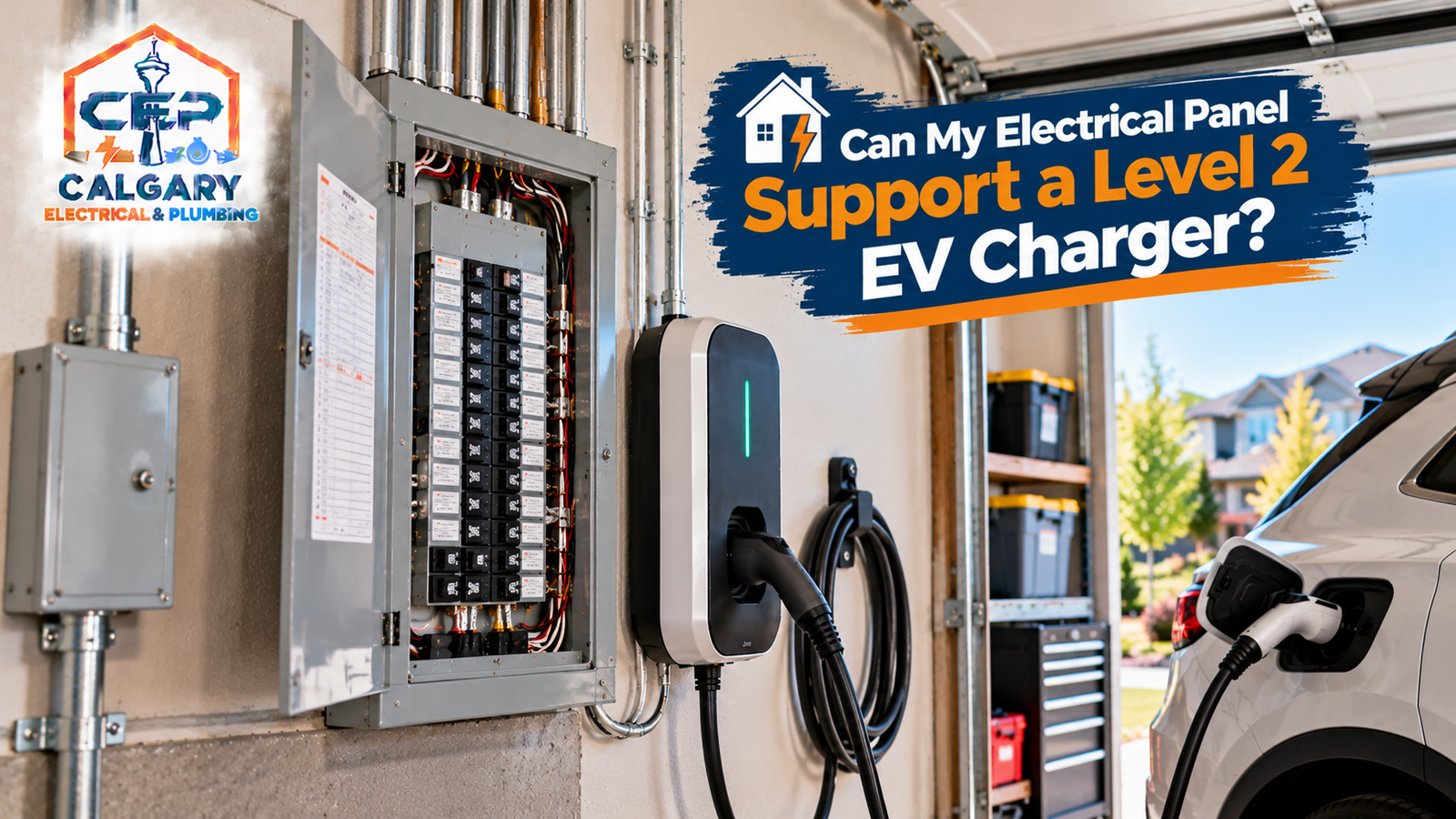

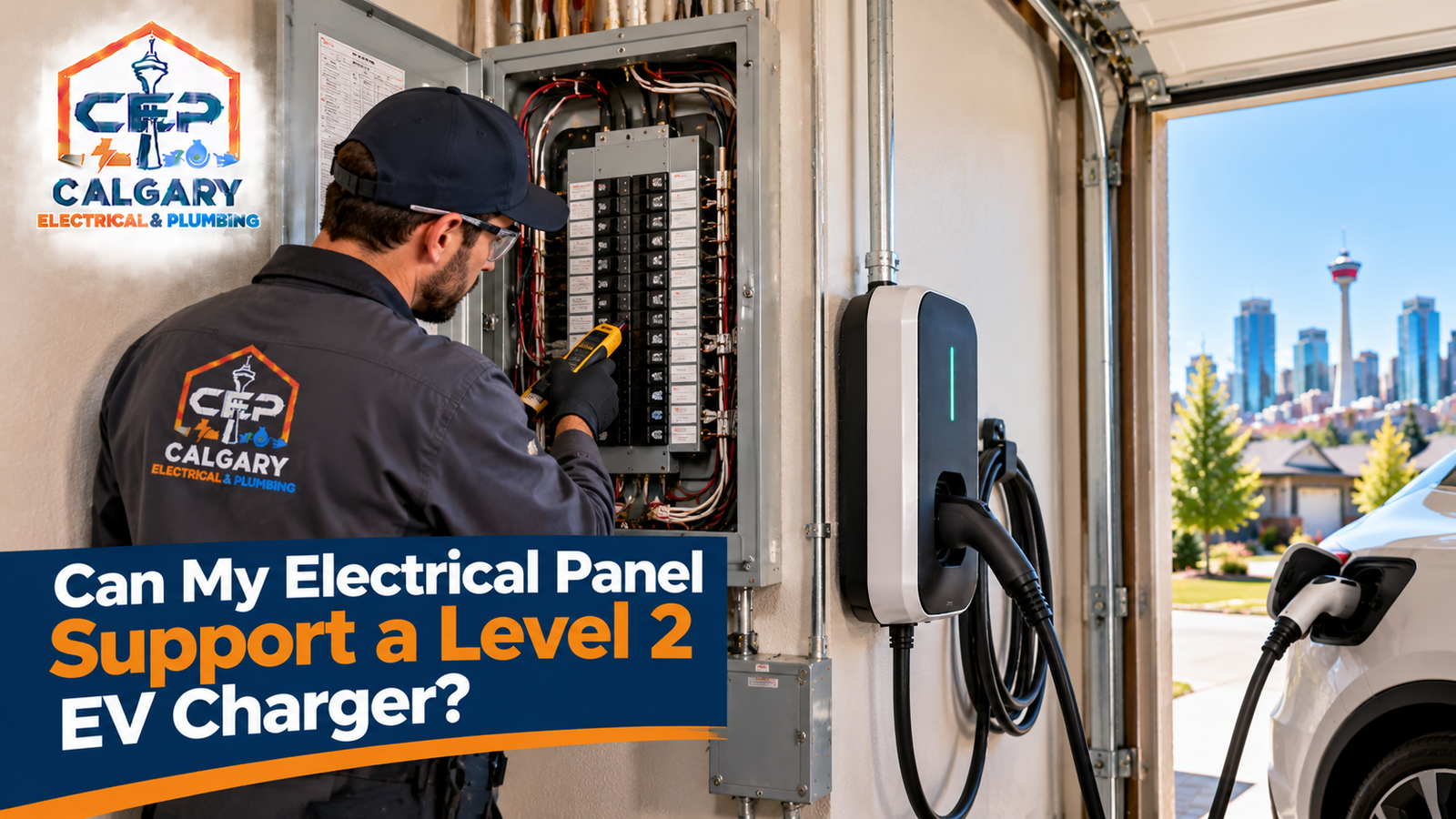
Can My Electrical Panel Support a Level 2 EV Charger? This is an important question for Calgary homeowners preparing to charge an electric vehicle at home. A Level 2 charger can provide significantly more charging power than a standard household outlet, but the additional electrical demand must be compatible with your home’s existing electrical infrastructure.
Whether you live in Mahogany, Auburn Bay, Cranston, or another Southeast Calgary neighbourhood, your electrical panel’s amperage rating does not automatically determine whether EV charging is possible. Understanding how residential electrical services and EV charger installation in Calgary relate to panel capacity, household demand, and dedicated charging circuits can help you plan the installation correctly.
Some homes can accommodate Level 2 charging without major electrical modifications, while others require load management, circuit adjustments, or electrical service upgrades. The correct decision depends on the property’s calculated electrical demand, charger requirements, and the condition of the existing installation.
Your electrical panel may support a Level 2 EV charger if sufficient electrical capacity is available after accounting for existing household loads. A 100-amp or 200-amp panel does not automatically guarantee compatibility. A qualified electrician must assess service capacity, circuit requirements, and applicable electrical code provisions.
How Do You Know If Your Electrical Panel Can Support a Level 2 EV Charger?
Determining whether an electrical panel can support EV charging requires more than checking its main breaker rating.
An electrician must evaluate the property’s electrical service capacity, existing loads, available circuit arrangements, and the proposed charger’s electrical requirements.
What Does Electrical Panel Amperage Mean?
Electrical panel amperage refers to the current rating associated with the panel or its electrical supply arrangement.
Residential properties commonly have electrical services rated at 100 amps, 125 amps, 150 amps, or 200 amps, although other configurations exist.
The rating provides important information, but it does not reveal how much capacity remains available for additional equipment.
Can a 100-Amp Electrical Panel Support a Level 2 EV Charger?
Yes, in some circumstances. A 100-amp service may accommodate Level 2 charging when the calculated household demand leaves sufficient capacity.
However, homes with substantial electric heating, electric water heating, air conditioning, or other large appliances may have limited remaining capacity.
A lower-current charger or approved energy management system may be appropriate where the electrical installation supports that arrangement.
Is a 200-Amp Panel Enough for Home EV Charging?
A 200-amp electrical service often provides greater flexibility for additional electrical loads than a smaller service.
Nevertheless, it does not automatically guarantee that a Level 2 charger can be installed without modifications.
Large homes with multiple electric appliances, secondary suites, or extensive electrical equipment may already have substantial calculated demand.
Does an Empty Breaker Space Mean There Is Enough Capacity?
No. Available breaker spaces and available electrical capacity are different considerations.
An electrical panel may have several unused spaces while the property’s calculated demand approaches the permitted service capacity.
Conversely, a panel with limited physical space may have sufficient electrical capacity but require an approved solution for accommodating the new circuit.
What Is an Electrical Load Calculation?
An electrical load calculation estimates the demand placed on a property’s electrical service according to applicable electrical code requirements.
It considers factors such as dwelling size, heating systems, cooking equipment, water heating, air conditioning, and other significant electrical loads.
The proposed EV charging demand is then evaluated to determine whether the existing service can safely accommodate it.
Can You Estimate Available Capacity From Your Electricity Bill?
Electricity bills provide useful information about energy consumption, usually measured in kilowatt-hours.
However, monthly energy consumption is not equivalent to the maximum electrical demand used for service-capacity calculations.
A household may consume relatively little electricity overall while still operating several high-demand appliances simultaneously.
Does the Age of Your Electrical Panel Matter?
Age can influence the condition and suitability of electrical equipment.
Older panels may have limited circuit spaces, deteriorated components, obsolete breaker designs, or installation conditions requiring closer examination.
However, panel age alone does not establish whether an upgrade is necessary. Condition, rating, compatibility, and calculated demand are more important.
Can an Electrician Determine Capacity Without Replacing the Panel?
Yes. A professional assessment can often establish whether the existing electrical system supports a proposed charger without immediately replacing equipment.
The electrician may review the main service rating, existing circuits, connected appliances, and installation condition.
Where necessary, additional information or measurements may be required to complete the assessment.
Calgary example: A homeowner in Mahogany has a 100-amp electrical service and wants to install a 40-amp Level 2 charger. Although the panel has two available breaker spaces, an electrician must calculate existing household demand before determining whether the proposed charging circuit can be added safely.
Do Different Calgary Homes Have Different Electrical Requirements?
Yes. Homes in Auburn Bay, Cranston, Copperfield, and McKenzie Towne can have different electrical service ratings and appliance configurations.
Even neighbouring properties built during the same period may have different electrical loads because of renovations or equipment changes.
Homeowners can find additional company information through the Calgary Electrical and Plumbing Google Maps listing.
Important distinction: A panel’s amperage rating and number of empty breaker spaces do not establish available EV charging capacity. A proper assessment considers the complete electrical installation and calculated household demand.
How Much Electrical Capacity Does a Level 2 EV Charger Require?
Level 2 EV chargers operate at higher electrical power than standard 120-volt household charging equipment.
The required circuit capacity depends on the charger’s maximum output current, manufacturer instructions, and applicable electrical installation requirements.
What Voltage Does a Level 2 EV Charger Use?
Most residential Level 2 chargers in Canada operate using a nominal 240-volt electrical supply.
This allows them to deliver substantially more power than typical Level 1 charging equipment connected to a standard household receptacle.
However, charging power depends on both voltage and current, not voltage alone.
How Many Amps Does a Level 2 EV Charger Draw?
Residential Level 2 charging equipment is available with different current ratings.
Common charging settings include 16, 24, 32, 40, and 48 amps, although other equipment configurations exist.
The appropriate current depends on the charger’s design, vehicle compatibility, circuit capacity, and applicable electrical requirements.
Why Does a 40-Amp Charger Often Need a 50-Amp Circuit?
EV charging is generally classified as a continuous electrical load.
Under common circuit-sizing arrangements using an 80% continuous-load allowance, a charger drawing 40 amps requires a circuit rated for at least 50 amps.
Actual installation requirements must be determined using the applicable Canadian Electrical Code provisions, equipment ratings, and manufacturer instructions.
Does a 48-Amp EV Charger Require a 60-Amp Circuit?
A 48-amp charger commonly requires a 60-amp branch circuit when the applicable continuous-load sizing rules use the 80% allowance.
However, the electrical service must also have sufficient calculated capacity to accommodate that additional load.
Installing a larger breaker without verifying wiring and service capacity is unsafe.
How Does Charger Amperage Affect Charging Speed?
Higher charging current can provide more electrical power when the vehicle supports the additional input.
For example, a 32-amp charger operating at 240 volts delivers approximately 7.7 kilowatts, while a 40-amp charger delivers approximately 9.6 kilowatts.
Actual battery charging performance depends on the vehicle’s onboard charger, battery temperature, charging losses, and other operating conditions.
| EV Charging Current | Approximate Power at 240V | Common Circuit Rating* |
|---|---|---|
| 16 amps | 3.8 kW | 20 amps |
| 24 amps | 5.8 kW | 30 amps |
| 32 amps | 7.7 kW | 40 amps |
| 40 amps | 9.6 kW | 50 amps |
| 48 amps | 11.5 kW | 60 amps |
*Important: Circuit ratings are illustrative examples based on common 80% continuous-load sizing. Actual conductor, breaker, equipment, and circuit requirements must comply with the applicable electrical code and manufacturer specifications.
Does Every Electric Vehicle Need a 48-Amp Charger?
No. Many electric vehicles can meet typical daily charging requirements using lower-current equipment.
A vehicle driven relatively short distances each day may recover its consumed energy during overnight charging without requiring the highest available charging current.
The vehicle’s onboard AC charging limit can also prevent it from using the full output of a higher-rated charger.
Can You Install a Lower-Amperage Level 2 Charger?
Yes. Lower-current Level 2 charging can be an effective option when electrical capacity is limited.
For example, a properly installed 16-amp or 24-amp charger may provide sufficient overnight charging for some households.
The equipment must support the selected current setting, and the installation must comply with applicable requirements.
Does Hardwired Charging Require More Electrical Capacity?
Not necessarily. Electrical demand depends on charging current rather than the connection method alone.
A hardwired charger operating at 32 amps places approximately the same charging load on the electrical system as a plug-in charger operating at 32 amps.
Hardwired equipment may support higher current ratings, but only when the installation is designed accordingly.
Can Two EV Chargers Overload a Residential Panel?
Yes. Two chargers operating simultaneously can create substantial combined electrical demand.
However, some compatible charging systems support coordinated power sharing or approved load management.
These arrangements may help control total demand, but their suitability depends on equipment certification and the property’s electrical design.
Electrical safety warning: Never increase breaker size, modify charger wiring, or bypass electrical protection to obtain faster charging. Electrical circuits must be designed for the connected equipment and permitted load. Incorrect modifications can cause overheating, equipment damage, or fire hazards.
How Can You Compare Charging Power With Your Daily Driving?
Consider a vehicle that consumes approximately 18 kWh per 100 kilometres.
A 50-kilometre day would use roughly 9 kWh of driving energy before accounting for charging losses and other conditions.
Even a modest Level 2 charging arrangement may replenish that energy within several hours, making maximum charging power unnecessary for some households.
Charging capacity takeaway: Higher charging current requires appropriately sized electrical infrastructure, but faster charging is not always necessary. The most suitable charger balances household electrical capacity, vehicle limitations, and the energy needed for regular driving.
Additional service information is available through this Calgary electrical service location reference.
Request an electrical panel assessment and Level 2 EV charger installation estimate in Calgary in just a few clicks.
Get My Free Estimate
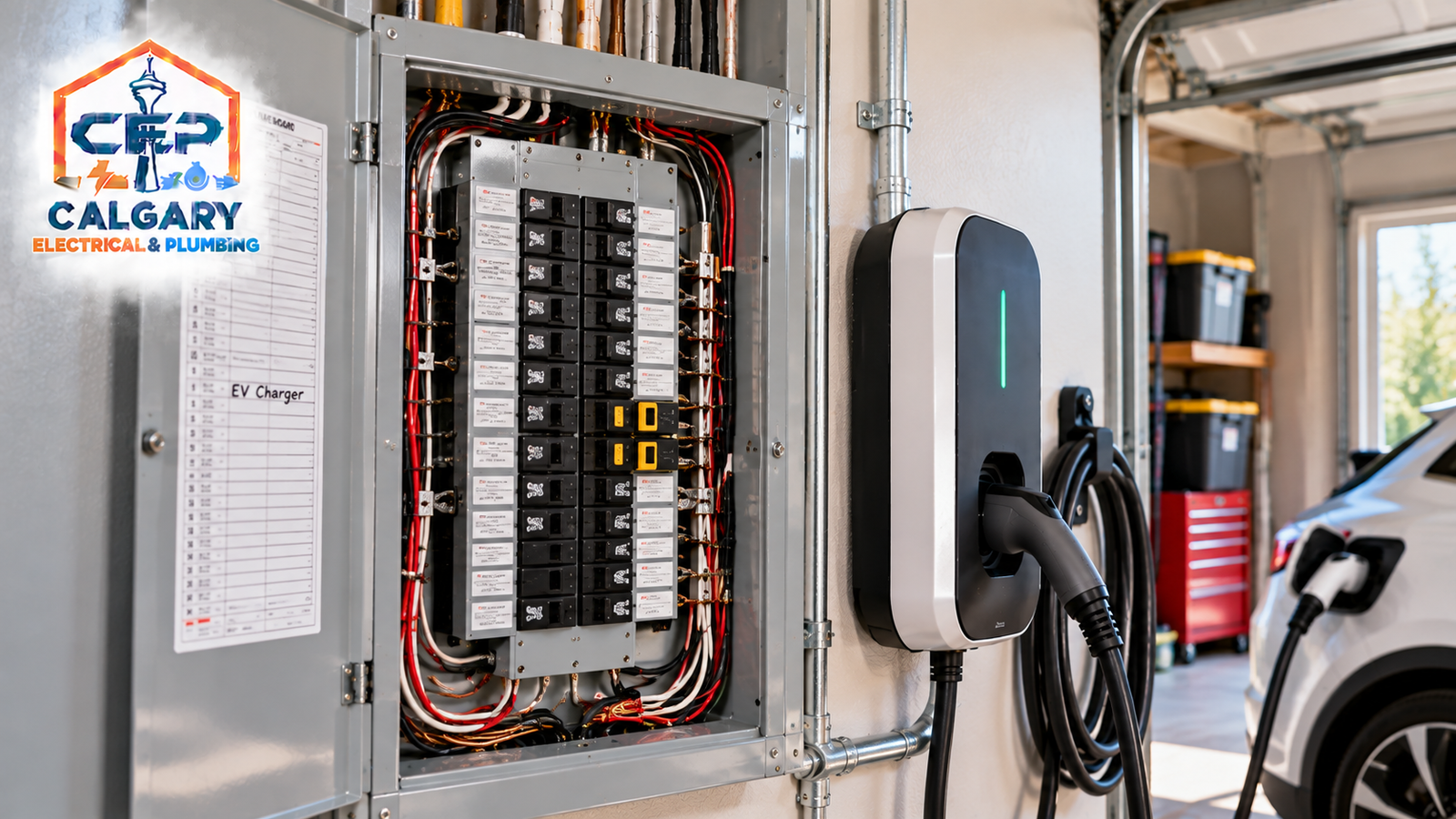
What Are Your Options If Your Electrical Panel Cannot Support EV Charging?
Insufficient electrical capacity does not necessarily mean that home EV charging is impossible.
Several solutions may be available depending on the property’s existing electrical demand, desired charging current, and installation conditions.
Can You Reduce the EV Charger’s Charging Current?
Yes. Some Level 2 chargers allow a qualified installer to configure a lower maximum charging current.
Reducing the current can decrease the additional electrical demand placed on the household service.
However, the selected setting must be supported by the equipment and established according to manufacturer instructions and applicable electrical requirements.
What Is an EV Energy Management System?
An EV energy management system is designed to control charging demand based on available electrical capacity.
Some systems monitor household electrical use and automatically reduce or interrupt charging when other loads increase.
Where approved and correctly designed, this approach may allow EV charging without a complete electrical service upgrade.
Can Load Management Prevent Electrical Overloading?
Properly designed load management can help prevent charging demand from exceeding the permitted capacity of an electrical installation.
For example, charging current may decrease when electric heating or other major household equipment operates.
The system must be compatible with the charger and accepted under the applicable electrical installation requirements.
When Is an Electrical Panel Upgrade Necessary?
A panel upgrade may be required when existing equipment is unsuitable, damaged, obsolete, or unable to accommodate the proposed circuit arrangement.
However, replacing the panel does not automatically increase the electrical service capacity available from the utility supply.
The electrician must distinguish between replacing distribution equipment and upgrading the property’s overall electrical service.
What Is the Difference Between a Panel Upgrade and a Service Upgrade?
A panel upgrade generally involves replacing or modifying electrical distribution equipment.
A service upgrade may involve increasing the property’s available electrical supply capacity, potentially requiring changes to service conductors, metering equipment, and utility infrastructure.
The scope depends on the existing installation and the capacity required.
Can a 100-Amp Service Be Upgraded to 200 Amps?
Many residential properties can potentially be upgraded from 100-amp to 200-amp service, but feasibility must be assessed individually.
The project may involve utility coordination, electrical permits, equipment replacement, and modifications to service wiring.
Some properties may require additional infrastructure work before the requested capacity can be provided.
How Much Does an Electrical Upgrade for EV Charging Cost?
Costs vary according to the existing electrical installation, required equipment, wiring accessibility, and utility involvement.
The following figures are broad illustrative planning allowances in Canadian dollars, not verified current Calgary contractor quotations.
| Potential Solution | Illustrative Budget (CAD) | Main Considerations |
|---|---|---|
| Basic dedicated EV charging circuit | $600–$1,500 | Short wiring route and sufficient existing electrical capacity |
| Complex circuit installation | $1,500–$3,500+ | Long wiring distances, conduit, or difficult access |
| Approved EV load management equipment | $700–$2,000+ | Equipment compatibility, controls, and installation complexity |
| Electrical panel replacement | $1,800–$4,000+ | Panel configuration, circuit modifications, and equipment requirements |
| Electrical service capacity upgrade | $3,000–$7,000+ | Utility coordination, service conductors, metering, and site conditions |
Pricing note: These nonbinding figures are planning illustrations only. They are not advertised CEP prices or guaranteed Calgary market rates. Taxes, permits, inspections, utility charges, and unusual installation conditions may change the final cost.
Is Load Management Cheaper Than a Service Upgrade?
It can be, particularly when the existing electrical service is otherwise suitable and the homeowner does not require maximum charging power at all times.
However, load management equipment has its own installation and compatibility requirements.
The appropriate choice depends on long-term electrical demand, charging expectations, and the cost of each available solution.
Can You Install a Charger Without Upgrading the Main Breaker?
Sometimes. A suitable lower-current charging circuit or approved energy management arrangement may allow installation without changing the main service rating.
However, an electrician must verify that the proposed design complies with applicable electrical requirements.
Simply adding a breaker does not establish that sufficient electrical capacity exists.
Does a Detached Garage Require Additional Electrical Work?
A detached garage may require assessment of its feeder, distribution equipment, grounding and bonding arrangements, and available circuit capacity.
Long wiring routes or underground electrical connections can increase installation complexity.
The existing garage electrical supply may need modification before a Level 2 charger can be installed.
Calgary example: A homeowner in Seton discovers that the existing electrical service cannot support a proposed 48-amp charger at full output. An electrician evaluates a lower-current charger and an approved energy management system before recommending whether a service upgrade is necessary.
Should You Upgrade the Panel Before Buying an Electric Vehicle?
Not automatically. The electrical system should first be assessed against the expected charging requirements.
Some households can charge effectively using a smaller Level 2 circuit, while others may benefit from planning for additional future electrical loads.
For broader installation budgeting, read How Much Does EV Charger Installation Cost in Calgary?.
Homeowners can also consult the Calgary Electrical and Plumbing shared business profile for additional company information.
What Should Calgary Homeowners Check Before Installing a Level 2 EV Charger?
A successful EV charger installation begins with understanding both the property’s electrical infrastructure and the vehicle’s charging requirements.
Planning these details before purchasing equipment can reduce unnecessary modifications and help ensure the installation meets everyday charging needs.
Should You Check Your Electrical Panel Rating First?
Yes. The service and panel ratings provide useful starting information for an electrical assessment.
However, homeowners should not remove panel covers or touch internal electrical components to investigate ratings.
Where information is not safely visible, a qualified electrician can inspect the equipment.
What Household Appliances Affect Available Capacity?
Major electrical loads may include electric heating, air conditioning, electric ranges, dryers, water heaters, hot tubs, and other permanently installed equipment.
The applicable load calculation determines how these loads are considered.
Actual service capacity cannot be established by simply adding appliance nameplate ratings or counting breakers.
Does an Electric Furnace Affect EV Charger Installation?
Yes. Electric heating can represent a substantial portion of household electrical demand.
Homes with gas heating may have different electrical load characteristics, although other appliances can still create significant demand.
The complete property configuration must be considered rather than focusing on a single appliance.
Where Should the EV Charger Be Installed?
Charger location affects convenience, wiring requirements, and installation cost.
The equipment should be positioned so the charging cable reaches the vehicle without creating unnecessary strain or trip hazards.
Garage layout, parking orientation, cable length, and manufacturer mounting requirements should guide placement.
Is Outdoor Level 2 Charging Possible in Calgary?
Yes. Outdoor charging can be practical when the equipment is certified and rated for the expected environmental conditions.
Calgary’s winter temperatures, snow accumulation, and moisture exposure make appropriate equipment selection particularly important.
Electrical connections, cable management, and mounting arrangements must also comply with applicable requirements.
Do You Need a Hardwired or Plug-In Charger?
Both configurations can provide Level 2 charging when properly installed.
Hardwired equipment is often preferred for permanent installations and higher charging currents, while plug-in equipment offers easier removal and relocation.
The electrical panel must support the charger’s actual configured load regardless of connection method.
Should You Plan for a Second Electric Vehicle?
Future vehicle purchases may affect the most suitable electrical design.
Where two chargers are anticipated, an electrician can evaluate separate circuits, compatible power-sharing equipment, or approved load management.
Planning ahead may reduce the need to repeat certain installation work later.
Are Electrical Permits Required for Level 2 EV Charger Installation?
Installing a new electrical circuit or permanently connected charging equipment generally involves electrical permit and inspection requirements.
The applicable process depends on the installation scope and current local regulations.
Homeowners should confirm permit responsibilities with their electrician and the relevant Calgary permitting authority before work begins.
Can You Install a Level 2 Charger Yourself?
EV charging circuits involve substantial continuous electrical loads and require appropriate installation knowledge.
Incorrect wiring, conductor sizing, protective devices, or equipment connections can create serious safety hazards.
Professional installation is generally the appropriate approach, particularly when new circuits, panel modifications, or service upgrades are required.
Important safety reminder: Never open energized electrical equipment, install oversized breakers, or connect EV charging equipment to an unverified circuit. Electrical panel modifications and new charging circuits should be assessed and installed by qualified personnel in accordance with applicable requirements.
What Should a Professional EV Charger Assessment Include?
- Reviewing the existing electrical service and panel ratings.
- Evaluating the condition and suitability of distribution equipment.
- Completing the applicable household electrical load calculation.
- Identifying available circuit spaces and compatible protective devices.
- Reviewing the charger’s voltage and current requirements.
- Assessing the proposed wiring route and installation location.
- Considering lower-current charging or approved load management.
- Determining whether panel or service upgrades are necessary.
- Reviewing permits, inspections, and installation requirements.
- Explaining suitable charging options and associated costs.
Do Calgary Neighbourhoods Have Different Electrical Panel Capacities?
Homes in New Brighton, Riverbend, Douglasdale, Lake Bonavista, and other Calgary communities may have different electrical service configurations.
Older homes are not automatically unsuitable for EV charging, and newer homes do not automatically have sufficient spare capacity.
Individual electrical demand and installation condition determine the appropriate solution.
Practical example: A homeowner in Lake Bonavista plans to purchase an electric SUV and wants convenient overnight charging. Instead of assuming that the existing 100-amp panel must be replaced, an electrician evaluates household demand and determines whether a suitable lower-current charging circuit or approved load-management system is feasible.
Why Is Electrical Planning Important Before Installation?
Choosing a charger before assessing the electrical system can result in unnecessary equipment purchases or unexpected installation changes.
Early planning helps establish a suitable charging current, identify infrastructure limitations, and determine whether future expansion should be considered.
It also helps homeowners compare practical options rather than assuming that the highest-powered charger is always the best choice.
What Is the Best Next Step for Calgary Homeowners?
Begin with a professional electrical capacity assessment before selecting the final charger configuration.
The assessment should establish whether the existing service can support the proposed load and identify any necessary circuit or equipment changes.
This provides a more reliable foundation for installation decisions than relying on panel amperage alone.
Final recommendation: A Level 2 EV charger should be selected according to verified electrical capacity, vehicle charging needs, and installation requirements. Many homes can support practical charging solutions without automatically requiring a 200-amp service, but every property must be assessed individually.
For additional information, explore this Calgary Electrical and Plumbing video resource, the company’s Pinterest profile, and EECOL Electric’s Canadian electrical supply resources.
Request an electrical panel assessment and Level 2 EV charger installation estimate in Calgary in just a few clicks.
Get My Free Estimate
Confirm Your Electrical Panel Capacity Before Installing an EV Charger
A Level 2 EV charger can make home charging more convenient, but its electrical requirements must be compatible with the property’s existing infrastructure. A 100-amp or 200-amp service rating alone cannot determine suitability. Proper load calculations, circuit design, and equipment selection are essential for a safe installation.
Whether you are discussing home improvements with a local calgary plumber or planning electrical upgrades, EV charger capacity should be assessed by a qualified electrician. Call Calgary Electrical and Plumbing at (403) 421-1991 to discuss your electrical panel and Level 2 charging options.
Frequently Asked Questions about Electrical Panel Capacity for Level 2 EV Chargers
Can I install a Level 2 EV charger with a 100-amp electrical panel?
Yes, some homes with 100-amp electrical service can support Level 2 EV charging. The decision depends on existing household demand, charger current, and available electrical capacity. A qualified electrician may recommend a lower-current charger, approved load management, or an electrical upgrade when necessary.
Do I need a 200-amp electrical panel for a Level 2 EV charger?
No. A 200-amp service is not universally required for Level 2 charging. Some 100-amp homes have sufficient capacity for appropriately sized charging circuits. Others may need load management or upgrades. A professional electrical load calculation determines whether the proposed installation is suitable.
How many amps does a Level 2 EV charger require?
Level 2 chargers are available with different current ratings, commonly including 16, 24, 32, 40, and 48 amps. Circuit requirements depend on the selected charging current and applicable electrical rules. For example, a 40-amp continuous charging load commonly requires a 50-amp circuit.
Can I install an EV charger if my electrical panel is full?
Possibly. A panel with no available breaker spaces may still have sufficient electrical capacity, but the circuit arrangement requires professional assessment. Approved equipment changes or distribution modifications may be possible. Adding breaker spaces does not automatically increase the property’s available electrical service capacity.
How much does it cost to upgrade an electrical panel for EV charging in Calgary?
Costs depend on whether the project involves panel replacement, service-capacity upgrades, wiring changes, or utility coordination. Some installations can avoid major upgrades through suitable lower-current charging or approved load management. A property-specific electrical assessment is necessary to determine the required work and actual cost.
Find out whether your electrical system can safely support a Level 2 charger.
Call (403) 421-1991 Now
Local Help Available 24/7 in Calgary