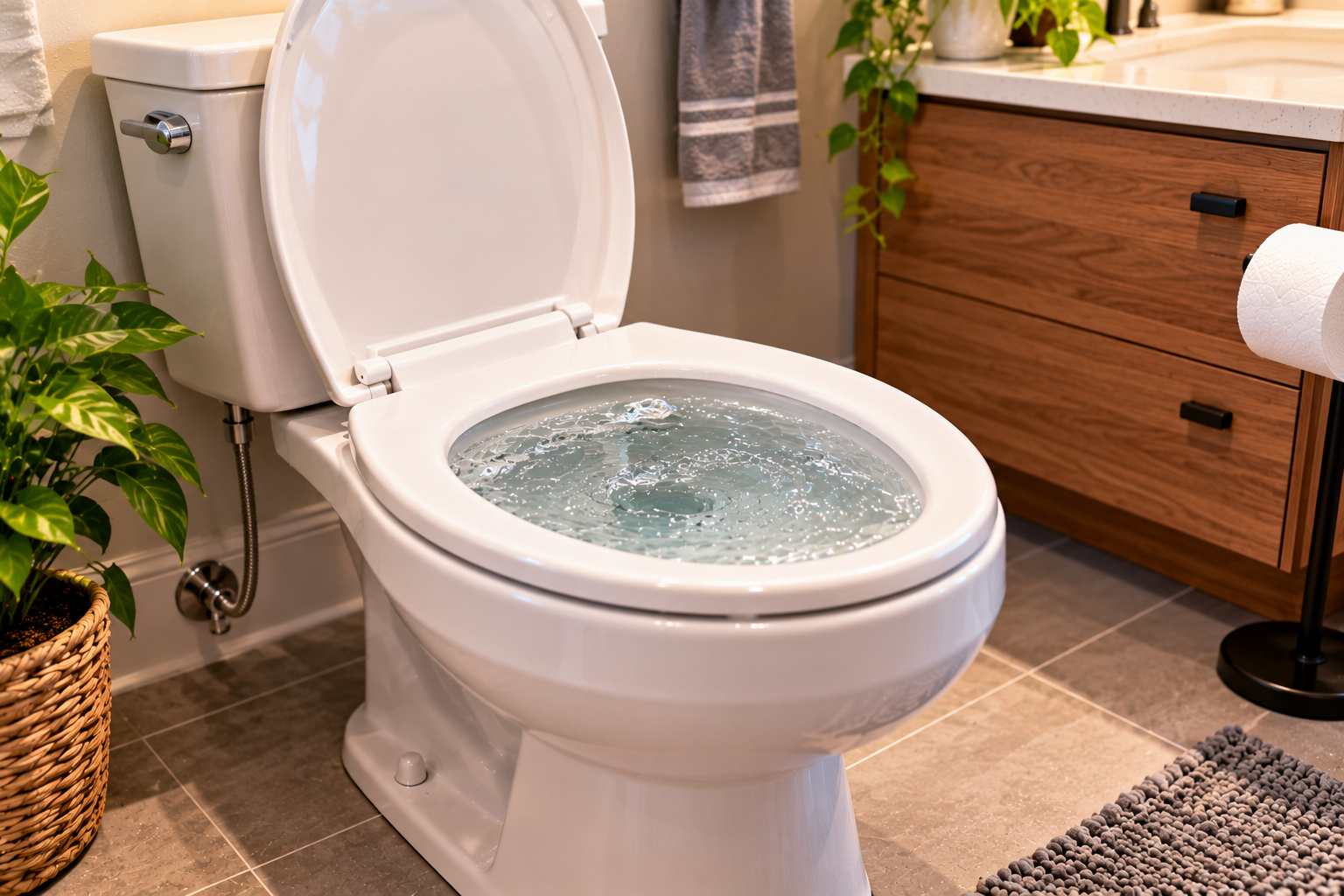

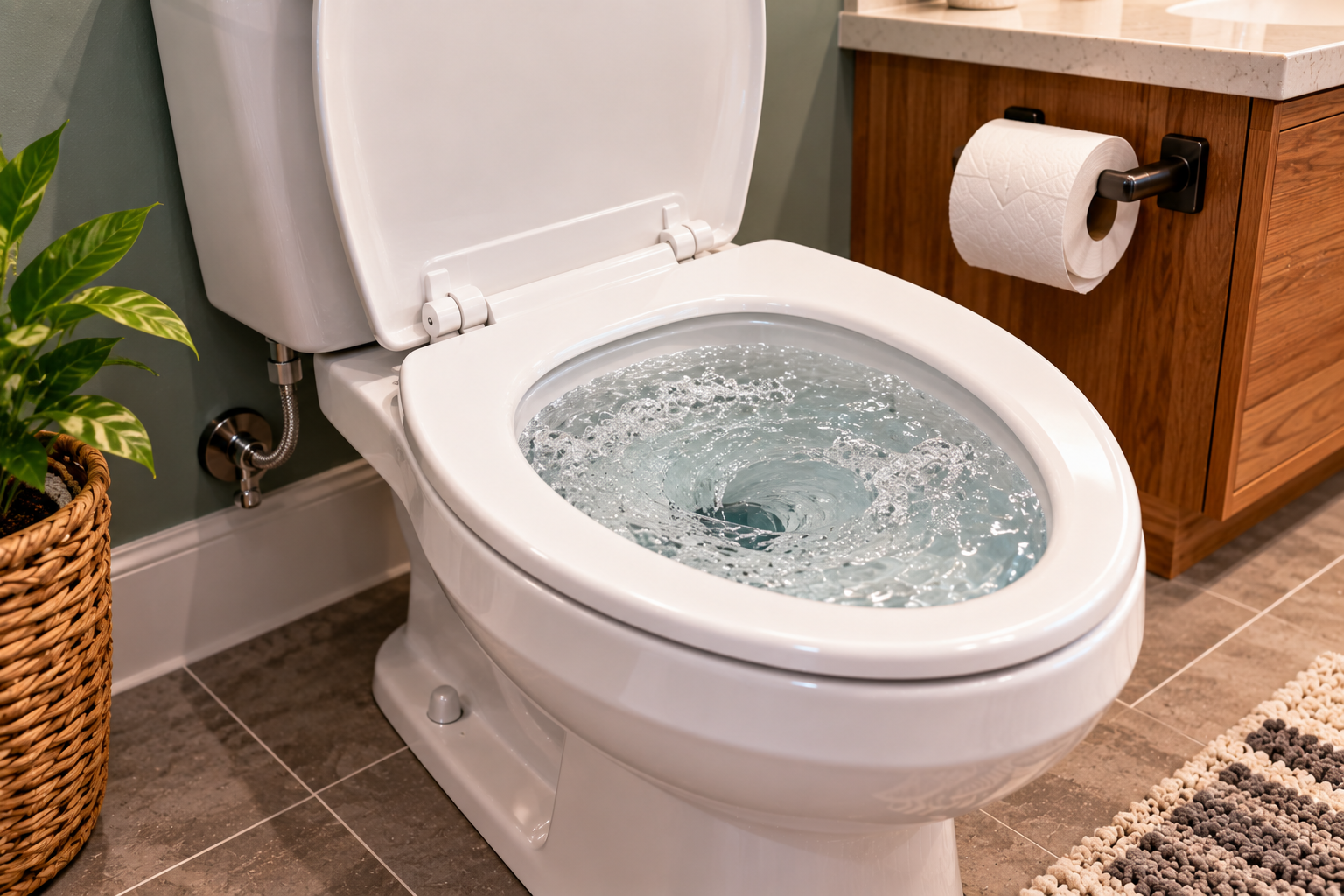
Why Does Toilet Water Rise Before Draining? If you flush and watch the bowl climb higher than usual before the water finally disappears, that uncomfortable few seconds can make you wonder if the next flush will overflow onto the bathroom floor.
A small, brief change in bowl level can occur during normal flushing, but a noticeable rise followed by slow drainage often deserves attention. Homeowners looking for Calgary toilet and drainage plumbing guidance should focus on how high the water rises, how quickly it drains and if the problem is becoming more frequent.
In Southeast Calgary communities such as Mahogany, Cranston, Copperfield, New Brighton, Auburn Bay and McKenzie Towne, this symptom can point to a partial toilet clog, restricted trapway, drain-line obstruction, poor flush performance or a broader drainage problem. The surrounding symptoms help separate a toilet-only issue from one affecting the home’s plumbing system.
Toilet water that rises unusually high before draining commonly indicates restricted flow. A partial clog in the toilet trapway or drain line is often responsible, although poor flushing performance and broader drainage problems can produce similar symptoms.
What Makes Toilet Water Rise Before It Goes Down?
A toilet depends on a fast, relatively unrestricted path through its built-in trapway and into the drainage piping. During a healthy flush, water and waste move through that pathway quickly enough to create the siphoning action that clears the bowl.
When something slows that movement, water enters the bowl faster than it can leave. The bowl level rises until enough water works past the restriction, after which it may drain slowly or suddenly drop.
1. A partial toilet clog is restricting the flush
A toilet does not have to be completely blocked to cause trouble. A partial obstruction may leave enough space for water to pass, but not quickly enough for a normal flush.
This explains the classic pattern: the bowl fills higher than expected, pauses, and then slowly drains. The next flush may behave normally or repeat the same problem depending on the position of the obstruction.
2. Something may be lodged in the toilet trapway
The curved passage built into the toilet helps maintain the water seal that blocks sewer gases from entering the bathroom. That narrow route can also trap objects or excessive material.
A restriction in the trapway can allow liquids to pass while slowing paper and waste, creating recurring high-water flushes without producing a permanent complete blockage.
3. The drain below the toilet may be restricted
If the toilet itself is clear, the restriction can be farther downstream. Buildup or an obstruction in the branch drain can slow the volume of water leaving the toilet.
This possibility becomes more important when plunging provides only temporary improvement or the toilet repeatedly returns to slow draining.
4. A weak flush can make an existing restriction more obvious
Not every high-water flush begins with a drain blockage alone. If the toilet releases insufficient water or does not generate strong flushing action, waste may not move efficiently through the trapway.
Over time, incomplete clearing can make recurring clogging more likely. The tank water level, flush mechanism and bowl-rim passages may therefore matter when drainage appears marginal rather than completely blocked.
5. A larger drainage issue may be developing
A toilet that rises before draining can occasionally be one symptom of a restriction beyond that single fixture. The strongest clue is usually that other plumbing fixtures begin behaving abnormally too.
Slow tubs or showers, gurgling drains, changing toilet-bowl levels or backup at a lower fixture should shift attention toward the shared drainage system.
6. Drain venting can affect fixture behaviour
Plumbing vents help balance pressure as wastewater moves through drainage piping. Venting problems can contribute to gurgling, unusual water movement or poor drainage behaviour.
However, a toilet that simply fills high and drains slowly is often investigated first for a physical restriction because partial clogs are a common explanation for that exact pattern.
Homeowners confirming local business information can use this Southeast Calgary plumbing map reference while reviewing service options.
How to Tell a Normal Flush From a Developing Toilet Clog
The water in a toilet bowl moves during every flush, so seeing it change level is not automatically a problem. What matters is how the flush compares with the toilet’s normal behaviour.
A sudden change in height, speed or sound is more informative than the water level by itself.
Water rises slightly, then clears fast
This may be normal for the toilet model if the bowl consistently clears strongly and returns to its usual level.
Water rises near the rim
This is more concerning and can indicate a significant restriction with an increased risk of overflow.
Water rises and drains slowly
A partial obstruction in the trapway or drain becomes a stronger possibility.
Other drains also act slowly
The problem may extend beyond the toilet and involve a shared branch or larger drainage pathway.
Watch what happens after the bowl rises
If the water rises and then drains very slowly, the drainage path is likely struggling to accept the flush volume. If it rises and suddenly drops with a strong siphon, the behaviour may be less serious, especially if it has always flushed that way.
A toilet that recently changed from fast clearing to slow clearing deserves more attention.
Listen for gurgling
Gurgling introduces another clue. Air moving through water because of restricted drainage or pressure changes can create bubbling sounds in the toilet or nearby fixtures.
If flushing one fixture makes another drain gurgle, the investigation should extend beyond the toilet bowl itself.
Check nearby fixtures
Run the bathroom sink and observe the tub or shower. Think about recent drainage changes elsewhere in the home.
A single slow toilet points more strongly toward the fixture or its branch. Several slow fixtures suggest that the affected area of the drainage system may be larger.
Notice if the toilet needs repeated flushing
A partial blockage can create a cycle in which the first flush raises the water and a later flush finally clears the bowl. Repeated flushing, however, can be risky when the bowl is already unusually high.
If the first flush approaches the rim, allowing the water to settle is safer than immediately adding another tankful of water.
If the bowl rises close to the rim and does not begin dropping, avoid repeatedly flushing the toilet. Adding more water can turn a drainage restriction into an overflow that spreads contaminated wastewater across the bathroom floor.
Scenario: a slow toilet in Cranston
A toilet that once cleared immediately now rises halfway up the bowl and takes twenty seconds to drain. The sink and shower still drain normally.
That pattern makes a toilet trapway or nearby branch restriction more likely than a house-wide drainage problem.
Scenario: toilet and shower symptoms in Copperfield
The toilet water rises before draining, and the shower has recently become slower. Flushing also causes a brief gurgle near the shower drain.
Because more than one fixture is involved, looking beyond the toilet itself becomes increasingly important.
Scenario: occasional high water in Mahogany
The toilet works normally most days but sometimes rises unusually high after heavier use. It eventually clears without overflowing.
An intermittent partial restriction can behave this way because the drainage pathway is reduced without being fully sealed off.
For additional plumbing-related media, homeowners can browse the Calgary Electrical and Plumbing YouTube resource library and this featured plumbing service video.
Request a toilet and drainage repair estimate in Calgary in just a few clicks.
Get My Free Estimate
How Much Can Toilet Drainage Repair Cost in Calgary?
The cost depends heavily on where the restriction is located. Clearing a simple toilet obstruction is different from removing a difficult object, cleaning a branch drain or investigating recurring problems farther into the drainage system.
Access also matters. A problem confined to the toilet can be simpler to diagnose than symptoms involving several fixtures or a drain that repeatedly blocks after being cleared.
| Possible Service | Typical Situation | Broad Calgary Planning Range |
|---|---|---|
| Basic toilet clog service | Accessible obstruction near the toilet trapway | $150–$250 |
| More difficult toilet blockage | Persistent obstruction requiring additional clearing work | $200–$350+ |
| Toilet removal for obstruction | Object or blockage cannot be reached through normal access | $300–$550+ |
| Branch drain clearing | Restriction extends beyond the individual toilet | $250–$500+ |
| Drain camera investigation | Recurring or difficult-to-locate drainage problem | $250–$500+ |
| Larger drainage repair | Damaged piping or more extensive obstruction discovered | Varies by findings |
These figures are broad Canadian-dollar planning ranges, not fixed quotes. Actual pricing can change with access, severity, equipment, the location of the restriction and any additional plumbing problems discovered during diagnosis.
Why recurring clogs may cost more to diagnose
A toilet that blocks once after excessive paper use presents a different situation from one that rises before draining every week. Recurring problems suggest there may be an unresolved restriction, object, fixture-performance problem or downstream drainage issue.
In that situation, simply restoring flow once may not explain why the symptom keeps returning.
Could an object be trapped inside the toilet?
Yes. Objects that do not belong in a toilet can lodge within the curved trapway. Some still allow water to move around them, creating a partial restriction instead of an immediate complete clog.
That can make the problem confusing because the toilet may occasionally flush well before becoming slow again.
Could the toilet itself be the problem?
Sometimes. An older or poorly performing toilet may not create strong enough flushing action to move waste efficiently, especially if internal passages are restricted or the tank does not deliver the intended flush volume.
However, replacing a toilet without first considering the drainage path can leave a downstream restriction unresolved.
Can low tank water cause poor flushing?
If the tank does not refill to the appropriate level, the toilet may release less water during the flush. That can weaken the action needed to clear the bowl effectively.
This differs from the previous symptom of a toilet that keeps hissing because of fill-valve or tank-water problems, although both conditions can involve the toilet’s refill system.
What if the bowl rises but then drains completely?
Complete drainage does not rule out a partial clog. A narrowed pathway can still pass water given enough time.
The important comparison is speed. If the toilet used to clear rapidly and now takes much longer, the change itself is useful diagnostic information.
What if the bowl water drops unusually low afterward?
An unusually low final water level, especially when accompanied by gurgling or symptoms at other fixtures, can justify looking beyond a basic toilet clog.
Drainage and venting conditions can affect water movement, so the full pattern should be considered rather than treating each symptom separately.
Homeowners reviewing municipal information can also consult this supplied City of Airdrie water and utility resource. For company updates, the Calgary Electrical and Plumbing Facebook page provides another online reference.
What Should You Do When Toilet Water Keeps Rising Too High?
The first priority is preventing an overflow. If the bowl has already climbed unusually close to the rim, do not keep testing it with repeated flushes.
Observe the water level and note how long it takes to drop. That information can help distinguish a temporary slow flush from a persistent restriction.
Start with the pattern, not a random repair
Think about when the problem began. Did it follow unusually heavy toilet use? Has a small object possibly entered the bowl? Has the toilet gradually become slower over several weeks?
A sudden one-time blockage and a long-term recurring restriction should not automatically be approached as the same problem.
Check if the issue is isolated to one toilet
If the home has another toilet, compare its behaviour. Also note how nearby sinks, tubs and showers drain.
Normal operation elsewhere makes a localized toilet or branch problem more likely. Multiple affected fixtures increase concern about a shared drainage route.
Do not repeatedly flush a nearly full bowl
It can be tempting to flush again because the first flush eventually went down. But a partial clog can shift, and the next tankful may arrive faster than the restricted drain can accept it.
A toilet that approaches the rim should be treated as an overflow risk until normal drainage is restored.
Be cautious with chemical drain products
Toilet blockages are not always well suited to chemical drain products, particularly when the obstruction is an object or dense material lodged in the trapway.
Harsh products can also remain in standing bowl water, creating additional concerns for anyone who later has to service the fixture.
Watch for warning signs outside the toilet
A broader drainage restriction may reveal itself through more than slow flushing. Pay attention to nearby drains and lower fixtures, especially if the problem is becoming progressively worse.
- Several fixtures are draining slowly.
- The toilet gurgles when another fixture drains.
- A shower or tub backs up after the toilet is flushed.
- The bowl repeatedly rises close to overflowing.
- The toilet improves temporarily and then blocks again.
- Water levels in the toilet change without a normal flush.
- Unusual drain odours appear alongside slow drainage.
Scenario: recurring blockage in New Brighton
A toilet is plunged successfully on Monday but begins rising again by the weekend. The repeated pattern suggests that normal flow was restored temporarily without removing the underlying restriction.
A more complete diagnosis can determine if the obstruction is within the toilet or farther down the drainage path.
Scenario: toilet water nearly reaches the rim in Auburn Bay
The bowl rises dramatically after one flush and takes more than a minute to fall. The homeowner wisely avoids flushing again.
Because the toilet is close to overflowing, the priority is clearing the restriction rather than continuing to test the fixture.
Scenario: several slow fixtures in Riverbend
The toilet is slow, the nearby tub drains poorly and gurgling can be heard when water moves through the bathroom plumbing.
This combination makes a toilet-only explanation less convincing and supports investigating the shared drainage system.
When professional drain diagnosis becomes important
A plumber should investigate when the toilet repeatedly rises high, normal clearing methods do not restore lasting flow, other fixtures are affected, an object may be trapped, or the bowl is regularly close to overflowing.
Recurring drainage problems are especially useful to diagnose before they become complete blockages.
If only one toilet is affected, start by considering the toilet and its nearby drain. If several fixtures are slow or react to one another, the restriction may be farther downstream. The pattern across the home can be as informative as the toilet itself.
Additional company activity can be found through the Calgary Electrical and Plumbing X profile, the Calgary plumbing Instagram page and this additional Calgary Maps service reference.
This supplied shared Calgary Electrical and Plumbing resource provides another company reference for homeowners researching local service information.
Request a toilet and drainage repair estimate in Calgary in just a few clicks.
Get My Free Estimate
Do Not Wait for a Slow Toilet to Become an Overflow
Toilet water that repeatedly rises higher than normal before draining is worth investigating. A partial clog may still pass water today but can become more restrictive as additional material catches at the same point.
If the bowl keeps rising, drainage is getting slower or nearby fixtures are developing symptoms, call a local calgary plumber at (403) 421-1991 for help identifying the source before the toilet stops draining completely.
Frequently Asked Questions about Toilet Water Rising Before Draining
Why does my toilet water rise high before it finally drains?
Water that rises unusually high and then drains slowly often indicates restricted flow through the toilet trapway or drain. A partial clog can still let water pass, but not quickly enough for a normal flush. Recurring high water should be investigated before a complete blockage develops.
Is it normal for toilet water to rise a little when I flush?
A brief change in bowl level can be normal for some toilets, especially if the bowl clears quickly and returns to its usual level. In Calgary homes, a new pattern of unusually high water, slow drainage or repeated near-overflows is more likely to indicate a developing problem.
Can a toilet be partially clogged even if the water eventually goes down?
Yes. A partial clog leaves enough space for water to move through slowly, so the bowl may eventually empty. The restriction can still worsen or catch additional material. Repeated slow flushes, high bowl levels and temporary improvement after plunging are useful warning signs.
Why does my toilet rise when other drains in the house are also slow?
If a toilet rises before draining while nearby tubs, showers or sinks are also slow, the restriction may extend beyond the toilet itself. Multiple affected fixtures can indicate a shared branch or larger drainage issue that should be diagnosed rather than repeatedly treating the toilet alone.
When should I call a Calgary plumber for a slow-rising toilet?
Call a Calgary plumber when the bowl repeatedly rises close to the rim, drainage keeps slowing, plunging provides only temporary relief, an object may be trapped or other fixtures are affected. These signs can indicate a persistent restriction that needs more complete diagnosis and clearing.
Don’t wait for a slow toilet to become an overflow.
Call (403) 421-1991 Now
Local Help Available 24/7 in Calgary