
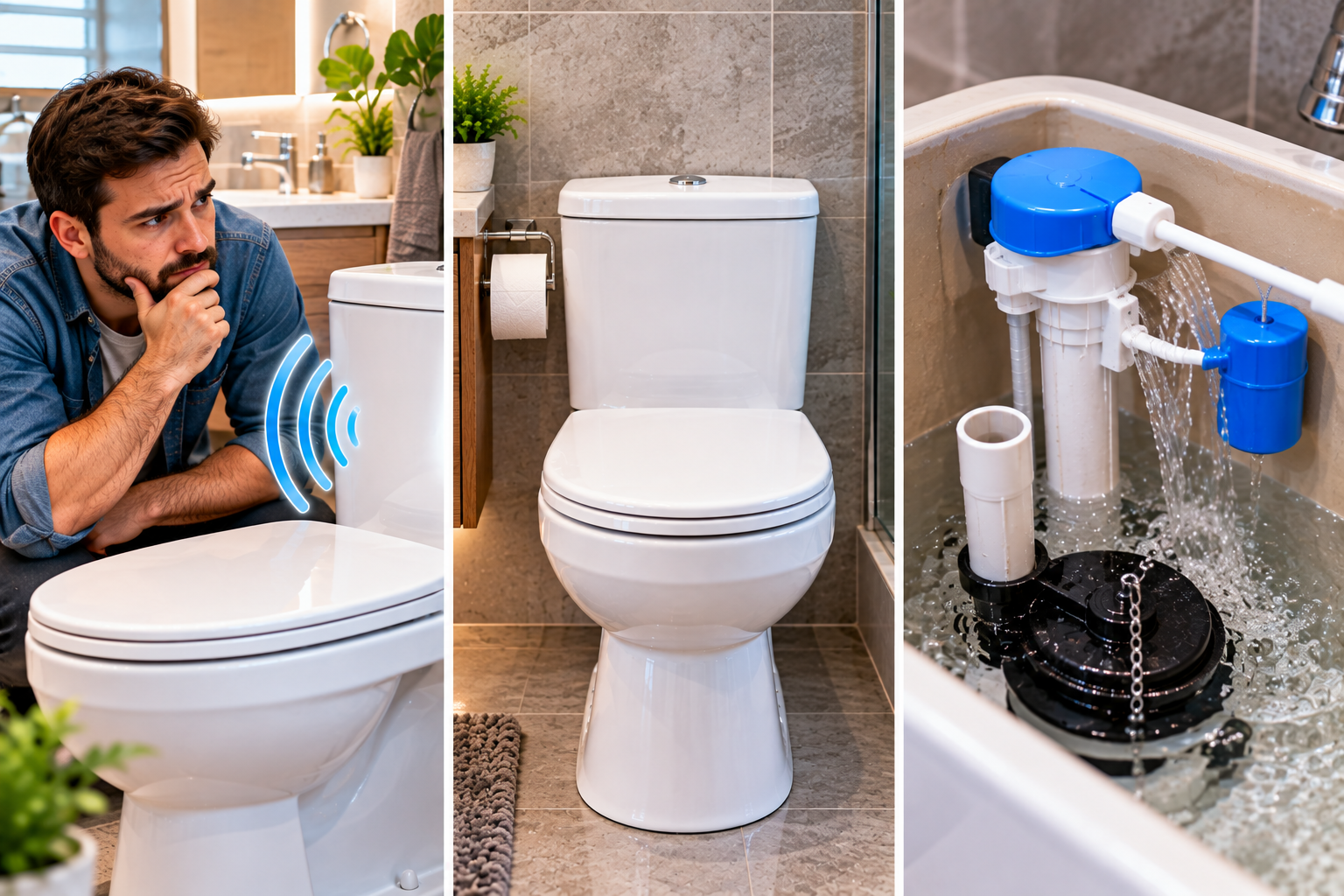
Why Does My Toilet Keep Running After It Is Flushed? If you hear water continuing long after the tank should have refilled, or the toilet suddenly starts again in the middle of the night, something is allowing water to keep moving through the tank or into the bowl.
Running toilets are common plumbing problems, but the cause can range from a worn rubber flapper to an incorrectly adjusted float or failing fill valve. Homeowners looking for Calgary toilet plumbing and repair guidance should focus first on identifying exactly how the water is escaping before replacing parts.
In Southeast Calgary communities such as Mahogany, Auburn Bay, Cranston, Copperfield, McKenzie Towne and Douglasdale, the symptom can be easy to ignore because the toilet may still flush normally. The continuing water sound, however, indicates that the tank is not completing its cycle correctly.
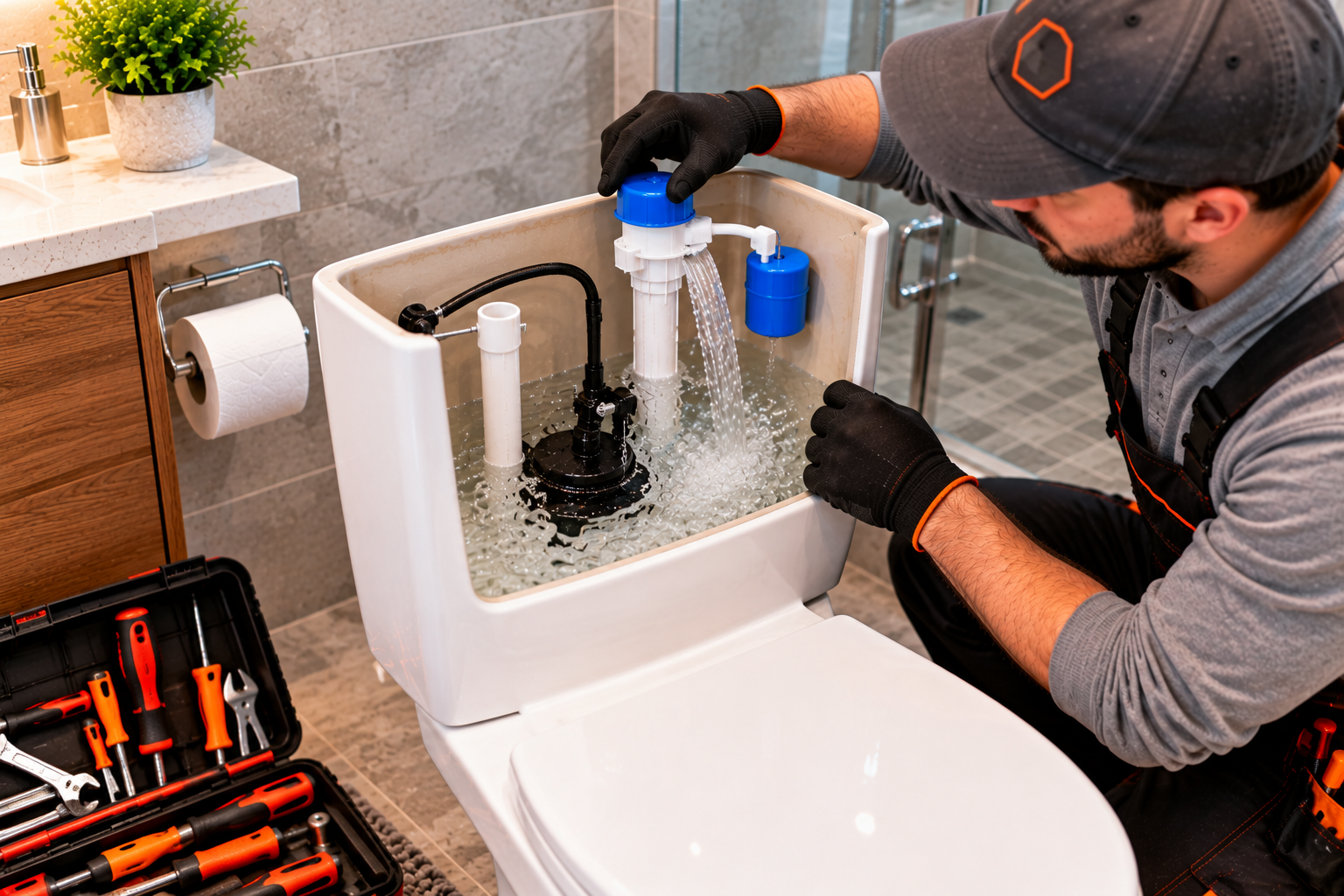
A toilet usually keeps running because the flapper is not sealing, the chain is incorrectly adjusted, the fill valve is failing, the float is set too high or water is entering the overflow tube. Identifying the exact cause prevents unnecessary parts replacement and ongoing water loss.
What Causes a Toilet to Keep Running After a Flush?
A normal toilet flush follows a simple cycle. Pressing the handle lifts the flapper or flush seal, water leaves the tank, the flapper closes, and the fill valve refills the tank until the float reaches the correct level.
If any part of that sequence fails, water can continue flowing. The sound may be constant, intermittent or so quiet that the first noticeable clue is the toilet refilling when nobody has used it.
Worn flapper
A damaged or distorted flapper cannot seal the tank opening completely, allowing water to leak slowly into the bowl.
Chain problem
A chain that is too short can hold the flapper open, while excessive slack can interfere with proper operation.
Faulty fill valve
A worn fill valve may continue supplying water after the tank has reached the intended level.
Incorrect float level
A float set too high can allow tank water to rise into the overflow tube instead of shutting the valve off.
1. The flapper is no longer sealing correctly
The flapper sits over the flush-valve opening at the bottom of many toilet tanks. During a flush it lifts to release water, then falls back into position to seal the tank.
Rubber can harden, warp or deteriorate with age. Deposits around the sealing surface can also prevent full contact. Even a small gap can allow water to leak into the bowl continuously.
2. The lift chain is too tight
The chain connects the toilet handle mechanism to the flapper. It should have enough slack for the flapper to close fully after flushing.
If the chain is too short, it may keep the flapper slightly raised. Water then escapes through the flush valve, causing the fill valve to keep replacing it.
3. The chain has too much slack or becomes tangled
Too much chain can also cause trouble. Excess chain may become trapped beneath the flapper or wrap around another component inside the tank.
A toilet may run only occasionally if the chain interferes with the seal on some flushes but not others.
4. The fill valve is worn or sticking
The fill valve controls incoming water after each flush. Once the correct tank level is reached, the valve should shut off.
A worn or sticking mechanism can continue allowing water into the tank. Depending on the failure, you may hear constant filling, hissing or repeated cycling.
5. The float is set too high
The float tells the fill valve when the tank has enough water. If the setting is too high, the water level can reach the overflow tube before the valve shuts off.
The excess water then drains into the bowl while the fill valve continues trying to reach its shut-off point.
6. Water is entering the overflow tube
Remove the tank lid carefully and observe the water level after the toilet finishes filling. If water is flowing over the top of the overflow tube, the problem usually relates to the fill level or fill-valve operation.
This is different from a flapper leak, where water escapes through the bottom of the tank.
7. The flush-valve sealing surface is damaged
Sometimes replacing the flapper does not stop the running because the surface beneath it is damaged, deteriorated or heavily affected by deposits.
The new flapper cannot create a reliable seal against an uneven surface, so water continues passing into the bowl.
Homeowners who want to confirm local service information can review this Calgary plumbing service location reference.
How Can You Tell Which Running-Toilet Part Is Failing?
The sound alone does not always identify the failed component. A better diagnosis comes from observing what happens inside the tank and noting when the toilet begins running.
Continuous running immediately after every flush
If the toilet never stops filling after a flush, look first at the water level, fill valve, float and overflow tube. Water visibly spilling into the overflow tube strongly points toward a filling or adjustment problem.
If the water level remains below the overflow but the toilet continues filling, leakage through the flapper or flush valve becomes more likely.
The toilet stops and then starts again later
A toilet that becomes quiet and unexpectedly refills several minutes later is often losing tank water slowly. As the level drops, the fill valve opens to restore it.
A worn flapper or another leaking flush-valve seal is a common explanation for this repeated cycling.
The handle needs to be moved before the toilet stops
If jiggling the handle makes the water stop, inspect the handle arm and chain relationship. The mechanism may be preventing the flapper from returning naturally to its closed position.
This symptom can sometimes be corrected through adjustment, but damaged handle or flush components may need replacement.
You hear a quiet hissing sound
A persistent hiss can indicate water passing through the fill valve or slowly entering the tank. The exact source should be confirmed rather than assuming that every hissing toilet needs the same part.
Observe the water level and look for movement around the overflow tube and fill-valve outlet.
The tank water level keeps dropping
If the supply is temporarily shut off and the water level in the tank falls without a flush, water is escaping somewhere. The flapper and flush-valve sealing area become important inspection points.
A plumber can distinguish a simple flapper problem from a more involved flush-valve issue when the source is unclear.
| What You Notice | Possible Cause | Useful Clue | Typical Direction |
|---|---|---|---|
| Water runs continuously | Fill valve or float setting | Water may reach the overflow tube | Adjustment or component repair |
| Toilet periodically refills by itself | Flapper or flush seal | Tank slowly loses water between cycles | Inspect sealing components |
| Running stops when handle is moved | Chain or handle mechanism | Flapper may not be returning correctly | Adjustment or hardware repair |
| Water flows into overflow tube | Float or fill valve | Tank water level is too high | Adjust level or service valve |
| New flapper does not solve problem | Flush-valve seat or incompatible part | Seal remains incomplete | Further inspection required |
Scenario: a toilet that refills every ten minutes in Mahogany
The toilet becomes completely quiet after flushing but suddenly refills later. Because the tank initially reaches the correct level and the fill valve shuts off, attention shifts toward water escaping from the tank between cycles.
A worn flapper or flush-valve sealing problem would be more likely than simply adjusting the float.
Scenario: nonstop water in Cranston
Another toilet keeps filling from the moment it is flushed. Looking inside the tank shows water spilling directly into the overflow tube.
In that situation, the float adjustment and fill valve deserve attention before replacing the flapper.
Scenario: jiggling the handle works in Copperfield
If the toilet stops only after the handle is moved, the handle arm or chain may be interfering with the flapper. This can explain why the problem appears after some flushes but not others.
The mechanism should operate freely without holding the seal open.
For additional plumbing-related visual information, homeowners can visit the Calgary plumbing video library or view this local plumbing service video resource.
Request a running toilet repair estimate in Calgary in just a few clicks.
Get My Free Estimate
How Much Can It Cost to Repair a Running Toilet in Calgary?
The cost depends on what is actually failing. A chain adjustment or straightforward tank component can involve a smaller repair than replacing a complete flush-valve assembly or addressing several deteriorated parts at once.
Diagnosis is particularly useful on older toilets because replacing one inexpensive part repeatedly without identifying the true source can cost more over time.
| Running-Toilet Problem | Typical Work | Broad Calgary Planning Range |
|---|---|---|
| Simple adjustment | Float, chain or minor mechanism correction | $150–$225 |
| Flapper or simple seal problem | Inspection and replacement of failed sealing component | $150–$250 |
| Fill valve problem | Fill-valve replacement and adjustment | $175–$300 |
| Multiple tank components | Several internal components serviced together | $225–$400+ |
| Flush-valve assembly issue | More involved tank disassembly and repair | $250–$450+ |
| Older toilet with recurring failures | Repair versus replacement evaluation | Varies by fixture condition |
These are broad Canadian-dollar planning ranges rather than fixed quotes. Toilet design, required parts, accessibility, service conditions and additional plumbing problems can change the final cost.
Can a running toilet increase water use?
Yes. The tank may continually replace water that is escaping into the bowl, meaning the toilet can consume water even when nobody is using it.
The amount depends on the severity and type of leak. A barely noticeable seal failure and a fill valve sending water continuously into the overflow tube will not necessarily waste water at the same rate.
Why intermittent running should not be dismissed
A toilet does not need to run continuously to have a problem. Repeated refilling every few minutes or every hour can indicate that tank water is escaping slowly.
This type of problem can be particularly easy to miss in a guest bathroom or basement bathroom that receives little daily use.
Does the whole toilet need replacement?
Usually not when the problem is limited to a flapper, fill valve, float or another accessible tank component. These parts are intended to be serviceable.
Replacement becomes more relevant when the toilet has structural damage, poor performance, repeated clogs or a history of multiple repairs.
Homeowners with an aging fixture can compare those factors in this guide on deciding between repairing and replacing an older toilet.
Can a new flapper still leak?
Yes. A replacement flapper must be compatible with the toilet and sit correctly on the flush-valve opening. The chain also needs appropriate slack.
If the sealing surface is damaged or covered by deposits, replacing the rubber component alone may not solve the leak.
What if the fill valve was recently replaced?
A newer valve can still be incorrectly adjusted, affected by debris or installed with the float setting too high. The presence of a recently installed part does not automatically eliminate it from diagnosis.
Observe where the water is going before assuming another component has failed.
Can water pressure contribute to toilet problems?
The tank’s internal components control normal filling, so most running-toilet complaints trace back to those mechanisms. Unusual supply conditions can still affect how some fill valves behave.
If the same home has unusual water behaviour at several fixtures, a broader plumbing assessment may be appropriate instead of treating the toilet as an isolated problem.
Water going over the overflow tube generally points toward the fill side of the system. Water disappearing through the bottom of the tank when the level is below the overflow points more strongly toward the flapper, flush seal or flush-valve area.
For additional regional water information, homeowners can review the supplied City of Airdrie water-related reference document. Local company updates can also be found through the Calgary plumbing Facebook page.
What Should You Do When Your Toilet Will Not Stop Running?
A running toilet is easier to diagnose when you observe the sequence rather than immediately changing components. Remove the tank lid carefully, flush once and watch how the mechanism behaves from beginning to end.
Pay attention to which part moves, where the water level stops and how water continues moving after the tank should be full.
Check whether the flapper closes completely
After flushing, the flapper should return to the valve opening without being held up by the chain. Look for visible gaps, distortion or anything caught beneath the seal.
A flapper that does not sit flat can allow a surprisingly small but continuous stream of water into the bowl.
Look at the chain position
The chain should have enough slack to allow full closure without so much extra length that it becomes trapped under the flapper.
If the handle feels unusual or the flapper remains raised after flushing, the chain and handle arm should be checked together.
Observe the tank water level
Allow the tank to refill and watch where the water stops. Water should not continue pouring over the overflow tube.
If it does, the float setting or fill valve is a more likely cause than a simple flapper leak.
Listen after the toilet becomes quiet
Stay nearby for several minutes. A toilet that appears fixed immediately after flushing may begin filling again once enough tank water leaks away.
This delayed refill pattern is a valuable clue when diagnosing an intermittent running problem.
Do not repeatedly force the handle
Jiggling the handle can temporarily allow a flapper to reseat, but it does not correct the component or adjustment causing the problem.
Repeated force can also place unnecessary stress on the handle assembly and chain.
Know where the toilet shut-off valve is
The shut-off valve is normally located on the water-supply line near the toilet. Knowing its location is useful if a tank component fails more significantly or the toilet begins overflowing for another reason.
An older or seized valve should not be forced. A valve that does not operate properly may itself require service.
Check for water outside the toilet
A running sound inside the tank is different from an external leak. If water is appearing around the toilet base, supply connection or tank bolts, the problem requires a different inspection.
External leakage can affect flooring and surrounding materials, so it should not be treated as an ordinary running-toilet symptom.
Scenario: the guest-bathroom toilet in Seton
A toilet used only occasionally begins refilling several times overnight. The tank reaches its correct level after every cycle, but the water level slowly drops.
That pattern directs attention toward a tank-to-bowl leak rather than simply increasing or decreasing the float setting.
Scenario: a constantly hissing toilet in Auburn Bay
In another home, water can be seen flowing into the overflow tube continuously. Adjusting or servicing the fill mechanism is more relevant than immediately replacing the flapper.
Observing the water path makes the diagnosis far more targeted.
Scenario: several tank parts are deteriorating in Riverbend
An older toilet has a worn flapper, corroded hardware and an unreliable fill valve. Repair is still possible, but the homeowner should compare the combined work with the age and overall condition of the fixture.
This prevents repeated service calls for one aging component after another.
When should a plumber inspect a running toilet?
Professional diagnosis is useful when the source is unclear, replacement parts have not solved the problem, the shut-off valve does not work, the flush-valve assembly needs service or external leakage is present.
It is also worth getting the entire fixture assessed when an older toilet has several simultaneous problems.
- The toilet runs continuously after every flush.
- It repeatedly refills when nobody has used it.
- Water constantly enters the overflow tube.
- A new flapper has not stopped the leak.
- The fill valve does not shut off reliably.
- The toilet also leaks externally.
- The shut-off valve cannot be operated normally.
- Several tank components appear worn or corroded.
Additional company and local-service references are available through the Calgary plumbing Instagram profile, Calgary Electrical and Plumbing Reddit profile and this additional Calgary Maps listing.
A further supplied business reference is available through this shared Calgary Electrical and Plumbing resource.
Request a running toilet repair estimate in Calgary in just a few clicks.
Get My Free Estimate
Stop the Running by Fixing the Actual Cause
A toilet that keeps running is usually telling you that water is escaping or the tank’s filling mechanism is not shutting down correctly. Finding the actual cause—rather than repeatedly replacing random parts—can restore normal operation and prevent unnecessary water use.
If the problem keeps returning or the failed component is unclear, call a local calgary plumber at (403) 421-1991 for professional help diagnosing and repairing the running toilet.
Frequently Asked Questions about Running Toilets
Why does my Calgary toilet keep running after every flush?
A Calgary toilet may keep running because its flapper is not sealing, the chain is holding the flapper open, the fill valve is failing or the float is set too high. Checking where the water continues flowing helps identify which component needs attention.
Why does my toilet stop running and then start again later?
A toilet that becomes quiet and later refills is often losing water slowly from the tank into the bowl. A worn flapper or another flush-valve sealing problem can lower the tank level until the fill valve automatically opens again.
Can a bad flapper make a toilet run continuously?
Yes. A warped, deteriorated or incorrectly seated flapper can prevent the tank from sealing after a flush. Water then escapes into the bowl, and the fill valve continues replacing it. The flapper and its sealing surface should both be inspected.
Why is water constantly flowing into my toilet’s overflow tube?
Water entering the overflow tube usually means the tank level is too high or the fill valve is not shutting off correctly. In Calgary homes, checking the float setting and fill-valve operation can help distinguish this problem from a leaking flapper.
When should I call a plumber for a running toilet in Calgary?
Call a Calgary plumber when the cause is unclear, adjustments do not stop the running, replacement parts keep failing, the shut-off valve does not operate correctly or water is leaking outside the fixture. Older toilets with several problems may also need a broader assessment.
Don’t let a continuous toilet leak keep wasting water.
Call (403) 421-1991 Now
Local Help Available 24/7 in Calgary