

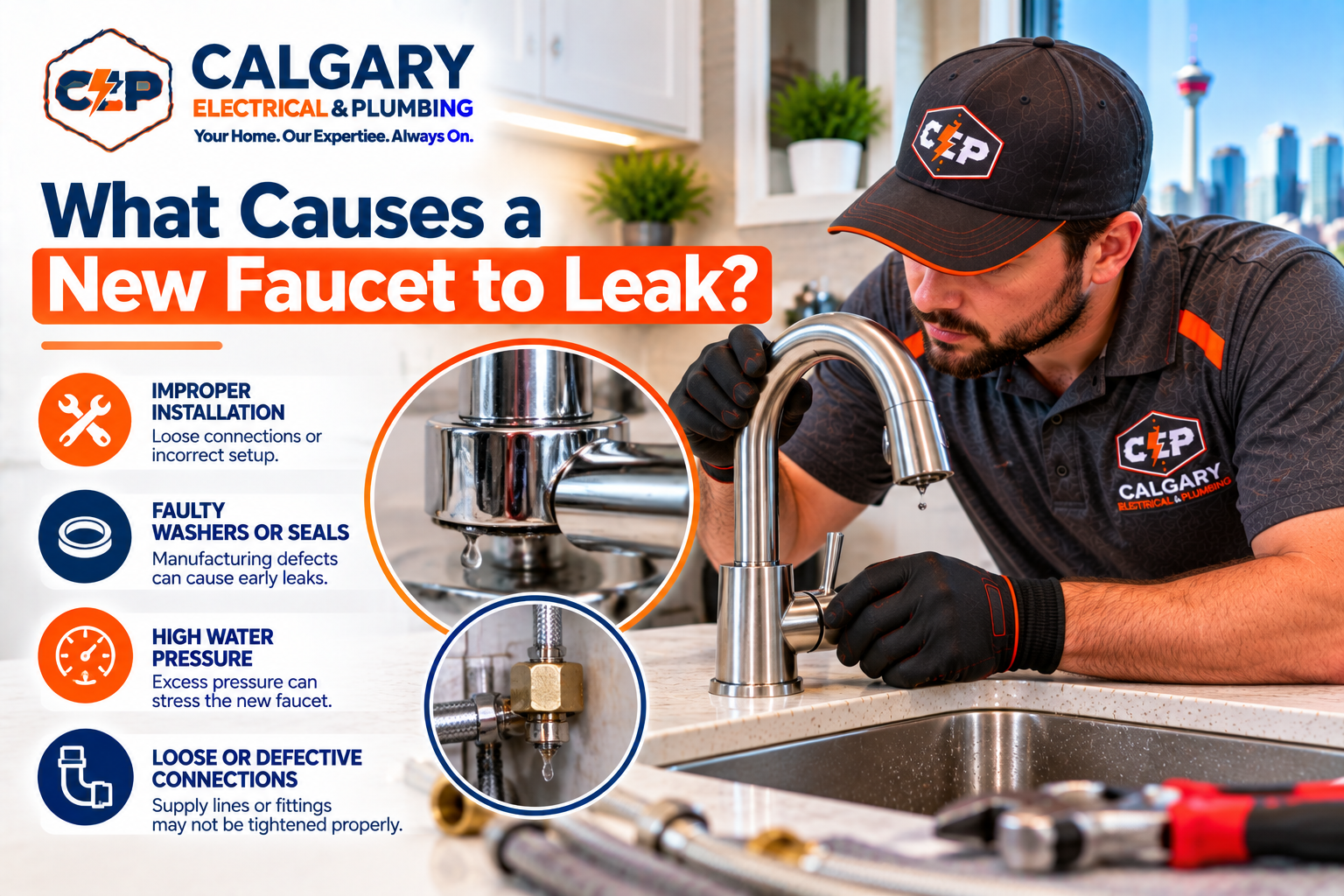
What causes a new faucet to leak? It is frustrating to replace an old fixture, enjoy the clean new installation, and then discover droplets around the faucet base, beneath the sink or from the spout. A new fixture can still leak when a seal, connection, cartridge or installation detail is not working as intended.
For homeowners trying to understand a leak after installation, Calgary faucet and plumbing repair support can help separate a faucet defect from an installation or existing plumbing problem. Finding the exact origin matters because water seen at the base may actually have travelled from another connection.
This can happen in newer homes around Seton and Mahogany just as easily as in established properties in Acadia, Riverbend or Douglasdale. The important question is not simply how old the faucet is, but where the water first appears and what happens immediately before the leak begins.
A new faucet may leak because of loose connections, incorrectly seated seals, damaged O-rings, cartridge problems, supply-line issues, installation errors or a defective component. Identifying the exact starting point of the water is the fastest way to narrow down the repair.
Why Can a Newly Installed Faucet Leak?
People often associate faucet leaks with old washers, worn cartridges and years of use. Those are common causes in older fixtures, but a new faucet introduces another set of possibilities because the fixture has recently been assembled and connected to the home’s plumbing.
Some problems appear immediately. Others show up after several days of normal use as connections settle, seals are exposed to water pressure and small installation issues become visible.
1. A connection is not sealed correctly
A faucet depends on several watertight connections. Depending on the design, these may include hot and cold supply lines, threaded fittings, quick-connect components, spray-hose connections and shut-off valve connections.
If a fitting is loose, misaligned or improperly seated, a small amount of water can escape each time the faucet is used. The moisture may collect beneath the cabinet before the homeowner notices anything above the sink.
2. An O-ring or gasket is not seated properly
New faucets use seals to keep water inside specific passages and connections. If an O-ring, gasket or rubber seal twists during assembly, sits unevenly or becomes pinched, the connection may not seal completely.
A seal can also be damaged during installation. Because these parts are small, the faucet can look perfectly installed from the outside while a hidden seal allows water to escape.
3. A supply line is loose or damaged
Water appearing beneath a new faucet does not always mean the faucet body is defective. The leak may originate where a flexible supply line connects to the faucet or shut-off valve.
A line can also become twisted or stressed during installation. Moisture may then run along the hose before dripping onto the cabinet floor, making the source appear farther away than it really is.
4. The faucet cartridge has a problem
A cartridge controls water flow and temperature in many modern faucets. Although cartridges are commonly associated with older faucet repairs, a new fixture can occasionally have a cartridge that is incorrectly seated, damaged or otherwise not sealing as intended.
A cartridge-related issue may cause dripping from the spout after shutoff or water around the handle area.
5. Installation debris entered the faucet
When water is turned off and restored during plumbing work, small particles can sometimes move through the lines. Debris reaching the faucet may interfere with an aerator, cartridge or another small internal component.
This may cause unusual flow, poor shutoff, dripping or other symptoms soon after installation. The timing can make it look as though the new fixture itself failed.
6. A threaded connection was assembled incorrectly
Some faucet and plumbing connections rely on threads, washers or manufacturer-specific sealing methods. A connection that is cross-threaded, overtightened, insufficiently tightened or assembled with the wrong sealing method may leak.
More tightening is not always the solution. Overtightening can deform washers, damage threads or stress fittings.
7. The leak is coming from existing plumbing
Installing a faucet requires working around existing shut-off valves, supply connections and sink plumbing. An older valve or connection may begin leaking after it has been operated during the installation.
This is especially relevant in established Calgary homes where the faucet is new but the valves and surrounding plumbing may be many years older.
8. The faucet or one of its components is defective
Manufacturing defects are less common than connection and installation issues, but they can occur. A damaged casting, faulty hose, defective cartridge or malformed seal can allow a brand-new fixture to leak.
The goal should be to confirm the defective component before assuming the entire faucet must be replaced.
Calgary homeowners checking service information and coverage can view the company’s Calgary plumbing location and business details.
Where Is the Water Actually Coming From?
Finding the first point where water appears is more useful than simply noticing where it eventually collects. Water can travel along the faucet body, mounting hardware, hoses and cabinet surfaces before it forms a visible drip.
Water dripping from the spout after shutoff
If the faucet continues dripping from the spout after the handle is fully closed, attention usually shifts toward the components responsible for stopping water flow.
A cartridge, valve component or internal seal may not be closing correctly. Debris inside a new faucet can sometimes interfere with proper shutoff as well.
Water around the faucet base
Moisture around the base can have several explanations. Water may be escaping from inside the faucet body, around a seal, from the handle area or simply running down from normal sink splashing.
Drying the area completely and observing when moisture returns helps distinguish a plumbing leak from water that reached the base during ordinary use.
Water beneath the sink
A leak inside the cabinet deserves quick attention because it can go unnoticed between uses. Supply connections, spray hoses, quick-connect fittings and shut-off valves are common areas to inspect.
Look at the highest point where fresh moisture appears. The puddle at the bottom of the cabinet is rarely enough to identify the source by itself.
Water near the handle
Water emerging around a faucet handle can indicate an internal seal or cartridge issue. The leak may happen only while the water is running because pressure inside the faucet changes when the valve opens.
That operating pattern is valuable information when diagnosing a newly installed fixture.
Water from a pull-down or pull-out hose
Modern kitchen faucets often include flexible spray hoses and connection fittings below the sink. A loose connection or hose problem may release water only when the sprayer is used or moved.
Because the hose moves, water may drip in different locations inside the cabinet and make the source difficult to identify at first glance.
| Where Water Appears | Possible Source | Useful Diagnostic Clue |
|---|---|---|
| From the spout after shutoff | Cartridge, valve or internal seal | Dripping continues with handle fully closed |
| Around the faucet base | Seal, internal leak or water travelling from above | Area becomes wet during faucet operation |
| Under the sink | Supply line, valve, hose or fitting | Fresh moisture appears at a connection |
| Around the handle | Cartridge or internal sealing component | Leak may increase while water is running |
| Near the sprayer hose | Hose or quick-connect fitting | Leak changes when sprayer is operated |
Scenario: a new kitchen faucet leaks only during use
Imagine a homeowner in Mahogany installs a new pull-down kitchen faucet. The cabinet remains dry overnight, but water appears beneath the sink whenever dishes are washed.
That timing suggests checking components that carry water only while the faucet is operating, such as supply connections, the spray hose and related fittings.
Scenario: a new faucet drips overnight
In a Cranston home, a recently installed bathroom faucet looks dry around the base and beneath the sink, yet a drop keeps forming at the spout long after use.
That pattern shifts attention toward the internal shutoff mechanism rather than the mounting connection beneath the fixture.
Scenario: moisture appears around the base
A homeowner in McKenzie Towne notices a ring of water around the new faucet base. Before assuming the mounting seal has failed, it is useful to dry the entire fixture and determine if the water begins around the handle, spout or another point.
Water travelling across the faucet can create a misleading puddle at the base.
Homeowners who want more plumbing maintenance information can browse the Calgary plumbing video library or view this faucet service video resource.
Request a new faucet leak repair estimate in Calgary in just a few clicks.
Get My Free Estimate

Can a New Faucet Be Repaired Instead of Replaced?
Yes. A leak soon after installation does not automatically mean the entire faucet needs to be removed and discarded. Many new-faucet problems involve a connection, seal or replaceable component rather than the main faucet body.
The appropriate decision depends on the source of the leak, condition of the fixture and availability of the correct parts.
Connection problems can often be corrected
If a supply line or manufacturer-specific fitting is not seated properly, correcting the connection may solve the leak without replacing the fixture.
The connection should still be inspected carefully. Repeatedly tightening fittings without understanding how they seal can damage washers, threads or connectors.
Cartridge problems may be repairable
If a new faucet drips from the spout or leaks around the handle, the cartridge may need inspection. Depending on the fixture, the cartridge can sometimes be reseated or replaced while the faucet body remains installed.
Brand and model identification matters because faucet cartridges and internal parts are not universal.
Damaged seals can often be replaced
An incorrectly seated or damaged O-ring, gasket or washer may be replaceable. The correct component must match the fixture and be installed in the intended position.
A plumber can also check for an underlying reason the seal failed instead of simply installing another one.
A defective faucet body may require replacement
If water is escaping through a damaged or defective section of the faucet body itself, replacing the fixture may be more practical than attempting a repair.
This is also a situation where the manufacturer’s warranty may be relevant, particularly when the fixture is genuinely new and the defect can be documented.
Existing shut-off valves may need separate repair
Sometimes the faucet is functioning correctly but an older shut-off valve begins leaking after being operated during installation. Replacing the brand-new faucet again would not solve that problem.
The leaking valve or connection needs to be identified separately from the new fixture.
How much can repair cost?
Costs vary because a loose accessible connection requires very different work from replacing a shut-off valve or diagnosing a hidden leak. Faucet brand, parts, accessibility and the condition of the existing plumbing all affect the total.
| Possible Service | Approximate Calgary Planning Range | Typical Factors |
|---|---|---|
| Faucet leak diagnosis or minor adjustment | $150–$250 | Access, connection type and service time |
| Cartridge, seal or internal faucet repair | $180–$350 | Brand, part availability and faucet design |
| Supply line or connection repair | $175–$350+ | Condition of fittings, lines and shut-off valves |
| Shut-off valve repair or replacement | $200–$450+ | Valve condition, accessibility and surrounding plumbing |
| Standard faucet replacement | $250–$650+ | Fixture style, sink access and required modifications |
Pricing note: These figures are broad Canadian-dollar planning ranges rather than fixed quotes. The actual price depends on the leak source, faucet design, parts, accessibility, existing plumbing and any additional work discovered during inspection.
Repair may make sense when:
- The faucet body is in good condition.
- The leak comes from an accessible connection.
- A replaceable cartridge, seal or hose is responsible.
- The required component is readily available.
- The surrounding plumbing is otherwise sound.
Replacement may make more sense when:
- The faucet body itself is defective or damaged.
- The fixture has multiple manufacturing problems.
- Correct replacement parts cannot be obtained.
- A warranty replacement is available.
- Repair would approach the cost of installing a suitable replacement.
If a complete replacement becomes necessary, homeowners can read about typical professional faucet replacement timing in Calgary and the conditions that can make an installation take longer.
What if the faucet was professionally installed?
A leak should still be investigated. Even carefully installed fixtures can have a defective component, unexpected connection problem or issue in the existing plumbing that becomes apparent after the water is restored.
The useful question is where the leak originates rather than assuming the fixture or installer is automatically responsible.
What if the faucet was installed months ago?
A faucet does not need to leak on the first day for the problem to be related to a connection or component. Small leaks can become noticeable gradually as seals move, fittings experience normal use or components begin showing a defect.
Document when the leak was first noticed and how it behaves during operation.
Additional local updates and plumbing information are available through the company’s Calgary home plumbing updates on Facebook.
How Can Future Faucet Leaks Be Prevented?
Good faucet performance begins with proper installation, but homeowners can also reduce the chance that a small problem goes unnoticed. Early observation is especially important during the first days after a new fixture is installed.
Check beneath the sink after installation
A cabinet can hide a slow leak for days or weeks. After a new faucet is installed, occasionally inspect the supply connections, shut-off valves, spray hose and cabinet floor for fresh moisture.
A dry paper towel placed against a suspected connection can make a very small amount of moisture easier to notice during an inspection.
Watch the faucet during operation
Some leaks appear only when water is flowing. Run both hot and cold water and observe the faucet body, handle, base and visible connections.
For a pull-down kitchen faucet, use the spray head and move the hose through its normal range. A hose-related leak may not appear when the faucet remains stationary.
Do not ignore a single drop beneath the cabinet
A slow drip may seem minor, but repeated moisture can affect cabinet materials and nearby finishes. More importantly, the drip confirms that a connection or component is not completely watertight.
Finding the source early is usually easier than diagnosing it after water has spread across several surfaces.
Avoid excessive tightening
When homeowners see a leaking connection, the natural response is often to tighten it as much as possible. Plumbing connections are not all designed to seal through extreme tightening.
Too much force can deform a gasket, damage threads or crack a component. The connection method should match the fixture manufacturer’s design.
Pay attention to older shut-off valves
Installing a new faucet does not renew the valves beneath the sink. If an older valve is stiff, corroded, difficult to close or already showing moisture, it may deserve attention while faucet work is being performed.
This is especially useful in older Southeast Calgary properties where the fixture may have been updated several times while some supply components remain original.
Know the difference between condensation, splashing and a leak
Not every drop near a faucet comes from a failed plumbing connection. Water can splash around the sink deck during normal use, and moisture can occasionally appear on cold plumbing surfaces under certain conditions.
Dry the area thoroughly, operate the faucet normally and observe exactly where fresh water first forms.
Keep faucet documentation
Retaining the model number, installation information and warranty documents can make future repairs easier. Faucets that look similar may use different cartridges, seals, hoses and connection systems.
Correct identification reduces guesswork when a replacement component is required.
Scenario: a Seton kitchen cabinet develops moisture
A homeowner notices dampness under a recently renovated kitchen sink several days after a new faucet was installed. The faucet base remains dry, and no water drips from the spout.
That pattern makes the under-sink connections, hoses and valves more important to inspect than the visible faucet body.
Scenario: a new faucet leaks around the handle
In an Auburn Bay bathroom, water appears around the handle only while the faucet is running. Once the water is turned off and the fixture is dried, no new moisture appears.
The operating pattern suggests an internal faucet component or seal should be inspected rather than focusing only on the supply lines beneath the sink.
Scenario: the faucet itself is dry but the valve drips
In an older Acadia home, the new faucet works correctly, but an existing shut-off valve begins dripping after being opened following installation.
Although the timing makes the problem seem like a new-faucet leak, the actual repair belongs to the older plumbing component.
- Where does fresh water first appear?
- Does the leak occur constantly or only while the faucet runs?
- Does it happen with hot water, cold water or both?
- Does using the pull-down sprayer change the leak?
- Are the shut-off valves or supply lines wet?
- How soon after installation did the problem begin?
When should a plumber inspect a new faucet leak?
Professional diagnosis is sensible when the leak source is unclear, water is collecting inside cabinetry, a shut-off valve is leaking, the faucet continues dripping after shutoff or an internal component appears defective.
It is also useful when repeated adjustments have not stopped the leak. Continuing to tighten or dismantle components without identifying the actual cause can create additional damage.
Why leak location matters more than faucet age
A fixture being new does not eliminate ordinary plumbing principles. Water still follows pressure, gravity and the path of least resistance. A small leak can travel before becoming visible.
Tracing the water to its highest fresh point often provides better information than focusing on the puddle where it eventually lands.
Request a new faucet leak diagnosis and repair estimate in Calgary in just a few clicks.
Request My Faucet Estimate
A New Faucet Should Not Be a New Source of Water Damage
A recently installed faucet can leak because of a connection, seal, cartridge, hose, valve, installation issue or defective component. Finding where the water actually starts makes it much easier to choose between a simple adjustment, targeted repair or replacement.
If your new fixture continues leaking, call a local calgary plumber at (403) 421-1991 to have the source checked before repeated moisture affects the surrounding area.
Frequently Asked Questions about New Faucet Leaks
Why would a brand-new faucet start leaking?
A new faucet can leak because of a loose connection, incorrectly seated gasket, damaged O-ring, cartridge problem, supply-line issue or defective component. In Calgary homes, existing shut-off valves and older connections should also be checked because the new fixture may not be the actual source.
Why is my new faucet leaking underneath the sink?
Water beneath a newly installed faucet often comes from a supply-line connection, spray hose, quick-connect fitting or shut-off valve. Because water can travel along hoses and fittings before dripping, Calgary homeowners should identify the highest point where fresh moisture first appears.
Can a new faucet cartridge cause a leak?
Yes. A new faucet can have a cartridge that is incorrectly seated, damaged or not sealing properly. Cartridge problems may cause dripping from the spout or moisture around the handle, although the exact symptoms depend on the faucet design and where the seal is failing.
Should a leaking new faucet be repaired or replaced?
Repair may be practical when the problem is a connection, replaceable seal, hose or cartridge. Replacement may make more sense if the faucet body is defective, several components are faulty or warranty coverage provides a new fixture. A Calgary plumber can first identify the leak source.
When should I call a plumber about a new faucet leak in Calgary?
Arrange professional help when water is collecting beneath the sink, the source cannot be identified, a shut-off valve is leaking, the faucet keeps dripping after shutoff or previous adjustments have failed. Early diagnosis can help limit moisture exposure around Calgary kitchen and bathroom cabinetry.
Don’t wait for repeated moisture to affect the surrounding area.
Call (403) 421-1991 Now
Local Help Available 24/7 in Calgary