

Cartridge, Washer or Valve: Which Faucet Part Is Failing? If your kitchen or bathroom faucet drips, becomes difficult to turn, leaks around the handle or refuses to shut off completely, the visible symptom is only part of the story. The actual problem is often hidden inside the faucet.
Understanding the difference between these components makes it easier to explain the problem and avoid replacing parts unnecessarily. Professional faucet troubleshooting and plumbing service in Calgary focuses first on the fixture design and symptoms, then on the specific internal component responsible for controlling or sealing the water.
A dripping faucet in Auburn Bay may have a very different internal design from an older two-handle fixture in Acadia or Riverbend. Even two faucets that look similar from the outside can use different cartridges, stems, washers, valve seats and seals.
A dripping spout can point to a cartridge, washer, stem or valve-seat problem, while leaking around a handle often suggests an internal seal or cartridge issue. The faucet’s design, leak location and handle behaviour provide the strongest clues about which component needs attention.
How Faucet Cartridges, Washers and Valves Work
The word “faucet” describes the complete fixture, but inside that fixture are several components responsible for opening, mixing and stopping water. The exact arrangement changes considerably between faucet types.
That is why diagnosing a leak by appearance alone can lead to the wrong repair. A traditional compression faucet may rely heavily on a washer and valve seat, while a modern single-handle faucet may use a replaceable cartridge to perform several functions.
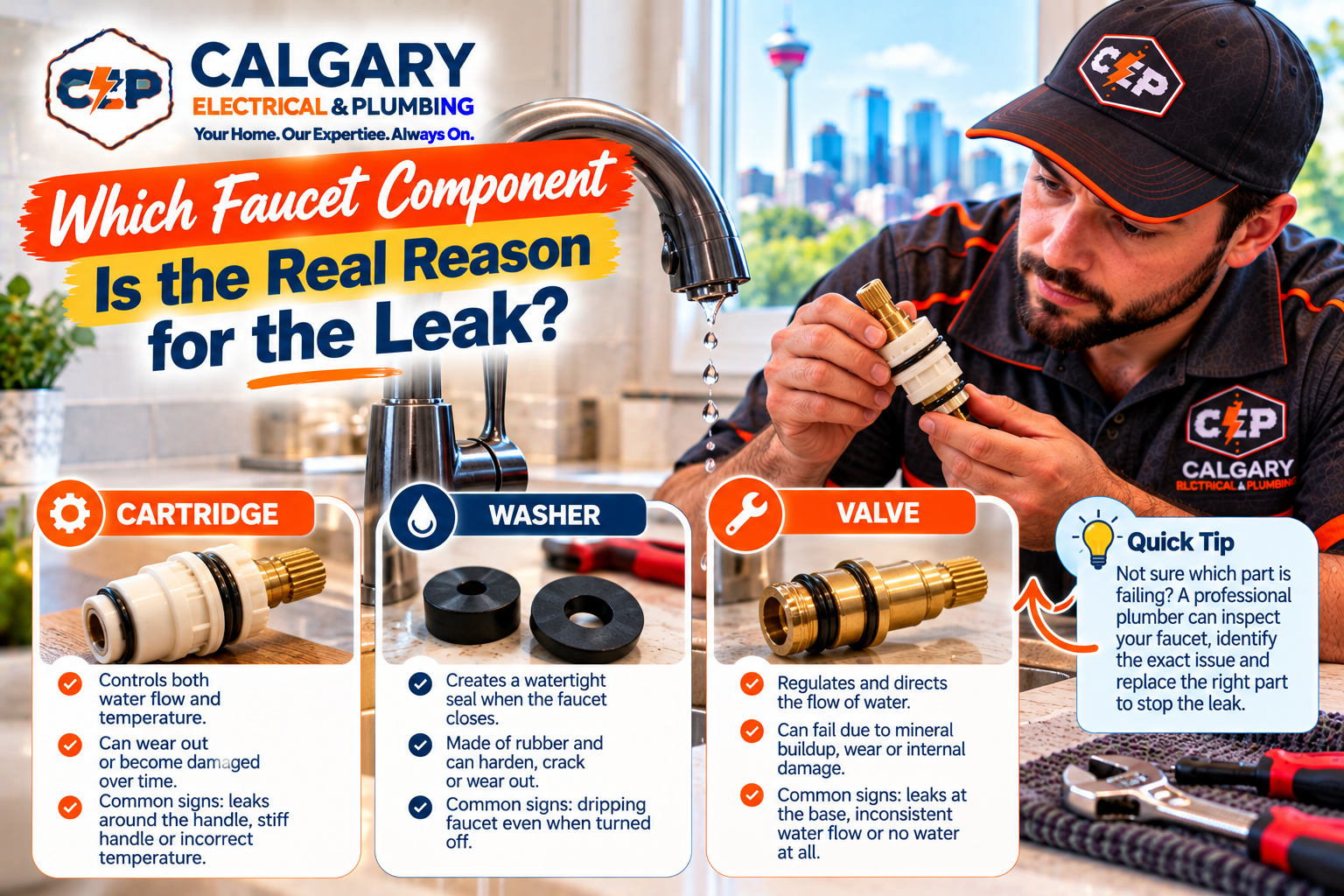
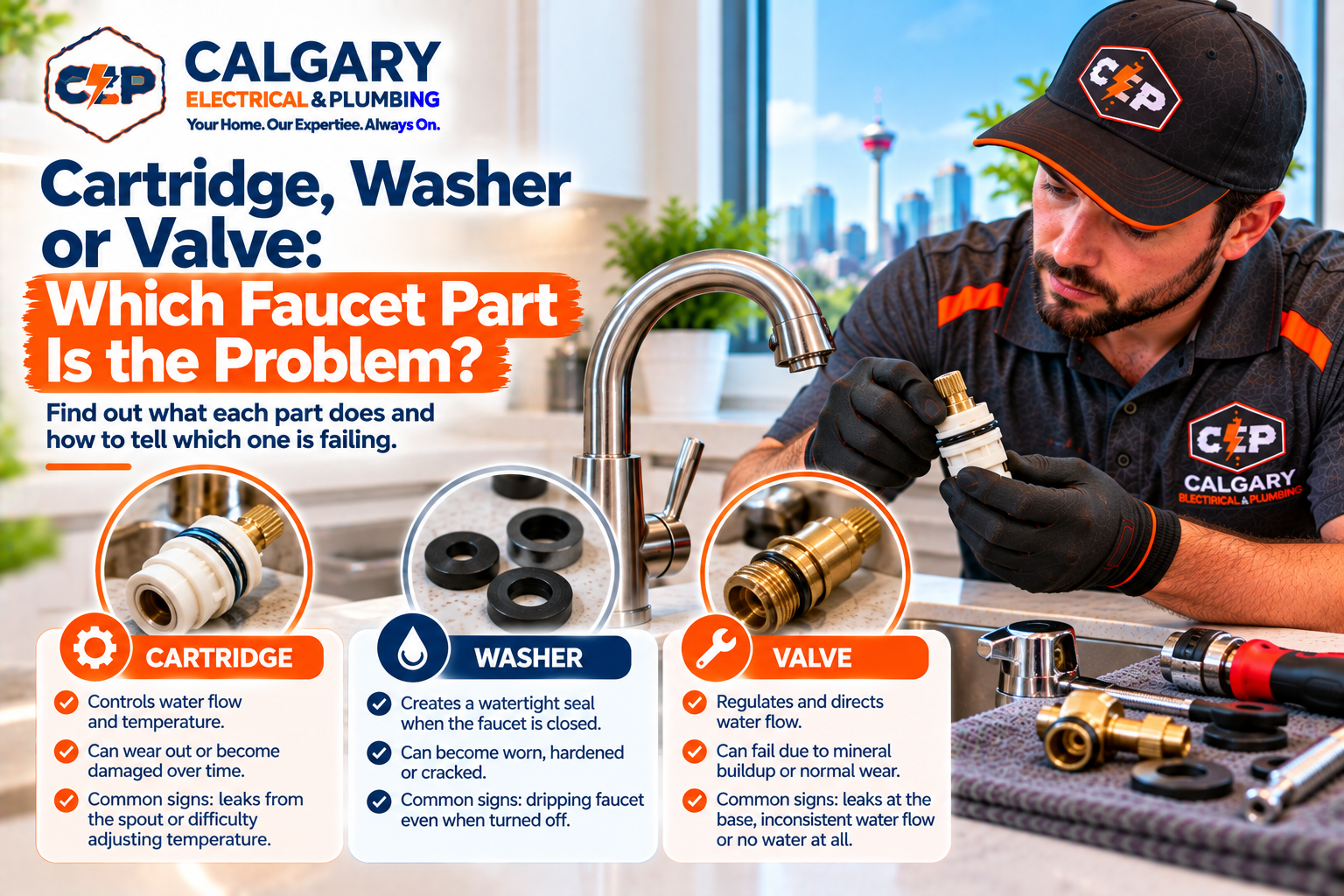
Controls water flow and, in many faucets, temperature mixing. A worn or damaged cartridge can cause dripping, stiffness, poor temperature control or handle-area leaks.
Creates a seal in certain faucet designs, especially traditional compression-style fixtures. Wear, deformation or damage can prevent complete shutoff.
Opens and closes the water path. Depending on the faucet design, the assembly may work with washers, seals, cartridges or valve seats.
What does a faucet cartridge do?
The cartridge is a replaceable internal control component found in many modern faucets. Moving the handle changes the cartridge position, which controls the amount of water flowing through the fixture.
In a single-handle faucet, the cartridge may also control the balance between hot and cold water. That makes it central to both flow and temperature operation.
When a cartridge wears or becomes damaged, homeowners may notice a persistent drip, a handle that feels unusually stiff, inconsistent water temperature, reduced control or moisture around the handle.
What does a faucet washer do?
Washers are especially associated with compression faucets. When the handle closes, the stem presses the washer against a valve seat to stop the flow of water.
Repeated opening and closing eventually places wear on this small sealing component. A washer can harden, deform, crack or wear unevenly, leaving a tiny pathway through which water continues to pass.
The classic symptom is a faucet that keeps dripping from the spout even after the handle has been firmly closed.
What is the faucet valve?
“Valve” can describe different components depending on the faucet design. Broadly, the valve mechanism controls the water path through the fixture. Some faucets use a stem-and-washer arrangement, while others rely on cartridges, ceramic discs or other internal mechanisms.
This is one reason saying “the valve is bad” does not always identify the exact replacement part. The fixture must first be identified so the internal design is understood.
What is a valve seat?
In faucets that use a washer, the valve seat provides the surface against which that washer seals. If the seat becomes worn, rough or damaged, installing a fresh washer may not completely stop the leak.
Mineral deposits or corrosion can also affect sealing surfaces. A repair should therefore consider the parts that work together rather than automatically replacing the smallest visible component.
Do O-rings and seals matter too?
Absolutely. Not every faucet leak comes from the cartridge, washer or main valve mechanism. O-rings and other seals help prevent water from escaping around moving or connected components.
A faucet that leaks around its handle or body may therefore have a sealing problem even if the fixture still shuts off properly at the spout.
Homeowners looking for local service information can also view the company’s Calgary plumbing service location on Google Maps.
How to Tell Which Faucet Part Is Failing
You do not need to dismantle the fixture to notice useful diagnostic clues. The way a faucet leaks, moves and responds to shutoff can help narrow the possibilities before the internal parts are inspected.
Symptom 1: The faucet drips from the spout after shutoff
A persistent spout drip means water is still passing through the internal shutoff mechanism. In a cartridge faucet, the cartridge or related seals may be worn. In a compression faucet, the washer, valve seat or stem assembly may be responsible.
The faucet’s construction therefore matters as much as the symptom itself.
Symptom 2: The handle is becoming hard to turn
Increasing handle resistance can point toward a cartridge or stem problem, mineral accumulation, corrosion or deteriorating internal components. Forcing a stiff handle can place additional stress on the handle connection and internal mechanism.
If the stiffness develops gradually, note if it affects the entire range of motion or only one part of the turn.
Symptom 3: Water leaks around the handle
A handle-area leak shifts attention away from a simple spout washer. Depending on the fixture, a cartridge, O-ring, packing seal or other internal sealing component may allow pressurized water to escape around the handle.
The leak may become more obvious while the faucet is running because internal water pressure changes when the fixture is opened.
Symptom 4: One side of a two-handle faucet drips
With separate hot and cold controls, a plumber may isolate which side is failing. If closing one supply side stops the dripping, that provides a useful clue about which stem, cartridge or sealing assembly needs inspection.
The correct repair still depends on the fixture’s internal design.
Symptom 5: The faucet will not shut off completely
A handle that reaches its normal closed position while water continues flowing indicates that the shutoff mechanism is not sealing correctly. A worn cartridge, damaged washer, deteriorated valve seat or internal mechanical problem could be responsible.
This symptom deserves attention because the leak may progress from an occasional drip to a steady stream.
Symptom 6: The temperature is difficult to control
On many single-handle faucets, one cartridge manages both water volume and temperature mixing. If the handle moves normally but temperature control becomes inconsistent, the cartridge becomes a stronger diagnostic consideration.
However, broader hot-water or supply issues should be ruled out if other fixtures in the home show similar symptoms.
Symptom 7: The faucet squeaks or feels rough
Rough or noisy handle movement can indicate internal friction, mineral accumulation, deteriorated seals or wear within the cartridge or stem assembly.
Adding a random household lubricant is not a good substitute for diagnosis because materials inside plumbing fixtures may require manufacturer-approved products or replacement components.
| Faucet Symptom | Possible Component | What a Plumber May Check |
|---|---|---|
| Drips from spout when off | Cartridge, washer, valve seat or stem | Fixture design and condition of shutoff surfaces |
| Leaks around handle | Cartridge, O-ring or internal seal | Seal condition and leak point under operation |
| Handle is stiff | Cartridge, stem or internal seals | Mineral buildup, corrosion and mechanical wear |
| Temperature control is poor | Mixing cartridge or supply issue | Cartridge operation and hot/cold supply |
| Two-handle faucet drips | Washer, stem, seat or cartridge | Which side is allowing water to pass |
| Water will not stop fully | Internal valve mechanism | Cartridge, washer, seat and mechanical condition |
Scenario: a dripping kitchen faucet in Mahogany
A single-handle kitchen faucet continues dripping every few seconds after shutoff. The handle also feels slightly tighter than it did several months ago.
Because a modern single-handle fixture often uses a cartridge, those combined symptoms make the cartridge and its associated seals important areas to inspect. Replacing a traditional rubber washer without confirming the faucet design would not address the right mechanism.
Scenario: an older two-handle faucet in Acadia
An older bathroom faucet requires the cold handle to be tightened firmly before the dripping stops. Over time, even extra force no longer closes it completely.
In a compression-style fixture, the washer and valve seat would be logical areas to investigate. The seat also matters because a damaged sealing surface can quickly affect a replacement washer.
Scenario: water appears around a handle in Seton
A relatively modern faucet shuts off at the spout but develops moisture around the handle while running. That symptom differs from a basic dripping-spout complaint.
The cartridge, O-rings or other internal seals may deserve more attention because the faucet can still stop flow while allowing water to escape from another internal location.
For visual plumbing information, homeowners can browse the Calgary plumbing maintenance video channel and this faucet-focused plumbing video.
Request a faucet repair estimate in Calgary in just a few clicks.
Get My Free Estimate
What Does Faucet Part Repair Cost in Calgary?
The cost of fixing a faucet is influenced by more than the price of a washer or cartridge. Diagnosis, accessibility, fixture design, replacement-part availability and the condition of surrounding plumbing all affect the job.
A common cartridge that can be accessed easily may be straightforward to replace. An older fixture with seized components, uncertain model identification or a damaged valve seat can require more time.
Typical planning ranges for faucet repair
| Possible Faucet Service | Approximate Calgary Planning Range | Factors That Can Affect Cost |
|---|---|---|
| Basic diagnosis or minor adjustment | $150–$250 | Accessibility, service time and fixture condition |
| Washer, O-ring or minor seal repair | $150–$275 | Faucet design and condition of related sealing surfaces |
| Cartridge replacement | $180–$350 | Brand, cartridge price, accessibility and part availability |
| Stem or internal valve repair | $200–$400+ | Age, corrosion, component condition and fixture design |
| Standard faucet replacement | $250–$650+ | Fixture selection, sink access and plumbing modifications |
Pricing note: These are broad Canadian-dollar planning ranges, not fixed quotations. Actual pricing can change according to the faucet, replacement parts, accessibility, existing plumbing, service timing and additional problems found during diagnosis.
Why can a small cartridge cost more to replace than expected?
The physical part is only one portion of a repair. The faucet must be identified, water isolated, components accessed without damaging the fixture, the correct replacement installed and the faucet tested after reassembly.
If the retaining hardware is corroded or difficult to remove, a seemingly simple repair may require additional time.
Why part identification matters
Cartridges are not universal. Neither are stems, seals or many other faucet components. Two fixtures from different manufacturers can require completely different replacement parts even when they look similar.
Model information, manufacturer markings and photographs can sometimes help narrow the search before the faucet is opened.
Can a plumber replace only the washer?
Yes, if the faucet actually uses a replaceable washer and the surrounding components remain serviceable. The valve seat should also be considered because a rough or damaged seat may prevent the new washer from sealing properly.
Replacing a washer without checking the surface it seals against can lead to a recurring drip.
Can only the cartridge be replaced?
Often, yes. Many cartridge faucets are designed so the internal cartridge can be replaced without replacing the complete fixture.
The plumber still needs the correct cartridge and should inspect related seals, retaining hardware and the faucet body for conditions that could affect the repair.
Can a new faucet have an internal part problem?
New fixtures are not immune to leaks. Installation issues, damaged seals, connection problems, debris or defective components can produce symptoms soon after installation.
For a deeper explanation, see this guide to why a newly installed faucet may start leaking.
Do Calgary water conditions affect faucet parts?
Mineral deposits can accumulate around aerators, cartridges and moving faucet components over time. Deposits do not automatically prove that a cartridge or valve has failed, but buildup can contribute to stiffness and interfere with normal operation.
That is another reason diagnosis should consider both the failed component and the conditions around it.
What if replacement parts are unavailable?
Parts availability becomes more important as a fixture ages. If a specific cartridge, stem or valve component has been discontinued, sourcing the correct part may be difficult or uneconomical.
At that point, complete faucet replacement can provide a more practical long-term solution than repeatedly searching for obsolete parts.
Calgary homeowners can also follow local plumbing maintenance information on Facebook for additional home-service updates.
When Should You Repair or Replace the Faucet?
Finding the failed part answers only half the question. The next decision is whether replacing that component makes sense compared with installing a new fixture.
For many faucets, a cartridge, washer or seal replacement can restore normal operation. Replacement becomes more attractive when several components are deteriorating or the fixture itself is in poor condition.
Repair usually makes sense when the problem is isolated
If the faucet body is sound and the leak traces back to one serviceable cartridge, washer, O-ring or stem, targeted repair can preserve the fixture without unnecessary replacement.
This can be especially practical when the faucet is relatively recent and replacement components remain readily available.
Consider replacement when several parts are deteriorating
An older faucet may show several warning signs at once: corrosion, stiff handles, recurring drips, worn finish, loose components and hard-to-find internal parts.
Fixing one component may solve today’s leak while another worn part causes the next problem. The overall condition should therefore be considered alongside the immediate repair cost.
Recurring cartridge failures deserve further investigation
If the same internal component repeatedly fails, simply installing another replacement may not answer why the problem keeps returning.
The fixture, installation, water conditions and surrounding plumbing may deserve a broader inspection before another identical repair is made.
Do not force a handle to stop a drip
With compression faucets, homeowners sometimes tighten the handle harder and harder as a washer begins losing its seal. Excessive force is not a lasting repair and can place more stress on the stem, washer and valve seat.
A faucet should shut off through normal operation rather than extreme handle pressure.
Do not assume every drip needs a washer
“Replace the washer” is traditional faucet advice, but many modern faucets do not rely on the same compression-washer design. Installing or searching for the wrong component wastes time and can lead to unnecessary disassembly.
Identify the faucet type before deciding which repair part is needed.
What information helps identify a faucet?
The manufacturer’s name is useful, but the model is even better. Look for documentation, packaging, model labels or identifying marks that came with the fixture.
Photos of the complete faucet and handle configuration can also help distinguish a single-handle cartridge faucet from a traditional two-handle or other design.
- Where exactly is the faucet leaking?
- What type of faucet mechanism is installed?
- Does the handle feel normal, stiff or loose?
- Are correct replacement parts still available?
- Is the rest of the fixture in good enough condition to justify repair?
Southeast Calgary scenario: cartridge repair in Cranston
A homeowner in Cranston has a single-handle kitchen faucet that drips and has become progressively harder to operate. The fixture is otherwise in good condition and the correct cartridge is available.
In that situation, targeted cartridge replacement may make more sense than discarding the complete faucet.
Southeast Calgary scenario: older compression faucet in Ogden
An older two-handle faucet in Ogden requires excessive force to stop a cold-side drip. Inspection shows deterioration at the washer and the sealing surface.
Replacing only the washer without addressing the related sealing problem could result in another leak. The components should be evaluated as a working system.
Southeast Calgary scenario: aging fixture in Douglasdale
A bathroom faucet in Douglasdale has already received several repairs, its finish is deteriorating and compatible internal parts are increasingly difficult to find.
Even if another temporary repair is technically possible, complete replacement may provide better value than continuing to invest in an aging fixture.
When should professional diagnosis become the next step?
Professional inspection is useful when the faucet type is unclear, the leak source cannot be isolated, shut-off valves are difficult to operate, internal components are seized or repeated repairs have failed.
It is also sensible when water is leaking beneath cabinetry or around connections rather than simply dripping into the sink. Those symptoms can involve supply lines, valves or connections outside the faucet’s main internal mechanism.
Request a cartridge, washer or faucet valve repair estimate in Calgary in just a few clicks.
Request My Faucet Estimate
Fix the Failed Part, Not Just the Visible Symptom
A dripping or difficult faucet does not automatically mean the washer, cartridge or complete fixture needs replacement. Faucet design and symptoms should identify the most likely component before repair begins.
If you need a local calgary plumber to diagnose a leaking or malfunctioning faucet, call (403) 421-1991 for help identifying the failed component and the appropriate repair.
Frequently Asked Questions about Faucet Cartridges, Washers and Valves
How do I know if my faucet cartridge is failing?
A failing faucet cartridge may cause dripping after shutoff, stiff handle movement, poor flow control, inconsistent temperature or moisture around the handle. Because similar symptoms can have other causes, a Calgary plumber may identify the faucet design and inspect the cartridge and related seals before replacement.
What are the signs of a worn faucet washer?
In a compression-style faucet, a worn washer commonly causes dripping from the spout because it no longer seals firmly against the valve seat. Calgary homeowners may also notice that progressively more handle pressure is needed to stop the water, which can indicate wear within the sealing assembly.
Can a bad valve seat make a new washer leak?
Yes. A new washer may still leak if the valve seat it seals against is worn, rough, corroded or damaged. On compatible faucet designs, both surfaces should be considered during diagnosis so a Calgary faucet repair does not address the washer while overlooking the surface responsible for sealing.
Is replacing a faucet cartridge cheaper than replacing the faucet?
Cartridge replacement can cost less when the faucet body is in good condition and the correct part is readily available. Complete replacement may be more practical for an older Calgary faucet with corrosion, repeated failures, obsolete parts or several worn components that would require additional repairs.
Should I replace the washer, cartridge or whole faucet?
The right choice depends on the faucet design, leak location, failed component, fixture age and parts availability. A serviceable washer or cartridge may justify a targeted repair, while a badly worn or obsolete fixture may be better replaced after a Calgary plumber confirms the underlying problem.
Don’t let a small drip develop into a recurring plumbing problem.
Call (403) 421-1991 Now
Local Help Available 24/7 in Calgary