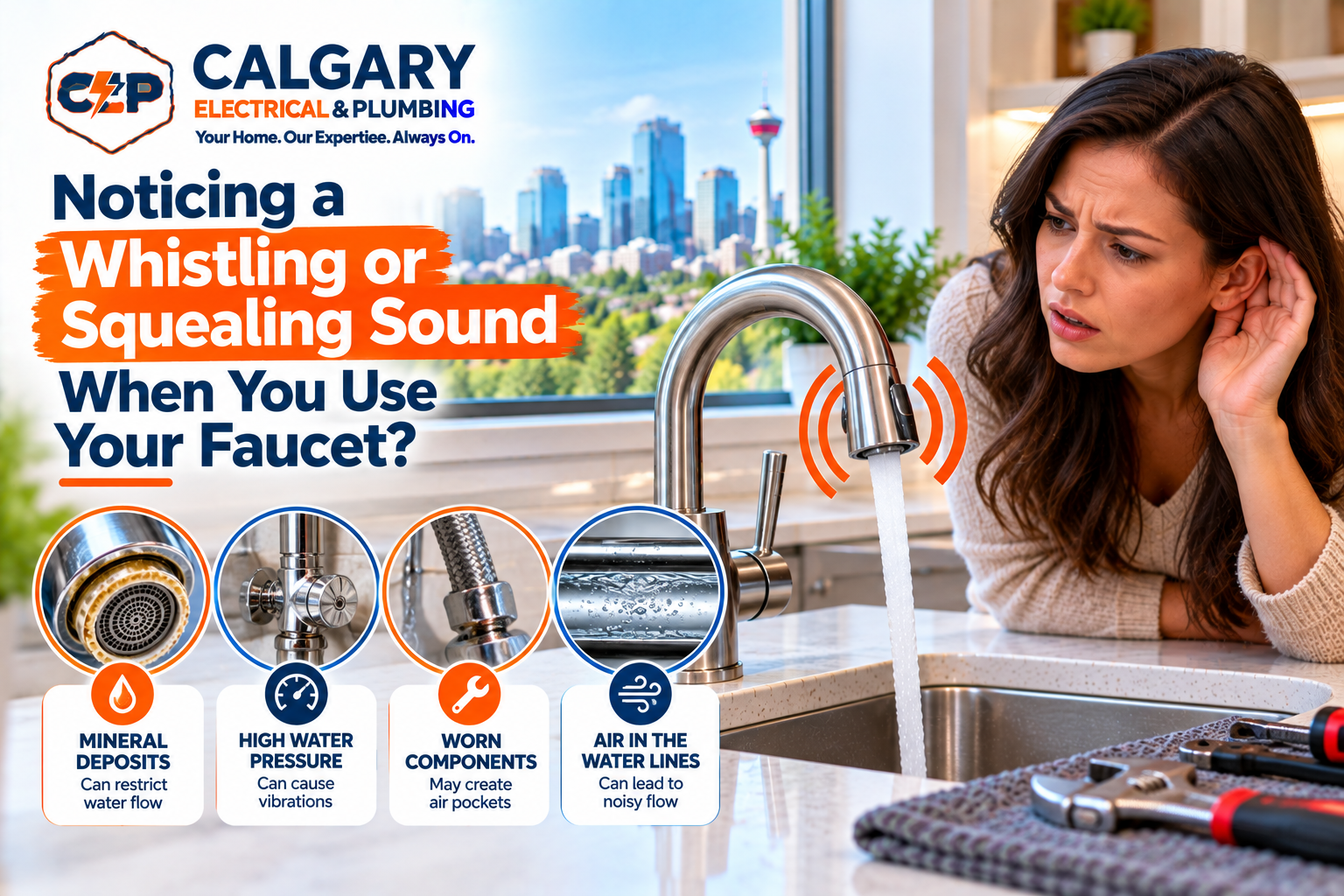

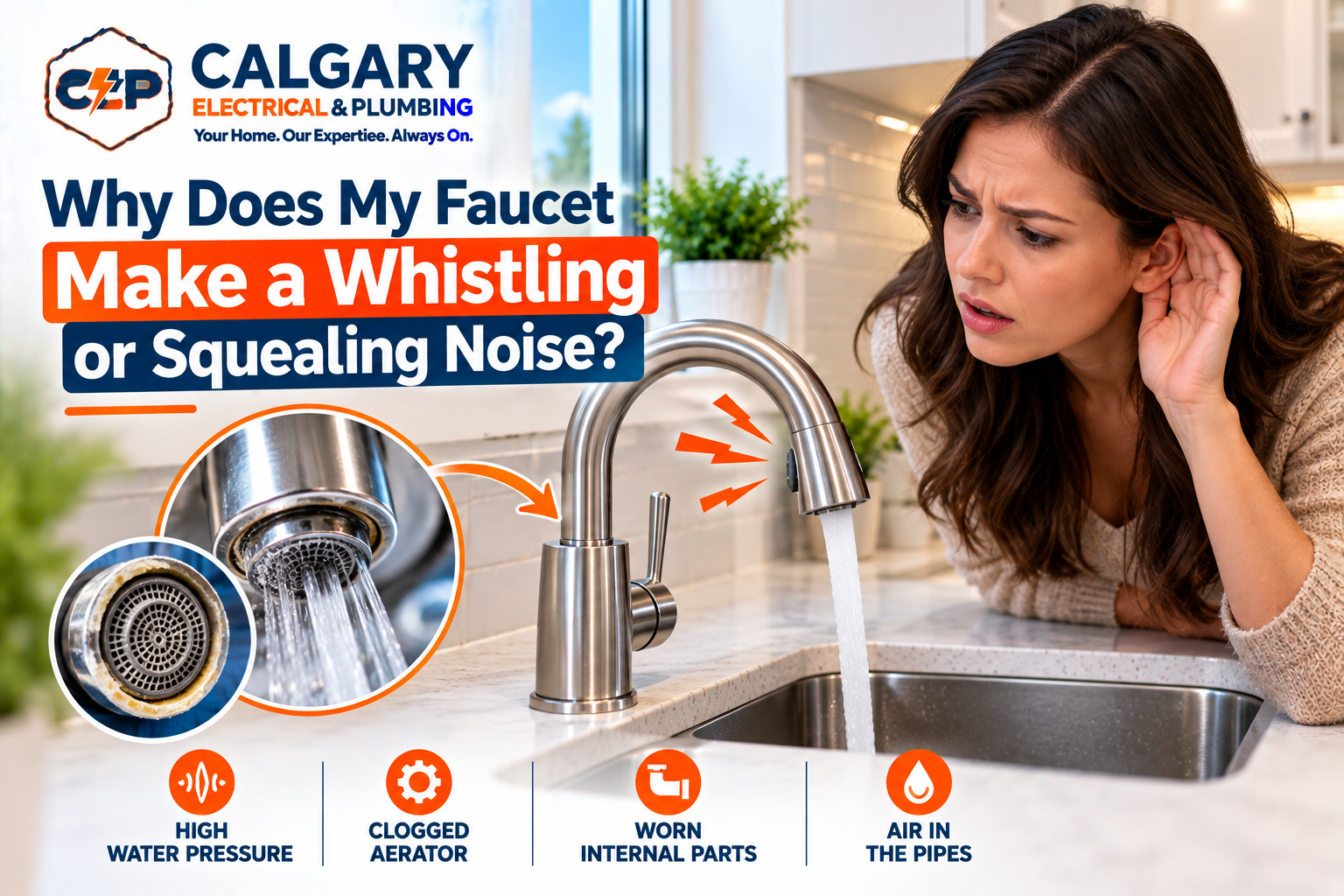
Why does my faucet make a whistling or squealing noise? That sharp sound can be unsettling when an otherwise normal kitchen or bathroom faucet suddenly starts making noise every time you turn the water on. In many cases, the sound comes from water being forced through a restricted opening or past a worn internal component.
Homeowners looking for professional faucet troubleshooting and plumbing service in Calgary should pay attention to when the noise occurs. A faucet that whistles only on hot water can point in a different direction from one that squeals on both hot and cold settings.
In homes around Cranston, Mahogany, McKenzie Towne, Riverbend, Acadia and other Calgary communities, the source may be as simple as an obstructed aerator or as involved as a deteriorating cartridge, partially closed valve, restricted supply line or pressure issue. The sound itself provides useful clues.
A whistling or squealing faucet often results from restricted water flow, mineral buildup, a worn cartridge or washer, a partially closed valve, supply-line problems or excessive pressure. Identifying when and where the noise occurs helps narrow down the cause.
What Causes a Faucet to Whistle or Squeal?
A faucet normally allows water to pass through its internal passages without producing a noticeable high-pitched sound. Whistling often begins when the flow path becomes unusually narrow or a component vibrates as water moves past it.
The exact cause depends on the faucet design, age of the fixture, water-flow conditions and the plumbing supplying it.
1. A restricted or dirty aerator
The aerator is the small fitting at the end of many faucet spouts. Its screens and flow-control components help shape the stream and reduce splashing, but debris or mineral deposits can gradually restrict its openings.
When water is pushed through a narrowed passage, it may create a noticeable whistle. Low or uneven water flow may appear at the same time.
This is especially worth considering when the sound seems strongest at the end of the spout rather than beneath the sink or inside the faucet body.
2. A worn cartridge
Many modern faucets use a cartridge to control water volume and temperature. As internal seals and surfaces wear, water may pass through the cartridge differently than intended.
The resulting turbulence or vibration can create squealing, whistling or other unusual sounds. A worn cartridge may also cause dripping, difficult handle movement or inconsistent temperature control.
3. A worn washer in an older faucet
Some older faucet designs use washers rather than modern cartridge assemblies. A loose, hardened or damaged washer can vibrate when water flows across it.
That vibration can create a squeal that changes as the handle is opened farther. In some cases, the sound is most noticeable at a particular flow setting.
4. A partially closed shut-off valve
The hot and cold shut-off valves beneath a sink should normally be fully open during everyday use. A valve that is only partly open creates a narrow path for the water.
That restriction can contribute to noise and reduced flow. An aging valve may also have internal deterioration that interferes with normal water movement even when its handle appears open.
5. Restricted or damaged supply lines
Flexible supply lines connect the faucet to the household plumbing. If one is kinked, deteriorated or otherwise restricted, water can accelerate through the narrowed area and create noise.
A restriction on only one side can explain why a faucet whistles when using hot water but remains quiet on cold water, or the opposite.
6. Water pressure problems
If the sound occurs at several fixtures rather than one faucet, the problem deserves a wider look. Pressure conditions can make valves and faucet components noisy as water passes through the plumbing system.
A plumber can assess the pressure rather than assuming the faucet itself is responsible. This distinction is important because replacing a perfectly good fixture will not solve a whole-home pressure problem.
7. Loose or vibrating internal components
A small component inside the faucet may vibrate at a certain flow rate. This can create a noise that disappears when the handle is opened fully or moved to another position.
The behaviour can make the faucet seem unpredictable, but the exact handle position that triggers the sound can be a useful diagnostic clue.
Calgary homeowners can review the company’s local plumbing service information on Google Maps when checking service coverage and business details.
How Can You Identify Where the Noise Is Coming From?
You do not need to dismantle the faucet to gather useful information. Listening carefully and observing when the sound starts can help separate a faucet-specific problem from a broader plumbing issue.
Does it happen on hot water, cold water or both?
Turn the faucet through its normal range and notice when the noise appears. If it occurs only when hot water is selected, the hot-side valve, connection or internal faucet passage deserves attention.
A sound limited to cold water provides the same clue for the cold side. Noise on both sides may point more strongly toward the aerator, common cartridge components or another shared part of the faucet.
Does the sound change with the handle position?
A faucet that squeals only when partly open may have a component vibrating at a specific flow rate. The sound may become quieter or disappear when the handle is opened farther.
Tell the plumber the approximate handle position that triggers the noise. That detail can make troubleshooting more efficient.
Is water flow weaker than before?
Whistling accompanied by low flow often suggests a restriction somewhere in the water path. The aerator, cartridge, supply line or shut-off valve may be limiting the amount of water reaching the spout.
If flow remains strong but the sound is unusually sharp, pressure or internal vibration may deserve more attention.
Does every faucet make the same noise?
Walk to another sink and compare. If the kitchen faucet whistles but the bathroom fixtures remain quiet, the problem is more likely localized around the kitchen fixture.
If similar sounds occur at multiple fixtures, treating each faucet as a separate problem may miss the actual cause.
Is the sound coming from the spout or below the sink?
A whistle that seems to originate at the end of the spout may indicate aerator restriction. Noise beneath the cabinet may instead direct attention toward shut-off valves or supply connections.
Sound can travel through pipes and cabinets, so the apparent location is not always exact, but it remains a helpful starting point.
| What You Notice | Possible Area to Check | Additional Clue |
|---|---|---|
| Whistle near the faucet spout | Aerator or faucet outlet | Flow may also look weak or uneven |
| Squeal at certain handle positions | Cartridge, washer or internal valve | Noise changes as flow changes |
| Noise only on hot water | Hot-side supply or faucet components | Cold water remains quiet |
| Noise beneath the sink | Shut-off valve or supply line | May occur with reduced flow |
| Several fixtures make noise | Pressure or wider plumbing system | Problem is not isolated to one faucet |
Scenario: a kitchen faucet in Cranston
Imagine a kitchen faucet that recently started whistling while the stream also became noticeably weaker. The bathrooms still have normal flow and remain quiet.
Because the problem is isolated to one fixture and includes reduced flow, the faucet’s aerator and internal flow path would be reasonable areas to investigate first.
Scenario: hot-water squealing in Riverbend
In another home, the faucet is quiet on cold water but produces a sharp squeal as the handle moves toward hot. That pattern provides a useful clue that the problem is associated with the hot side rather than the faucet’s entire supply.
A plumber can then inspect the relevant valve, connection and internal faucet components rather than replacing parts at random.
For additional plumbing information, homeowners can browse the Calgary plumbing video resource channel and view this faucet and plumbing service video.
Request a noisy faucet repair estimate in Calgary in just a few clicks.
Get My Free Estimate

When Does a Noisy Faucet Need Professional Repair?
An occasional change in plumbing sound does not automatically mean a faucet must be replaced. Persistent whistling or squealing, however, deserves attention when it appears alongside other changes in performance.
The faucet is becoming difficult to operate
If the handle feels stiff, catches while moving or requires unusual force, the internal cartridge or valve assembly may be deteriorating. Noise combined with difficult operation makes internal wear more likely.
Avoid forcing a stiff handle. Excessive force can damage the handle, cartridge stem or other faucet components.
The faucet is also dripping
A faucet that squeals during use and drips after shutoff may have more than one symptom of internal wear. Depending on the fixture, replacing a cartridge, washer, seal or related component may restore normal operation.
The correct repair depends on the faucet design and condition rather than the noise alone.
Water pressure or flow has changed
Reduced flow combined with whistling strongly suggests that water is passing through a restricted area. If simple external causes do not explain it, a plumber can investigate the faucet and supply connections.
A sudden increase in force or unusual noise at several fixtures deserves a broader pressure assessment.
The shut-off valve is making noise
Aging shut-off valves can become noisy as internal parts wear or as water moves through a restricted opening. If the sound clearly comes from beneath the sink, the faucet may not be the primary problem.
A leaking, damaged or unreliable shut-off valve is particularly important because it is needed to isolate the fixture during future repairs.
The faucet is older and repeatedly causing problems
A single worn component may justify repair. A fixture that has already required several repairs, has a deteriorated finish, loose body and recurring leaks may be approaching the point where replacement makes more sense.
Replacement is also worth considering when correct parts are difficult to source or several internal components are worn.
Repair versus replacement
A noisy faucet does not automatically require a new fixture. A clogged aerator, serviceable cartridge or replaceable washer can make repair practical.
Replacement becomes more attractive when the faucet body itself is deteriorating, the correct repair parts are unavailable, repeated problems continue or the homeowner already planned to upgrade the fixture.
If replacement becomes the better option, this guide explains how long professional faucet replacement can take in a Calgary home and what can extend the installation.
How much can noisy faucet repair cost?
The cost depends on the actual cause. Cleaning or addressing a simple faucet component is different from replacing a cartridge, repairing a shut-off valve or investigating a whole-home pressure issue.
| Possible Service | Approximate Calgary Planning Range | What Influences Cost |
|---|---|---|
| Minor faucet diagnosis or simple component service | $150–$250 | Access, fixture condition and required parts |
| Cartridge or internal faucet repair | $180–$350 | Faucet brand, cartridge availability and labour |
| Shut-off valve or supply-side repair | $200–$400+ | Valve condition, access and required plumbing work |
| Standard faucet replacement | $250–$600+ | Fixture type, installation complexity and existing connections |
| Broader pressure or plumbing diagnosis | Varies | Scope of testing and underlying system condition |
Pricing note: These are broad planning ranges in Canadian dollars, not fixed quotes. Faucet brand, replacement parts, accessibility, plumbing condition and the actual cause of the noise can change the final cost.
Scenario: several faucets suddenly start whistling
Suppose a homeowner in Douglasdale notices noise from the kitchen faucet, bathroom sink and another fixture within the same period. Replacing the kitchen faucet first would be an incomplete diagnostic approach.
The fact that several fixtures are affected suggests that the plumbing system should be evaluated more broadly, including water-pressure conditions.
Scenario: the noise follows a recent faucet installation
If a new faucet begins whistling soon after installation, the cause may involve a restricted supply connection, aerator debris, valve position or an installation-specific component.
Recording whether the sound occurs on hot, cold or both sides can help narrow the investigation.
Homeowners can also follow local Calgary plumbing updates on Facebook for additional service and maintenance information.
How Can Faucet Whistling and Squealing Be Prevented?
Not every noisy faucet can be prevented, especially as internal parts naturally wear with age. Still, basic maintenance and attention to early warning signs can reduce the chance of a small restriction developing into a recurring plumbing problem.
Pay attention to gradual changes in flow
Faucet problems often develop slowly. The stream may become slightly weaker before the whistle becomes obvious, or the handle may begin feeling different weeks before a cartridge causes noticeable noise.
Changes are easier to diagnose when they are noticed early rather than after several symptoms appear at once.
Keep the aerator in mind
The faucet aerator is exposed directly to the water flowing through the fixture. Small particles and mineral deposits can accumulate there over time.
If flow becomes uneven or the sound clearly originates from the spout, the aerator is one of the first components worth considering.
Avoid forcing faucet handles
A handle should move through its normal range without excessive effort. Forcing a stiff faucet can put additional stress on the cartridge, stem and handle assembly.
If the handle becomes increasingly difficult to operate while the faucet also squeals, professional inspection can address the cause rather than simply applying more force.
Do not repeatedly adjust old shut-off valves without reason
Older shut-off valves beneath a sink may not respond well to repeated forceful operation. If a valve is stiff, leaking or obviously deteriorated, it should be assessed rather than repeatedly opened and closed in an attempt to stop a sound.
The valve may itself be contributing to the restriction.
Notice problems after plumbing work
Debris can occasionally move through plumbing after water has been shut off and restored. If a faucet begins behaving differently immediately after plumbing work, mention that timing during diagnosis.
A sudden change is often more informative than a symptom that has existed unchanged for years.
Know when the problem is bigger than the faucet
One of the most useful distinctions is the number of fixtures affected. A single noisy faucet points toward a local problem. Several noisy fixtures can suggest a shared condition.
This simple observation can prevent unnecessary faucet replacement when the source lies elsewhere.
What about whistling only at low flow?
A sound that occurs only when the handle is barely open can be caused by water passing through a very narrow internal opening. A worn or vibrating component may also react only at that specific flow rate.
If the sound disappears at full flow but returns consistently at the same handle position, mention that pattern during service.
What if the faucet squeals only when fully open?
A high-flow squeal can point toward a different type of restriction or vibration. The greater volume of moving water may cause a component to resonate or expose a supply-side limitation that is less noticeable at lower flow.
Again, the exact operating condition matters more than simply describing the faucet as noisy.
What if there is banging as well as squealing?
A sharp squeal and a banging or knocking sound should not automatically be treated as the same symptom. Banging may involve rapid changes in water movement or piping conditions beyond the faucet itself.
If several unusual sounds occur throughout the plumbing system, professional diagnosis is more useful than focusing on a single faucet component.
Can a noisy faucet waste water?
The sound itself does not necessarily mean water is being wasted. However, the worn component causing the noise may also produce dripping or poor shutoff.
Check whether the faucet stops completely after use and watch for moisture around the fixture or beneath the cabinet.
Calgary homes can have very different faucet conditions
A newer fixture in Seton or Mahogany may have different likely causes from an older faucet in Acadia, Riverbend or Lake Bonavista. Age, faucet design, previous repairs and the condition of the surrounding plumbing all influence diagnosis.
That is why the best repair starts with the symptom pattern rather than assuming every whistle comes from the same component.
- Does the sound happen on hot water, cold water or both?
- Does it happen at low flow, full flow or every handle position?
- Has water pressure or flow changed?
- Is the faucet dripping or becoming difficult to operate?
- Do other fixtures make similar sounds?
- Does the noise seem to come from the spout, faucet body or beneath the sink?
Request a faucet noise diagnosis and repair estimate in Calgary in just a few clicks.
Request My Faucet Estimate
Do Not Let a Noisy Faucet Become the New Normal
A faucet that whistles or squeals is often telling you that water is moving through a restriction or causing an internal component to vibrate. Finding the cause early can clarify whether the solution is simple faucet service, a replacement part or a wider plumbing inspection.
If the sound keeps returning, contact a local calgary plumber at (403) 421-1991 for help identifying and repairing the source.
Frequently Asked Questions about Noisy Faucets
Why does my Calgary faucet whistle when I turn it on?
A faucet may whistle when water is forced through a restricted aerator, worn cartridge, partially closed valve or narrowed supply connection. If only one Calgary faucet makes the sound, the problem is often localized around that fixture rather than the entire plumbing system.
Why does my faucet squeal only when using hot water?
A hot-water-only squeal can point toward the hot-side faucet components, supply connection or shut-off valve. The fact that cold water remains quiet gives a Calgary plumber a useful diagnostic clue and can help narrow the inspection to the affected side.
Can a clogged faucet aerator cause a whistling noise?
Yes. Debris or mineral deposits can reduce the openings inside an aerator, forcing water through a smaller space and sometimes producing a whistle. A restricted aerator may also cause weak, uneven or distorted flow from a kitchen or bathroom faucet.
Should I worry if several faucets in my Calgary home are making noise?
If several fixtures begin making similar whistling or squealing sounds, the cause may extend beyond one faucet. Water-pressure conditions or another shared plumbing issue may need investigation, so diagnosing the wider system can be more useful than replacing individual faucets.
Does a squealing faucet need to be replaced?
Not necessarily. A serviceable cartridge, washer, aerator or supply-side component may be responsible for the noise. Replacement becomes more reasonable when the faucet is badly worn, correct repair parts are unavailable or the fixture has recurring leaks and operating problems.
Have the source checked before the problem becomes more disruptive.
Call (403) 421-1991 Now
Local Help Available 24/7 in Calgary