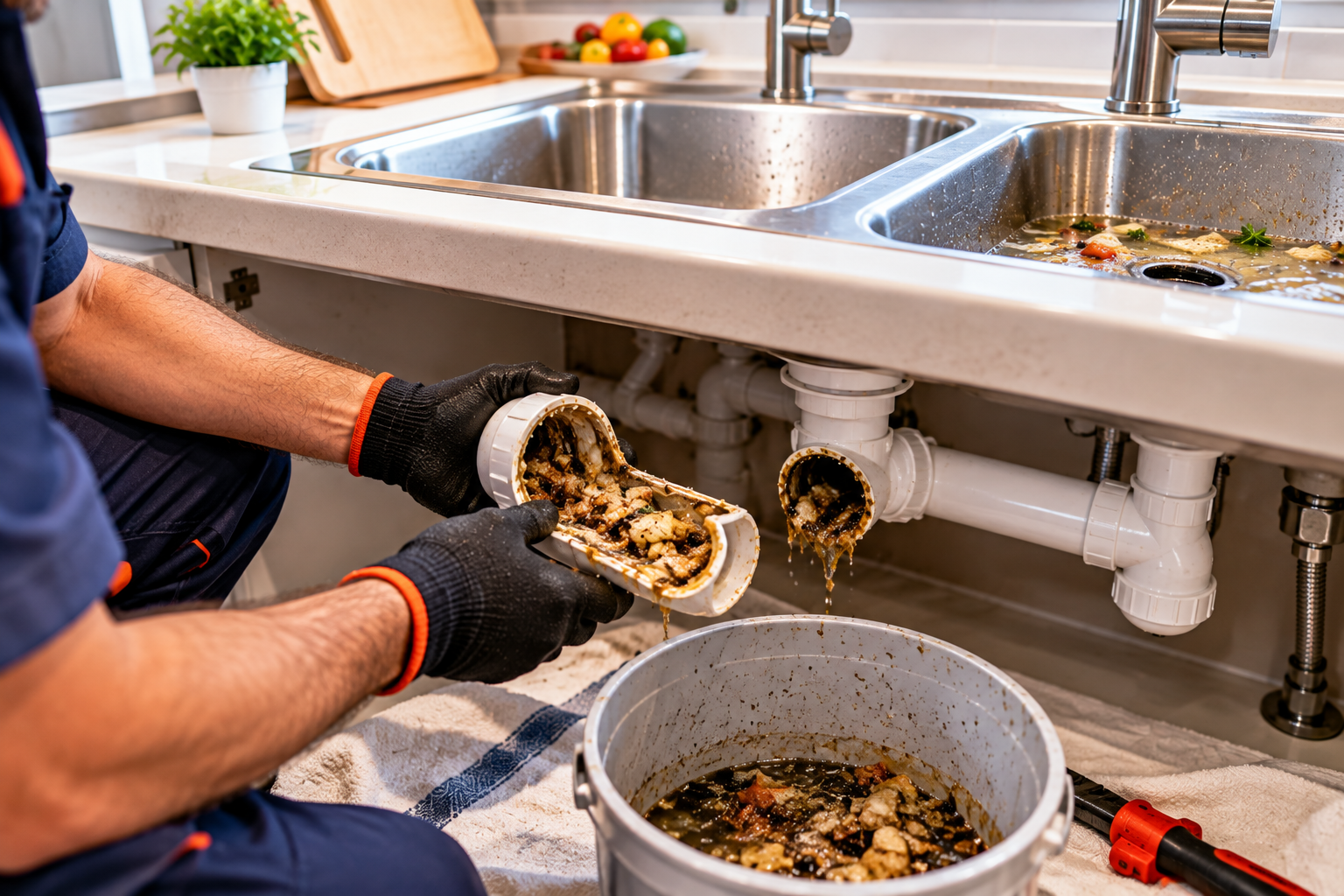


Why Does My Kitchen Sink Keep Clogging? If you clear the drain only to find standing water returning a few days later, the problem may involve more than one piece of food debris. Recurring kitchen sink clogs often develop gradually as grease, soap residue, and small particles accumulate inside the drainage system.
Homeowners in Southeast Calgary communities such as Mahogany, Auburn Bay, Cranston, and Copperfield may notice slow drainage, unpleasant sink odours, or water collecting in a second sink basin. Understanding when to seek professional drain cleaning and plumbing services in Calgary can help prevent repeated disruption and unnecessary attempts at clearing the same obstruction.
Although some clogs are located inside the removable sink trap, others form farther along the branch drain. Identifying the source matters because clearing a small opening through accumulated grease may restore drainage temporarily without removing the material responsible for the recurring problem.
A kitchen sink that keeps clogging usually has recurring grease, food debris, soap residue, or buildup inside the trap or connected drainpipe. Other causes include disposal problems, poor drainage slope, or a deeper obstruction. Lasting results depend on identifying and addressing the actual cause.
Why Does My Kitchen Sink Keep Clogging Even After Cleaning?
A recurring kitchen sink clog often means the previous cleaning removed part of the obstruction without addressing the remaining deposits or underlying drainage problem.
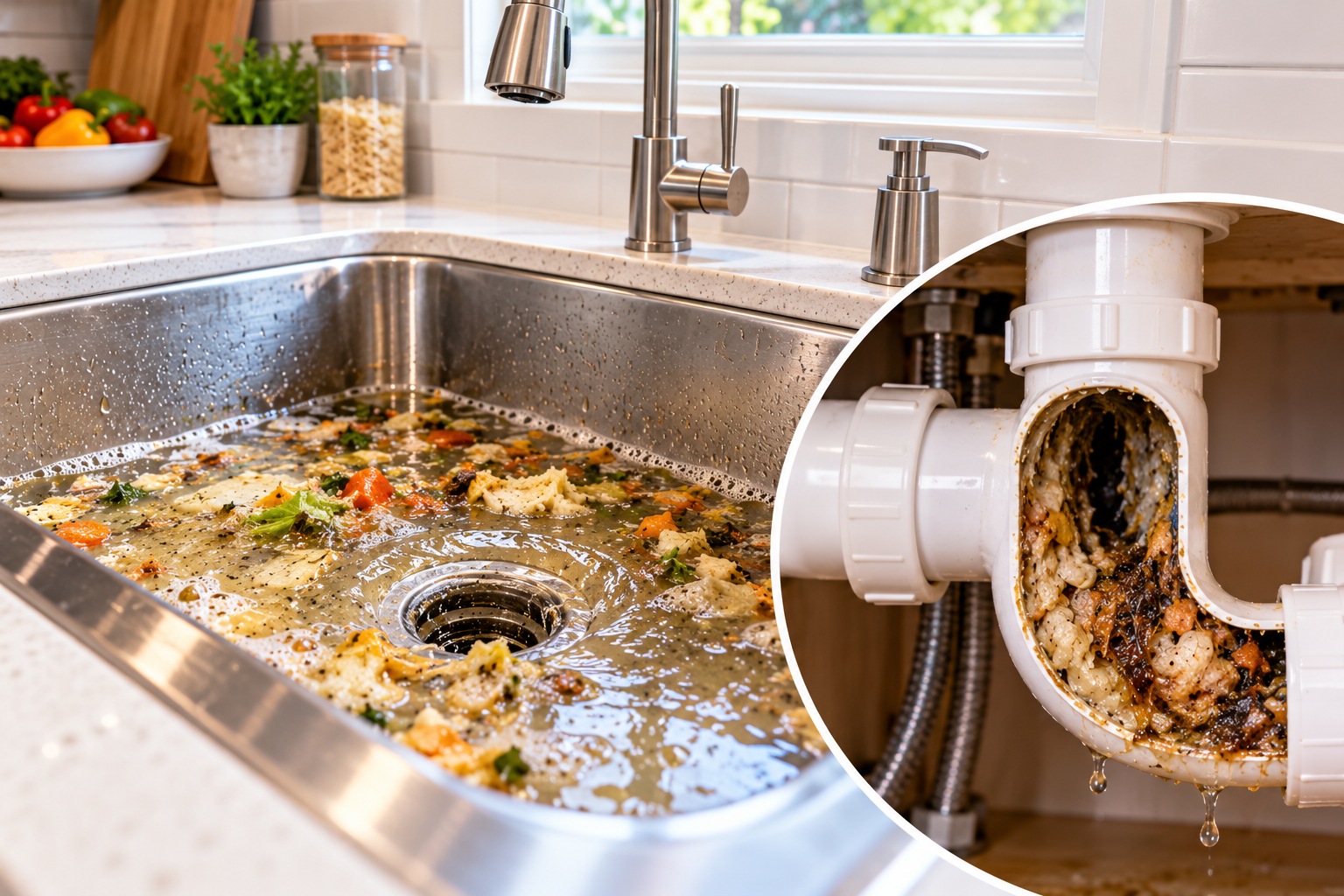
Kitchen drains carry more than water. Cooking grease, dishwashing residue, food particles, and other materials can accumulate along the pipe walls over time.
Even when water begins flowing again, deposits remaining inside the pipe can trap additional debris and gradually restrict drainage.
How Does Grease Build Up Inside Kitchen Drainpipes?
Cooking oils, fats, and grease are among the most common contributors to recurring kitchen drainage problems.
Warm grease may flow into the sink as a liquid, but it can cool, thicken, and adhere to the inside of drainage pipes.
As additional grease and debris accumulate, the effective opening through the pipe becomes smaller.
In a Mahogany household where cooking pans are regularly rinsed in the sink, grease deposits may gradually restrict the kitchen branch drain.
Pouring hot water into the sink does not guarantee that the grease will leave the drainage system. Material can move farther into the piping before cooling and collecting again.
Important: Cooking grease should be allowed to cool and placed in an appropriate waste container rather than poured into the sink. Even small amounts can contribute to buildup when repeated over time.
Can Food Scraps and Soap Residue Cause Repeated Sink Clogs?
Yes. Small food particles can collect inside the trap or adhere to existing grease deposits farther along the drain.
Rice, pasta, coffee grounds, vegetable scraps, and other food waste may contribute to restrictions, especially when combined with fatty residue.
Dishwashing products can also leave residues that mix with grease and suspended particles.
For a family in Auburn Bay, repeated slow drainage after washing dishes may indicate accumulated material rather than one large object blocking the sink.
Can a Garbage Disposal Make a Kitchen Sink Clog More Often?
A garbage disposal reduces certain food scraps into smaller particles, but it does not eliminate the possibility of drainage blockages.
Fibrous food, grease, and excessive debris can still create restrictions in connected piping.
A disposal may also develop a separate mechanical problem that affects drainage.
If the unit hums without operating normally, makes unusual noises, or appears jammed, it should be assessed according to the manufacturer’s safety guidance.
Never place a hand inside a disposal opening to investigate a suspected jam.
Why Does the Sink Drain Normally After Cleaning but Clog Again?
Some cleaning methods create a temporary passage through accumulated material without removing the deposits coating the pipe walls.
Water may begin flowing again, but the remaining buildup can continue trapping food particles and grease.
Another possibility is a drainage defect such as an unsuitable pipe slope or a damaged connection.
Repeated cleaning may provide temporary relief without correcting that underlying condition.
Do Older Kitchen Pipes Clog More Easily?
Older pipes can develop internal corrosion, rough surfaces, and deposits that influence drainage.
However, pipe age alone does not determine how frequently a kitchen sink will clog.
Newer plumbing can also experience recurring obstructions when grease and food debris enter the drain regularly.
In established Southeast Calgary communities such as Riverbend and Lake Bonavista, a plumber may consider the pipe material and repair history when investigating repeated blockages.
Key takeaway: A kitchen sink that repeatedly clogs may have deposits remaining inside the drain or a deeper drainage defect. Restoring water flow does not always mean the underlying cause has been eliminated.
Homeowners seeking local plumbing assistance can review the Calgary Electrical and Plumbing Google Maps listing and watch a video introducing the company’s plumbing services.
How Can You Tell Where a Kitchen Sink Blockage Is Located?
The location of a kitchen sink obstruction influences the appropriate cleaning method.
A restriction inside the sink trap may be relatively accessible, while a blockage farther along the branch drain may require specialized equipment.
Professional diagnosis considers the symptoms, affected fixtures, pipe configuration, and previous cleaning attempts.
Is the Kitchen Sink P-Trap Causing the Blockage?
The P-trap is the curved pipe section beneath the sink. It retains water to help prevent sewer gases from entering the home.
Because of its shape, the trap can collect food debris and other material.
If the kitchen sink is the only affected fixture, the trap may be one of the first areas a plumber examines.
However, the presence of a trap does not mean every sink blockage is located there.
What Does It Mean When Both Kitchen Sink Basins Back Up?
In a double-basin kitchen sink, both bowls commonly connect to a shared drainage assembly.
If water discharged into one basin rises in the other, the restriction may be located downstream of their shared connection.
For example, a Copperfield homeowner may notice water appearing in the second sink bowl when the first is emptied.
That pattern can help a plumber narrow down the affected section, although it does not establish the exact blockage location by itself.
Why Does My Kitchen Sink Gurgle When the Dishwasher Drains?
Many dishwashers discharge wastewater through a connection associated with the kitchen sink drainage assembly.
If the connected drain is partially restricted, dishwasher discharge may contribute to gurgling, slow drainage, or water rising in the sink.
Improper connections or venting conditions can also contribute to unusual drainage behaviour.
A plumber may examine the dishwasher drain connection, sink trap, and downstream piping to identify the cause.
Can a Blockage Be Farther Inside the Wall or Floor?
Yes. Kitchen sink drainage pipes commonly extend through walls or floors before connecting to larger drainage branches.
Grease and debris can accumulate beyond the visible under-sink plumbing.
If the accessible trap is clear but drainage remains slow, the restriction may be farther downstream.
In a New Brighton home, repeated clogs that persist after trap cleaning may justify examining the connected branch drain.
How Do Plumbers Locate a Hidden Kitchen Drain Blockage?
Plumbers begin by reviewing the drainage symptoms and inspecting accessible connections.
They may use mechanical equipment to investigate or clear an obstruction. A sewer camera may be recommended if problems recur or pipe damage is suspected.
Camera inspection can sometimes reveal grease deposits, foreign objects, displaced joints, or other visible defects.
For a detailed explanation, read How Do Plumbers Find a Blockage Inside a Drain?
Warning: If wastewater backs up through other fixtures or a basement floor drain, stop using connected plumbing and arrange an assessment. Multiple affected drains can indicate a restriction beyond the kitchen sink.
Is a Kitchen Sink Clog the Same as a Blocked Storm Drain?
No. Household kitchen sinks discharge into sanitary drainage systems, while municipal storm drains collect surface runoff such as rainwater and snowmelt.
Calgary residents sometimes discuss neighbourhood storm drain conditions, including in this community discussion about monitoring local storm drains.
That public infrastructure topic is separate from a kitchen sink blockage inside a home’s sanitary plumbing.
Additional company location information is available through another Calgary Electrical and Plumbing map reference.
Request a kitchen sink drain cleaning estimate in Calgary in just a few clicks.
Get My Free Estimate
How Do Calgary Plumbers Fix a Kitchen Sink That Keeps Clogging?
The correct solution depends on the obstruction material, pipe condition, and location of the restriction.
A localized trap blockage may require a straightforward cleaning procedure. Extensive grease deposits farther along the drain may call for more specialized equipment.
Repeated clogs can also justify additional inspection before further cleaning is attempted.
Which Professional Drain Cleaning Method Works Best?
Two common professional methods are mechanical drain snaking and hydro jetting.
Mechanical cleaning uses a flexible cable and suitable attachments to break apart or remove accessible obstructions.
Hydro jetting uses pressurized water to remove suitable deposits from inside drainage pipes that have been assessed as appropriate for the process.
Mechanical Drain Snaking
Often suitable for localized food debris, hair, or other accessible obstructions. It may restore drainage without removing every deposit attached to the pipe walls.
Hydro Jetting
May be appropriate for extensive grease and sludge buildup in structurally suitable piping. Pipe condition and access must be evaluated before high-pressure cleaning.
Can a Plumber Clean the Kitchen Sink Trap?
Yes. If inspection identifies debris inside the accessible trap, the plumber may clean the affected section and check the connections.
The trap must be correctly reassembled to maintain its water seal and prevent leaks.
If drainage remains restricted after the trap is clear, further investigation may be necessary.
Are Chemical Drain Cleaners a Good Solution for Recurring Clogs?
Chemical drain cleaners may not address the underlying cause of repeated kitchen sink blockages.
Some products can present risks to users and complicate later plumbing work, especially if chemicals remain in standing wastewater.
Mixing different drain-cleaning chemicals can be particularly hazardous.
If a chemical product has already been used, inform the plumber before work begins.
When Is a Sewer Camera Inspection Necessary?
A camera inspection may be useful when the sink repeatedly clogs despite cleaning or when the plumber suspects a defect farther along the pipe.
Depending on visibility, the camera may reveal heavy deposits, foreign objects, damaged joints, or other conditions affecting drainage.
However, a camera cannot necessarily see through standing wastewater or a complete obstruction.
How Much Does Kitchen Sink Drain Cleaning Cost in Calgary?
Pricing depends on the blockage location, pipe accessibility, cleaning method, and diagnostic work required.
| Service | Illustrative CAD Range | Typical Application |
|---|---|---|
| Basic sink trap cleaning | $100–$250+ | Accessible localized debris |
| Mechanical kitchen drain cleaning | $150–$400+ | Suitable obstructions inside connected drainage piping |
| Sewer camera inspection | $200–$500+ | Recurring clogs or suspected deeper defects |
| Hydro jetting | $400–$900+ | Extensive deposits in suitable drainage lines |
Pricing disclaimer: These are broad illustrative planning ranges, not verified Calgary market averages or published Calgary Electrical and Plumbing prices. Actual charges may vary substantially. Taxes, emergency service, access work, and additional repairs may be extra.
Why Does Professional Drain Cleaning Sometimes Cost More?
A blockage close to the sink may be easier to access than grease buildup deep inside a concealed branch line.
Longer cleaning runs, specialized equipment, and camera inspection can increase the service scope.
Structural defects may require separate repairs rather than cleaning alone.
Will Professional Cleaning Stop the Sink From Clogging Again?
Removing the obstruction can restore drainage, but no cleaning method can guarantee that future clogs will never occur.
Continued grease disposal, food debris accumulation, or an unresolved pipe defect can cause problems to return.
A suitable maintenance approach depends on the actual condition of the plumbing.
Professional cleaning takeaway: The best service is the one matched to the diagnosed blockage. A plumber may recommend trap cleaning, mechanical snaking, hydro jetting, camera inspection, or a separate repair when the drainage system has structural defects.
For company updates and additional information, visit the Calgary Electrical and Plumbing X profile or explore the company’s shared Google business information.
How Can You Prevent Your Kitchen Sink From Clogging Again?
Preventing recurring kitchen sink clogs begins with reducing the materials entering the drain and addressing any confirmed plumbing defects.
Simple kitchen habits can make a meaningful difference, especially in homes where grease and food debris frequently enter the sink.
Keep Cooking Grease Out of the Sink
Allow cooking grease to cool and collect it in a suitable waste container.
Wipe greasy pans with a paper towel before washing them, and place the used towel in the appropriate waste stream.
This reduces the amount of fatty material entering the drainage system.
Use a Kitchen Sink Strainer
A suitable sink strainer can collect food scraps before they enter the drain.
Empty the strainer into the appropriate waste container rather than rinsing the collected material down the sink.
This simple measure helps reduce the amount of solid debris entering the trap and branch drain.
Be Careful With Coffee Grounds and Starchy Foods
Coffee grounds, rice, pasta, and other food residues can contribute to restrictions when combined with grease.
Dispose of these materials through appropriate household waste or composting systems rather than the kitchen sink.
Small quantities may seem harmless, but repeated disposal can contribute to accumulated debris.
Maintain Your Garbage Disposal Properly
If your kitchen includes a garbage disposal, follow the manufacturer’s operating and maintenance instructions.
Avoid forcing unsuitable materials through the unit or using it as a substitute for collecting food waste.
If the disposal is malfunctioning, disconnect power according to the manufacturer’s guidance and arrange appropriate servicing.
Investigate Recurring Slow Drainage Early
A sink that repeatedly becomes slow may be showing early signs of an unresolved obstruction.
Waiting until the drain is completely blocked can make the problem more disruptive.
Homeowners in Seton, McKenzie Towne, and Douglasdale can benefit from identifying repeated drainage symptoms before wastewater begins backing up.
Does Regular Drain Maintenance Prevent Every Clog?
Maintenance can reduce some avoidable deposits, but it cannot prevent every drainage problem.
Pipe damage, root intrusion, poor alignment, and other structural conditions may require repair.
Maintenance schedules should reflect the property’s actual drainage history rather than assuming every kitchen requires frequent mechanical cleaning.
When Should You Contact a Plumber?
Consider professional assessment when a kitchen sink repeatedly clogs, drainage remains slow after accessible debris is removed, or water backs up into another connected fixture.
Gurgling, recurring odours, and repeated drainage interruptions can also justify further investigation.
For Southeast Calgary homeowners, describing the full pattern of symptoms helps the plumber determine if the problem is limited to the kitchen sink or extends into a shared drainage line.
Final recommendation: Keep grease and food debris out of the kitchen sink, use suitable strainers, and investigate repeated drainage restrictions. If the same clog returns after cleaning, the underlying cause may require a more detailed plumbing assessment.
Request a kitchen sink drain cleaning estimate in Calgary in just a few clicks.
Get My Free Estimate
Stop Repeating the Same Kitchen Sink Drainage Problem
A kitchen sink that repeatedly clogs may have grease deposits, trapped food debris, a partially obstructed branch drain, or an underlying pipe defect. Identifying the cause is essential before choosing the appropriate cleaning or repair method.
If your kitchen drain keeps backing up, a local calgary plumber can help investigate the problem. Call Calgary Electrical and Plumbing at (403) 421-1991 to discuss your kitchen sink drainage concerns.
Frequently Asked Questions about Recurring Kitchen Sink Clogs
Why does my kitchen sink keep clogging after I clean it?
Recurring clogs often indicate grease, food debris, or other deposits remaining inside the connected drainpipe. Cleaning may restore a small passage without removing all the buildup. A deeper obstruction or structural drainage problem can also cause the same symptoms to return.
Can grease cause my kitchen sink to clog repeatedly?
Yes. Cooking fats and oils can cool, thicken, and collect inside drainage pipes. Food particles and other debris may attach to these deposits, gradually restricting water flow. Keeping grease out of the sink can help reduce preventable kitchen drainage blockages.
Why does water back up into the other side of my double kitchen sink?
Both sink basins commonly connect to a shared drainage assembly. If water discharged into one basin rises in the other, the restriction may be downstream of their shared connection. A plumber can examine the trap and connected piping to locate the obstruction.
How much does it cost to unclog a kitchen sink in Calgary?
Costs depend on the blockage location, pipe accessibility, and cleaning method. An illustrative planning range for mechanical kitchen drain cleaning is CAD $150–$400 or more. This is not a verified local average or binding quote, and additional diagnostics or repairs may cost extra.
When should I call a plumber for a recurring kitchen sink clog?
Arrange a plumbing assessment when the sink repeatedly clogs, drainage remains slow, or water backs up into another connected fixture. Recurring symptoms may indicate deposits farther along the pipe or an underlying defect that requires more than basic trap cleaning.
Don’t wait for the problem to get worse.
Call (403) 421-1991 Now
Local Help Available 24/7 in Calgary