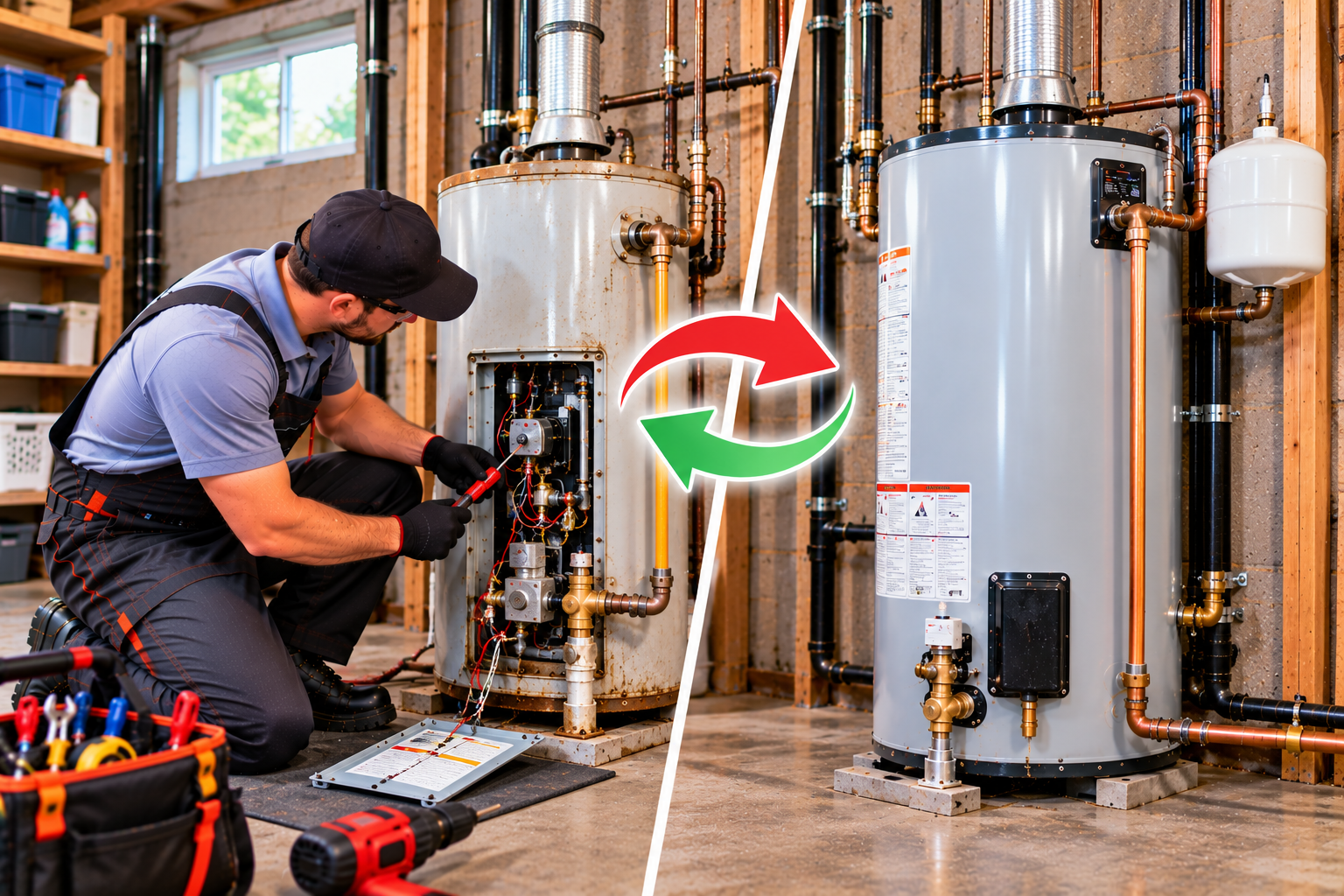

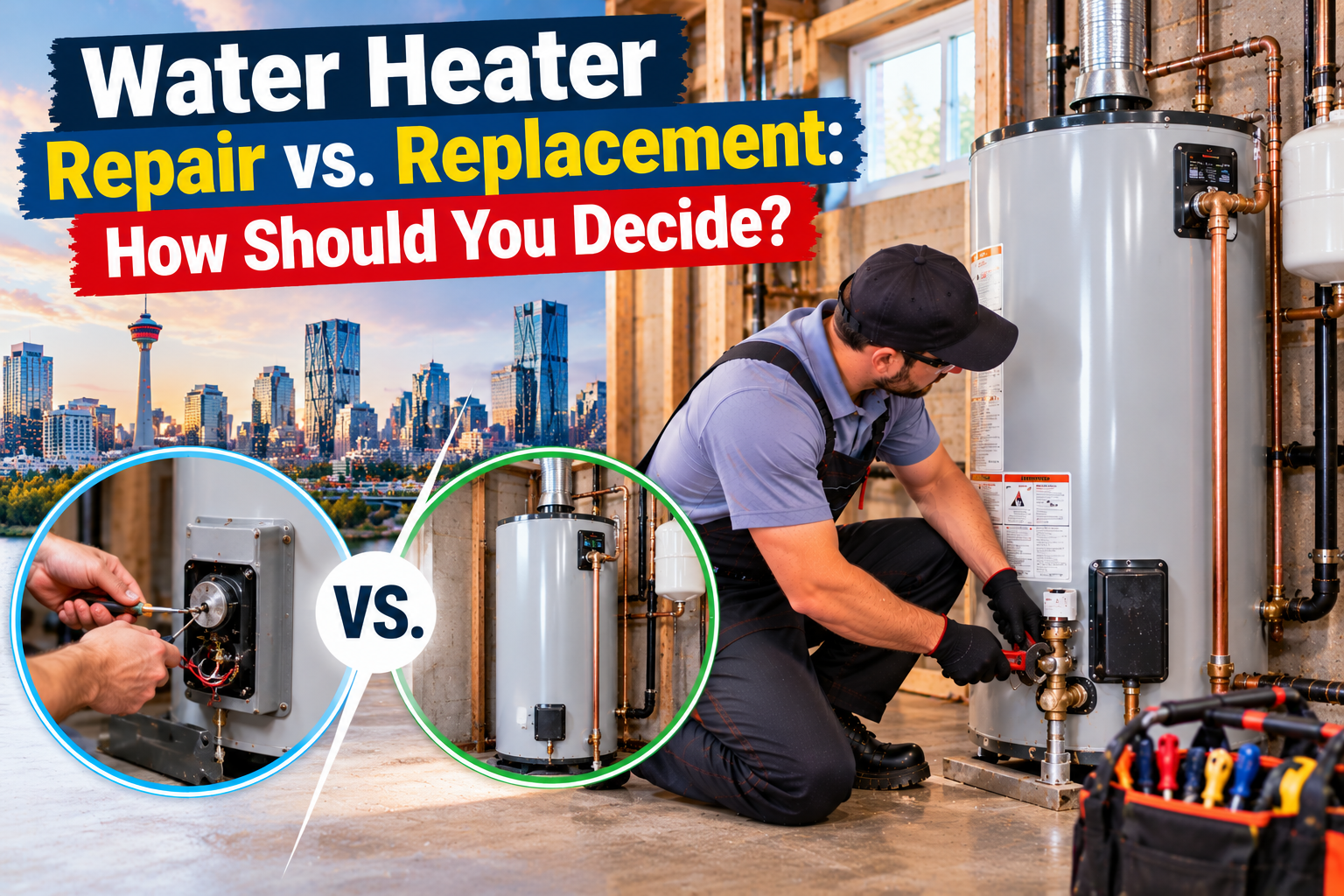
Should you repair your water heater or invest in a new one when the hot water suddenly becomes unreliable? Water Heater Repair vs. Replacement: How Should You Decide? is an important question for Calgary homeowners facing leaks, unusual noises, fluctuating temperatures, or rising repair expenses. The right decision depends on the underlying fault, equipment condition, and long-term costs rather than age alone.
In Southeast Calgary communities such as Mahogany, Cranston, Auburn Bay, and McKenzie Towne, homes rely on different types of water heating equipment. When a problem develops, professional water heater repair and replacement services in Calgary can help determine whether a specific component can be repaired or whether the entire system requires replacement.
Some water heater problems can be resolved by replacing a faulty control, valve, or heating component. Others involve tank corrosion, repeated failures, or installation conditions that make replacement the more practical investment. This guide explains how to evaluate warning signs, compare costs, understand equipment lifespan, and make an informed decision for your home.
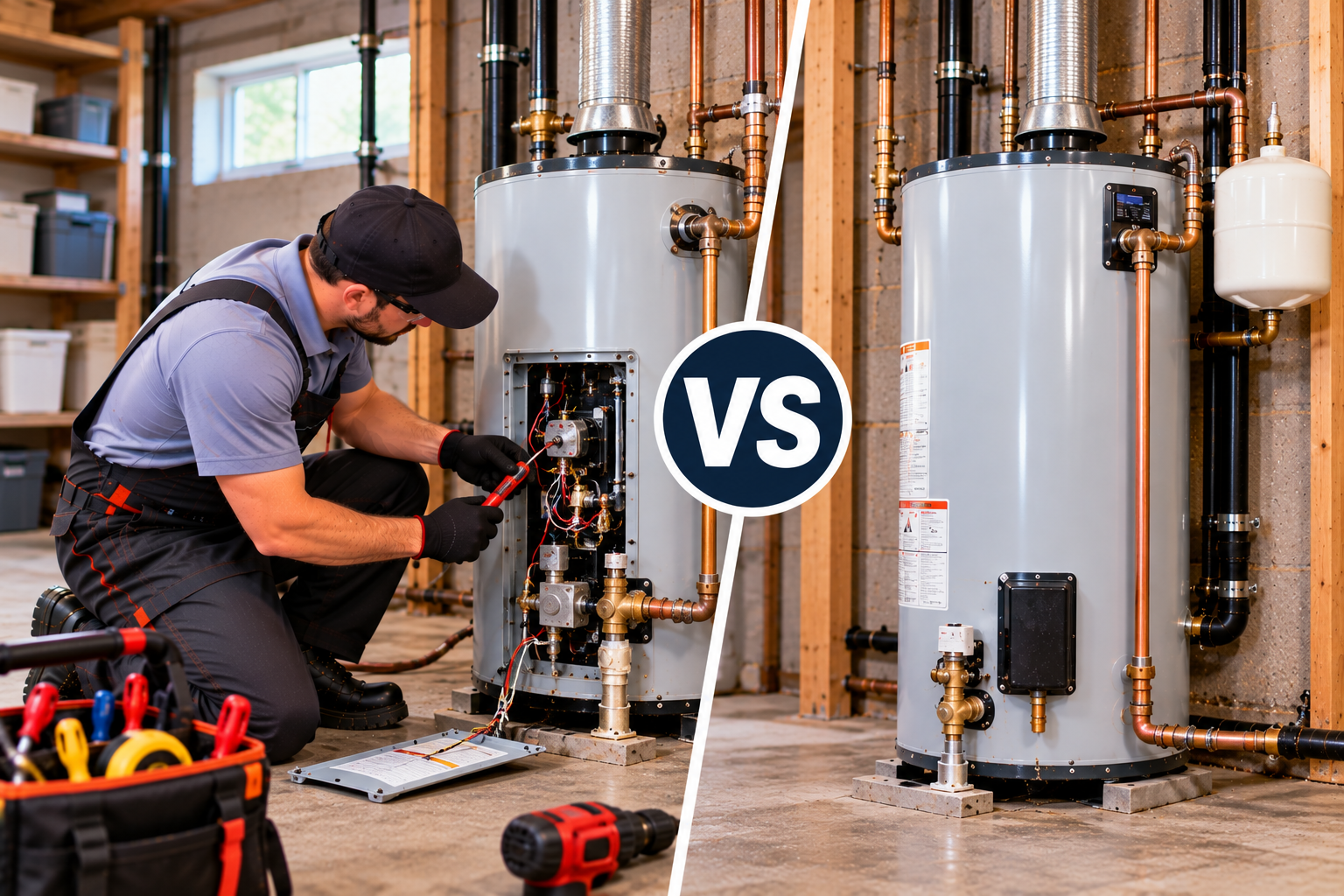
Repair a water heater when the fault is limited, the tank is sound, and repair costs are reasonable. Consider replacement when the tank leaks, breakdowns recur, or major repairs approach the cost of a suitable new system. A professional diagnosis should guide the decision.
What Water Heater Problems Can Be Repaired Instead of Replaced?
Many water heater problems involve individual components rather than failure of the entire appliance. When the storage tank remains structurally sound and the equipment is otherwise in reasonable condition, targeted repairs may restore normal operation without the expense of replacement.
The important first step is identifying the actual fault. Similar symptoms can have different causes, and replacing an entire water heater without proper diagnosis may result in unnecessary spending.
Faulty Thermostats and Temperature Controls
Temperature controls regulate water heating according to the appliance’s design. When a thermostat or related control malfunctions, homeowners may experience insufficient hot water or inconsistent temperatures.
In some systems, replacing the defective component can restore operation. However, the technician must first determine whether the problem involves the control itself, another heating component, or the incoming energy supply.
Failed Electric Heating Elements
Electric storage water heaters commonly use heating elements to warm stored water. A failed element can reduce heating capacity or prevent the appliance from delivering adequate hot water.
Replacing an accessible, compatible heating element may be economical when the tank is in good condition. Electrical testing and replacement should be performed by appropriately qualified personnel.
Minor Plumbing Connection Leaks
Water around the base of a heater does not always mean the tank has ruptured. Leaks may originate from nearby pipe connections, fittings, or valves.
If the source is a repairable external connection, correcting that connection may resolve the problem. The leak must be traced carefully because water can travel along pipes before becoming visible.
Problems With Pressure Relief Components
Temperature and pressure relief devices are important safety components. Discharge may indicate a valve problem, excessive pressure, abnormal temperature, or another condition requiring investigation.
A qualified technician can assess the cause and determine whether component replacement or correction of an underlying system issue is required.
Safety warning: Never cap, plug, or disable a water heater’s temperature and pressure relief discharge. The device serves a critical safety function. Repeated discharge or unusually hot water requires professional assessment.
Sediment and Reduced Heating Performance
Mineral deposits and sediment can accumulate in storage water heaters over time. Depending on the equipment and operating conditions, these deposits may contribute to noise, reduced performance, or maintenance concerns.
Manufacturer-approved servicing may improve certain conditions, although cleaning cannot reverse extensive tank corrosion or repair damaged internal components.
Ignition and Burner Problems in Gas Water Heaters
Gas water heaters may develop ignition, control, or burner-related faults. Some of these problems can be repaired by qualified gas technicians.
The correct solution depends on the appliance design, condition, and availability of approved replacement parts. Gas supply and combustion systems should never be modified without the necessary qualifications.
When Does a Repair Make Financial Sense?
Repair is often worth considering when the problem is clearly identified, the required part is available, and the appliance has a reasonable expected remaining life.
For example, replacing a failed component in a relatively recent heater may be more economical than installing an entirely new unit.
The calculation changes when the appliance has several unrelated problems or evidence of significant deterioration.
Why Professional Diagnosis Matters
A homeowner may interpret reduced hot water as a failed heater when the cause is a faulty component, mixing issue, or increased household demand.
Accurate diagnosis separates repairable problems from equipment failure and helps establish whether the proposed work offers reasonable value.
Repair takeaway: Thermostats, heating elements, some valves, and certain external connections may be repairable. The storage tank’s condition, equipment age, and cost of the proposed work determine whether repair is sensible.
Homeowners researching local plumbing assistance can review the Calgary Electrical and Plumbing Google Maps listing for company location information.
When Is Water Heater Replacement the Better Decision?
Replacement becomes more attractive when repairs cannot address the underlying problem or when the appliance is approaching the end of its practical service life.
Several warning signs deserve particular attention because they may indicate deterioration that cannot be resolved by replacing a minor component.
The Storage Tank Itself Is Leaking
A leak originating from the storage tank is one of the strongest reasons to consider replacement.
Unlike an external fitting, a deteriorated tank shell is generally not a practical or safe candidate for routine repair. Continuing to operate a leaking tank may increase the risk of property damage.
A professional should confirm the source before replacement is authorized.
The Water Heater Is Nearing the End of Its Service Life
Many conventional storage water heaters operate for approximately eight to fifteen years, although actual service life varies considerably.
Maintenance history, water conditions, installation quality, and usage all influence longevity.
An older heater is not automatically defective, but age becomes more important when significant repairs are required.
Repairs Are Becoming Frequent
Repeated service calls can make an aging water heater increasingly expensive to maintain.
Even when each individual repair is manageable, cumulative expenses may approach the cost of a replacement system.
Consider the frequency of failures and whether each repair addresses the root cause or merely another symptom.
Hot Water Capacity No Longer Meets Household Demand
A water heater originally selected for a smaller household may no longer provide enough hot water.
Additional occupants, bathrooms, or simultaneous hot water use can change capacity requirements.
If the appliance is operating correctly but is undersized, repairs will not necessarily solve the comfort problem. Replacement with appropriately sized equipment may be more effective.
Extensive Corrosion or Structural Deterioration
Visible corrosion around a water heater should be evaluated to determine its source and significance.
Some corrosion affects replaceable external parts, while deterioration involving the tank can indicate a more serious problem.
Rust-coloured hot water may also have several causes, so the condition should be investigated before deciding on replacement.
Major Repairs Cost Too Much Relative to Replacement
A substantial repair may be difficult to justify when the appliance is older and additional failures are likely.
Homeowners sometimes use a percentage of replacement cost as a rough decision guide, but no single percentage works for every situation.
The better approach is to compare actual quotations, remaining service life, warranty coverage, and the condition of the tank.
Energy Efficiency Is an Important Priority
Replacing an older heater may provide an opportunity to consider equipment with improved efficiency.
However, energy savings depend on the old and new models, household demand, energy prices, and installation conditions.
Higher efficiency does not automatically justify a more expensive replacement. Compare projected operating costs with the additional upfront investment.
Should You Upgrade to a Tankless Water Heater?
Tankless systems heat water as needed rather than maintaining a large conventional storage tank.
They can offer advantages in some homes, but conversion may require modifications to gas supply, venting, and other connections.
Equipment selection should account for simultaneous fixture demand and the temperature rise required during Calgary’s colder months.
What About Heat Pump Water Heaters?
Heat pump water heaters can provide efficient water heating under suitable conditions.
They require adequate installation space, airflow, electrical supply, and condensate management.
For Calgary properties, mechanical room conditions and winter operation should be considered carefully before selecting this technology.
Water Damage Can Change the Urgency
A failing water heater in a finished basement may place flooring, stored belongings, and nearby building materials at risk.
Active leakage requires timely assessment, particularly when water is approaching electrical equipment.
If water is also emerging from a floor drain, the cause may involve the drainage system rather than the heater itself. The related guide, What Causes Basement Floor Drains to Back Up?, explains that separate concern.
Replacement consideration: A leaking tank, repeated major failures, significant deterioration, or inadequate capacity can justify replacement. The decision should still be based on a confirmed diagnosis and a complete installation estimate.
Are Older Calgary Homes More Likely to Need Replacement?
Established neighbourhoods such as Riverbend, Douglasdale, and Lake Bonavista may contain homes with older mechanical systems.
However, the age of the property does not establish the age of its water heater. Previous renovations and equipment replacements can significantly change the situation.
Newer homes in Seton, Copperfield, and New Brighton can also experience equipment defects or installation-related problems.
Additional local service information is available through this Calgary plumbing location reference.
Request a water heater repair or replacement estimate in Calgary in just a few clicks.
Get My Free Estimate
How Do Water Heater Repair and Replacement Costs Compare in Calgary?
Cost is often the deciding factor when homeowners compare water heater repair with replacement.
However, the lowest immediate expense is not always the most economical long-term option. Repair cost, equipment age, energy use, and the likelihood of additional failures should all be considered.
Illustrative Water Heater Repair and Replacement Prices
| Service or Equipment | Illustrative Cost (CAD) | Important Notes |
|---|---|---|
| Water heater diagnostic assessment | $100–$250+ | Varies by service provider, access, and scope |
| Minor component repair | $200–$500+ | Depends on component, labour, and equipment type |
| More involved water heater repair | $400–$1,000+ | May involve specialized parts or additional labour |
| Conventional storage-tank replacement | $1,500–$3,500+ | Equipment, connections, removal, and installation conditions |
| Tankless water heater installation | $3,500–$7,500+ | Equipment and possible gas, venting, or plumbing upgrades |
Pricing disclaimer: These are broad, nonbinding CAD planning ranges, not verified current market averages or Calgary Electrical and Plumbing quotations. Actual prices may fall outside these figures. Taxes, permits, unusual site conditions, and required upgrades may affect the final total.
Why Does Water Heater Repair Pricing Vary?
Repair costs depend on the fault, replacement part, appliance type, and accessibility.
A straightforward component replacement may require less work than diagnosing an intermittent gas control problem or correcting a complicated installation issue.
Some equipment also uses specialized components that may be more expensive or difficult to source.
What Makes Replacement More Expensive?
Replacement involves purchasing equipment and installing it safely in the existing property.
Costs may include removal, disposal, plumbing connections, venting, gas or electrical work, and applicable permits.
A direct replacement with compatible equipment may involve less work than changing to a different heating technology.
Compare the Cost of Repair With Remaining Service Life
Suppose an older heater needs a substantial repair but has already experienced several breakdowns.
Even if the repair is cheaper than replacement today, the homeowner should consider whether additional service expenses are likely.
By contrast, a relatively new heater with one defective replaceable component may be worth repairing.
Can Manufacturer Warranty Coverage Reduce Repair Costs?
Warranty coverage may help with certain component failures, depending on the manufacturer and the specific terms.
Coverage can vary by component, equipment age, registration status, and installation conditions.
Labour and other charges may not be included, so homeowners should review the warranty before assuming a repair will be free.
How Do Operating Costs Affect the Decision?
Different water heaters consume energy at different rates.
A more efficient replacement may lower operating costs compared with certain older systems, but savings depend on actual usage and energy prices.
Consider the expected annual operating expense alongside the purchase price and installation cost.
Does a More Expensive Water Heater Always Last Longer?
No. Price alone does not guarantee longer service life.
Equipment quality, installation, maintenance, operating conditions, and water characteristics all influence longevity.
Compare manufacturer specifications and warranty terms rather than assuming the highest-priced model will provide the best value.
How Should You Evaluate a Replacement Quote?
A complete estimate should identify the proposed model, capacity, efficiency rating, installation work, and relevant warranty details.
Ask whether the quote includes removal of the old unit, required connections, and permit responsibilities.
Comparing equivalent scopes of work is more meaningful than comparing headline prices.
Are There Local Requirements to Consider?
Water heater work may involve plumbing, gas, or electrical requirements depending on the equipment and project scope.
Homeowners can review the City of Calgary’s water bylaws information for municipal water-related requirements, while qualified installers should identify the applicable technical codes, permits, and inspections for the specific installation.
Financial takeaway: A lower-cost repair may be appropriate for a sound water heater with a limited fault. Replacement becomes more attractive when the tank is failing, repairs are expensive, or future reliability is uncertain.
Company profile information can also be accessed through the Calgary Electrical and Plumbing shared Google listing.
How Can Calgary Homeowners Make the Right Water Heater Decision?
A good repair-or-replacement decision combines technical diagnosis with realistic budgeting.
Instead of deciding solely from the age of the appliance or the first quoted price, consider how the water heater performs, what is failing, and what the household will need over the coming years.
Step 1: Identify the Actual Problem
Begin with the symptoms: insufficient hot water, unusual noises, leakage, inconsistent temperatures, or repeated shutdowns.
These observations can help a technician investigate the system, but they should not be treated as a final diagnosis.
A clear understanding of the fault prevents unnecessary equipment replacement.
Step 2: Determine the Age and Maintenance History
Check the equipment label, installation records, and previous service documentation where available.
Knowing when the heater was installed and which components have already been repaired helps establish its maintenance history.
An older system with repeated problems deserves a different evaluation from a newer unit experiencing its first failure.
Step 3: Assess the Condition of the Storage Tank
The tank’s structural condition is particularly important for conventional storage heaters.
If the tank itself is leaking or significantly deteriorated, component repairs will not resolve that failure.
A qualified professional should distinguish tank damage from leaks at external connections.
Step 4: Request a Clear Repair Estimate
Ask what component has failed, what work is recommended, and whether the repair addresses the underlying problem.
The estimate should identify labour and parts where practical.
Also ask whether the repair carries a workmanship or parts warranty and whether additional problems have been identified.
Step 5: Compare a Suitable Replacement Option
If replacement is being considered, compare equipment that meets the household’s actual hot water requirements.
Consider capacity, fuel type, efficiency, available space, and existing connections.
A properly selected replacement should address the household’s needs without unnecessary oversizing or avoidable installation changes.
Step 6: Evaluate Long-Term Value
Compare the immediate repair expense with the installed cost of replacement.
Then consider expected reliability, maintenance, warranty coverage, and energy consumption.
This broader evaluation helps determine whether the cheaper short-term option is also the better long-term choice.
Step 7: Consider Household Hot Water Demand
A household’s needs may have changed since the current water heater was installed.
Additional occupants or simultaneous use of showers, laundry, and dishwashing can increase demand.
If the existing equipment is undersized, repairing it may not improve the amount of hot water available during busy periods.
Step 8: Review Warranty and Installation Requirements
Before authorizing repairs or replacement, confirm the relevant manufacturer warranty and any applicable workmanship coverage.
For a new installation, ask whether plumbing, gas, venting, or electrical modifications will be necessary.
These details can affect the overall price and future maintenance responsibilities.
What If the Water Heater Is Still Working?
Proactive replacement can be considered when an aging heater has become unreliable or when an unexpected failure would create major disruption.
However, a functioning unit does not need to be replaced simply because it reaches a particular age.
Regular assessment and realistic planning may be more appropriate.
Can Maintenance Extend Water Heater Life?
Manufacturer-recommended maintenance can support safe operation and help identify developing problems.
Depending on the equipment, maintenance may involve inspections, approved cleaning procedures, or replacement of serviceable components.
Maintenance cannot guarantee a specific lifespan or reverse structural tank deterioration.
How Do Calgary Water Conditions Affect Water Heaters?
Water characteristics can influence mineral accumulation and equipment maintenance requirements.
However, the effect depends on the heater type, temperature settings, usage, and other conditions.
Homeowners should follow manufacturer guidance rather than assuming that every performance issue is caused by sediment or mineral deposits.
What Should You Do If the Water Heater Is Leaking?
Keep people away from water near electrical equipment and avoid attempting repairs to gas, electrical, or pressure-control components.
If the leak is significant, arrange qualified assistance and follow applicable appliance and utility safety instructions.
Do not continue using a visibly compromised heater simply to delay replacement costs.
How Does the Decision Differ Across Calgary Homes?
A newer home in Mahogany or Seton may have different equipment and mechanical arrangements from an established property in Lake Bonavista or Riverbend.
Previous renovations, fuel type, equipment capacity, and installation accessibility can all influence the repair-versus-replacement decision.
The individual system matters more than the neighbourhood alone.
Practical Water Heater Decision Checklist
- Confirm the cause of the problem before choosing a solution.
- Check the appliance’s age and previous repair history.
- Determine whether the storage tank is structurally sound.
- Compare the proposed repair cost with a complete replacement estimate.
- Consider the likelihood of additional breakdowns.
- Review equipment capacity and household hot water demand.
- Compare warranty coverage and expected operating costs.
- Confirm required installation modifications and permit responsibilities.
Professional recommendation: The most useful decision is based on a confirmed diagnosis, an honest assessment of the equipment’s condition, and comparable repair and replacement estimates. Avoid choosing a solution based on age or price alone.
Why a Detailed Assessment Can Save Money
Replacing a repairable water heater may create unnecessary expense, while repeatedly repairing a failing tank can also waste money.
Identifying the actual problem and understanding the available options helps homeowners direct their budget toward a practical, lasting solution.
For company news and service updates, visit Calgary Electrical and Plumbing on X.
Final decision: Choose repair when the problem is limited and the water heater remains in sound condition. Consider replacement when the tank is failing, major repairs are recurring, or the existing system no longer meets household needs.
Request a water heater repair or replacement estimate in Calgary in just a few clicks.
Get My Free Estimate
Choose the Right Water Heater Solution for Your Calgary Home
Water heater repair and replacement each have their place. A targeted repair may restore an otherwise healthy system, while replacement can be the more practical choice when the tank is failing or repeated repairs no longer provide good value.
Before making a decision, have the problem properly assessed and compare the full costs of both options. A local calgary plumber can help explain the condition of your equipment and the available solutions. Call Calgary Electrical and Plumbing at (403) 421-1991 to discuss your water heater concerns.
Frequently Asked Questions about Water Heater Repair vs. Replacement
Is it better to repair or replace a ten-year-old water heater in Calgary?
It depends on the water heater’s condition and the required repair. A minor component failure may justify repair, while a leaking tank or repeated breakdowns may favour replacement. Age matters, but a professional diagnosis and comparison of costs provide a better basis for deciding.
Can a leaking hot water tank be repaired instead of replaced?
Leaks from external fittings or certain replaceable components may be repairable. However, a leak originating from the storage tank itself generally indicates that replacement is necessary. A qualified plumber should identify the source before determining whether the entire water heater must be replaced.
How much does water heater repair cost compared with replacement in Calgary?
Minor repairs may cost a few hundred dollars, while conventional tank replacement can require several thousand dollars installed. These are broad planning figures, not confirmed company prices. Actual costs depend on the fault, equipment type, labour, required modifications, and installation conditions.
Does replacing an old water heater reduce energy bills?
A newer, more efficient water heater may reduce energy consumption compared with certain older systems. Actual savings depend on equipment efficiency, household hot water use, energy prices, and installation conditions. Compare expected operating costs and upfront expenses before assuming replacement will pay for itself.
When should Calgary homeowners call a plumber about a failing water heater?
Arrange professional assessment when the heater leaks, repeatedly shuts down, produces inconsistent hot water, or shows signs of significant deterioration. Prompt attention is especially important when water is near electrical equipment or gas appliance problems are suspected. Avoid attempting hazardous repairs yourself.
Don’t wait for the problem to get worse.
Call (403) 421-1991 Now
Contact Our Calgary Plumbing Team