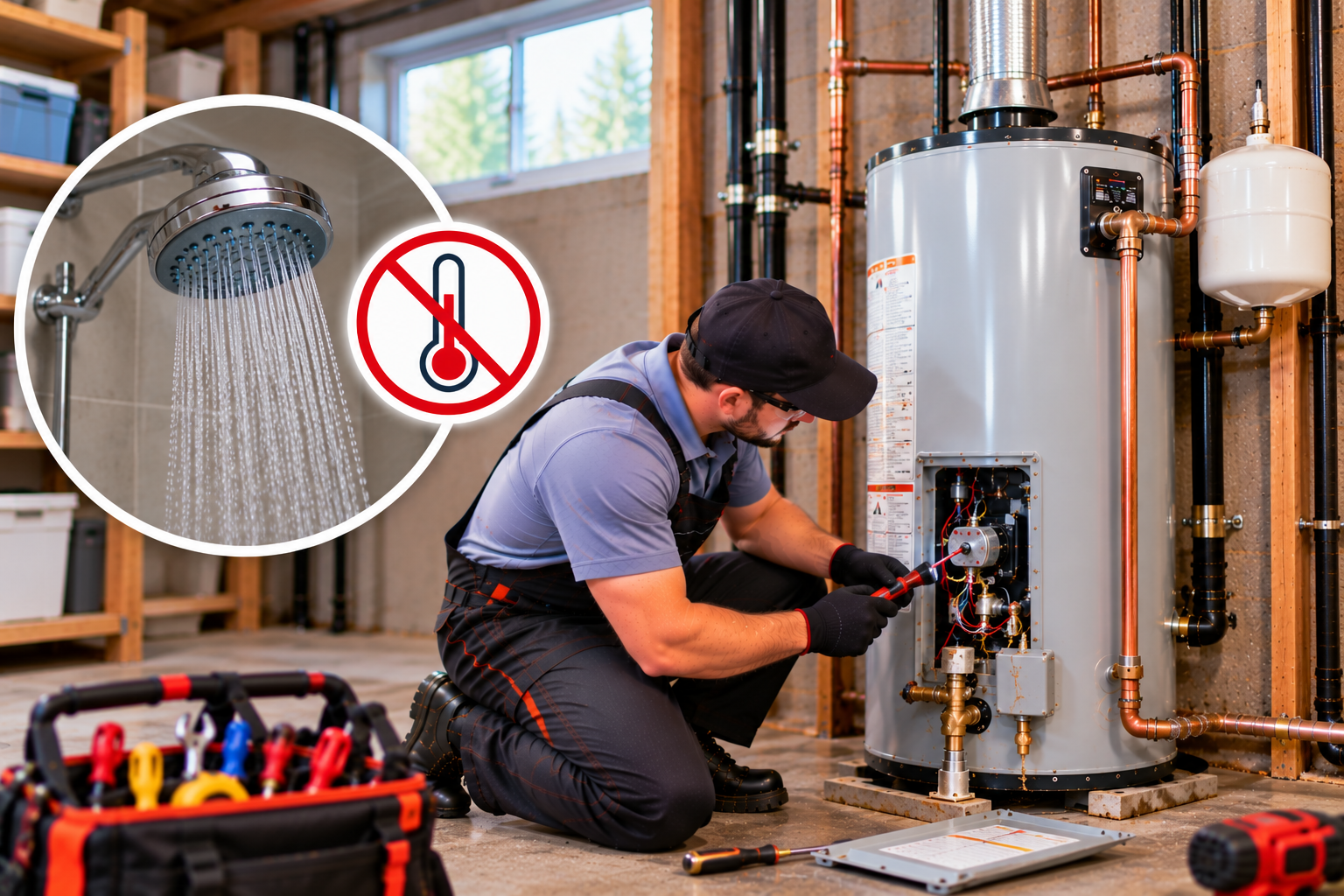

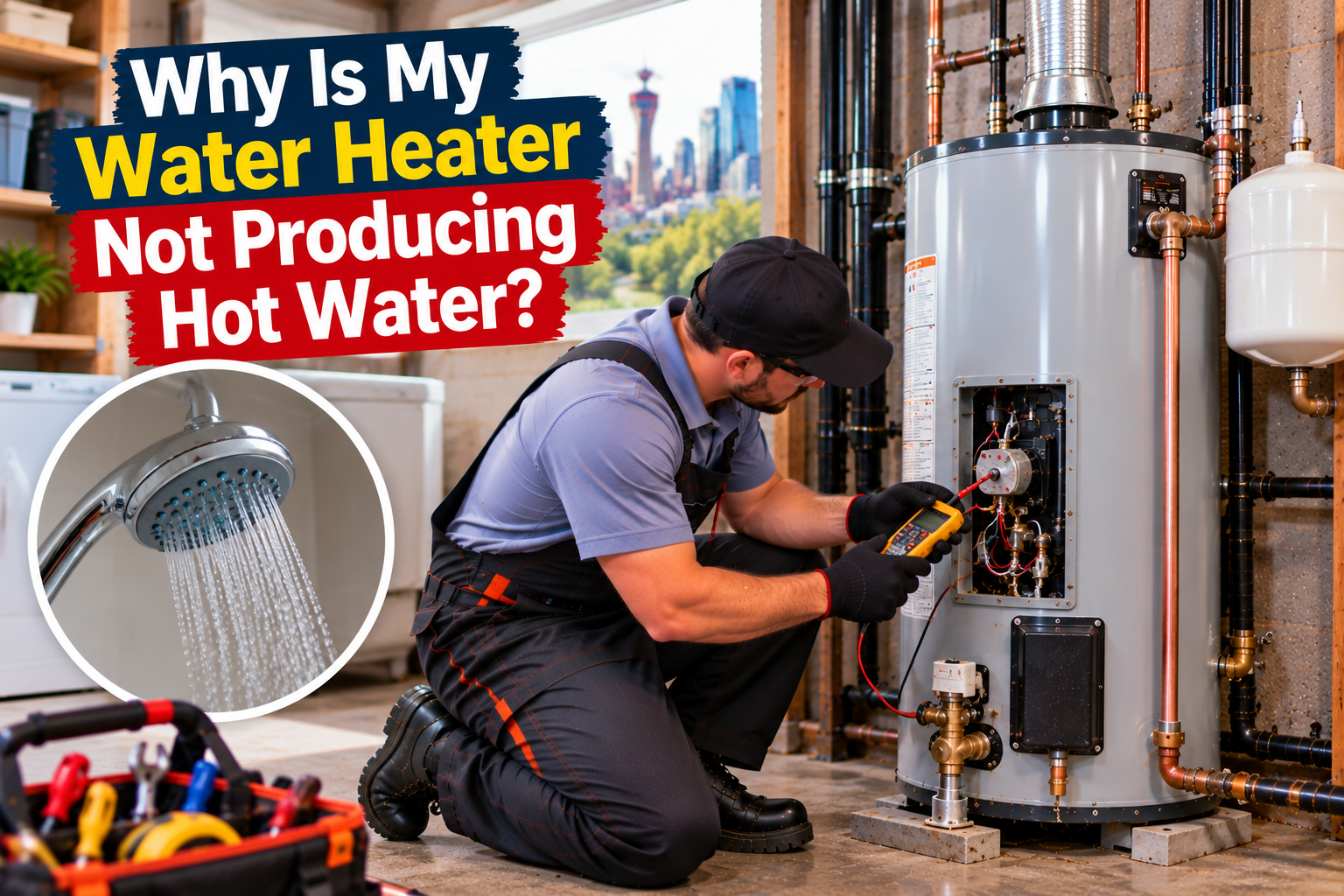
Why Is My Water Heater Not Producing Hot Water? If you have turned on the shower in your Calgary home only to discover cold water, you are probably wondering what went wrong. A water heater can stop heating because of an interrupted energy supply, a failed heating component, a malfunctioning thermostat, or another issue within the system.
Homeowners in Southeast Calgary communities such as Mahogany, Auburn Bay, Cranston, and Copperfield may have conventional gas tanks, electric storage heaters, or tankless equipment. Because these systems operate differently, identifying the cause requires understanding the appliance type. Professional water heater repair and plumbing services in Calgary can help distinguish a simple interruption from a problem requiring specialized attention.
Not every loss of hot water means the entire heater needs replacing. Some problems involve individual components, while others indicate equipment deterioration or an installation concern. This guide explains the most common causes, safe initial observations, warning signs, and how to decide whether repair or replacement is appropriate.
A water heater may stop producing hot water because of a power interruption, failed heating element, thermostat fault, gas ignition problem, defective control, or equipment deterioration. Check for obvious household supply issues without opening equipment. Persistent problems, leaks, or gas-related concerns require qualified professional assessment.
What Are the Most Common Reasons a Water Heater Stops Producing Hot Water?
When a water heater suddenly stops supplying hot water, the cause may involve the energy source, heating equipment, controls, or connected plumbing. The symptoms often provide useful clues, but similar problems can arise from different faults.
1. Interrupted Electrical Power
Electric water heaters require a functioning electrical supply to heat stored water. If power is interrupted, the appliance cannot operate normally.
A household power outage or electrical circuit problem may explain a sudden loss of hot water. However, repeated electrical interruptions can indicate an underlying fault requiring professional investigation.
Electrical components inside a water heater should not be accessed without the necessary qualifications.
2. Failed Heating Elements
Many electric storage heaters use one or more heating elements. These components transfer heat into the water inside the tank.
When an element fails, the system may produce insufficient hot water or none at all, depending on its design and which component has failed.
Replacing a defective element can sometimes restore normal operation without replacing the entire water heater.
3. Malfunctioning Thermostat
A thermostat or temperature-control system helps regulate water heating. If it malfunctions, the heater may fail to activate or may not maintain the intended temperature.
Some symptoms resemble heating element problems, making proper testing important.
A qualified technician can identify whether the issue involves the thermostat, wiring, or another component.
4. Gas Ignition or Burner Problems
Gas water heaters rely on a combustion system to heat water. Depending on the appliance, this may include electronic ignition, a pilot system, burner components, and safety controls.
If the ignition or combustion system cannot operate, the water may remain cold.
Gas-related diagnosis and repair should be performed by appropriately qualified technicians.
5. Faulty Gas Control Components
Gas water heaters use controls that manage fuel delivery and heating operation.
A defective control or safety-related component may prevent the appliance from heating, even when gas service is available elsewhere in the home.
Because these components are part of the fuel and combustion system, they should not be bypassed or modified by homeowners.
6. Sediment Accumulation
Mineral deposits and sediment can accumulate in storage tanks over time. Depending on the equipment, this buildup may contribute to noise, reduced performance, and maintenance problems.
Sediment does not explain every complete loss of hot water. A heater that suddenly produces only cold water may have an electrical, ignition, or control fault instead.
Professional diagnosis helps avoid treating sediment as the cause without evidence.
7. Damaged or Deteriorating Equipment
Water heaters can develop corrosion, internal component deterioration, and other age-related problems.
Some faults are repairable, while deterioration affecting the storage tank may make replacement necessary.
Age should be considered alongside the actual condition of the appliance, rather than treated as proof of failure.
8. Hot Water Demand Exceeds Capacity
A water heater may still function correctly but struggle to meet household demand.
Multiple showers, laundry, and dishwashing at the same time can exhaust stored hot water or exceed a tankless unit’s heating capacity.
If hot water returns after the appliance has had sufficient recovery time, the issue may involve capacity or usage patterns rather than a complete breakdown.
9. Plumbing or Fixture Mixing Problems
Not every cold-water complaint originates at the heater.
A defective shower mixing valve or another fixture-related issue can affect delivered water temperature.
When one fixture has a problem but others work normally, investigating that fixture may be more appropriate than immediately replacing the heater.
Key diagnostic clue: If every hot-water fixture produces cold water, the central water heating system deserves attention. If only one fixture is affected, the problem may be local to that fixture or its plumbing connections.
For local business information, homeowners can consult the Calgary Electrical and Plumbing Google Maps listing.
Why Do Gas, Electric, and Tankless Water Heaters Lose Hot Water?
Different water heating technologies can develop different faults. Understanding the basic differences helps homeowners describe symptoms accurately and recognize when specialist attention is required.
Gas Storage Water Heaters
Conventional gas water heaters use combustion to heat water stored in a tank.
Depending on the model, problems may involve ignition, burners, gas controls, temperature regulation, or safety systems.
A gas heater that fails to ignite cannot provide normal heating. The cause should be established by a qualified gas technician.
What If the Gas Water Heater Has No Flame?
Some older appliances use a standing pilot flame, while many newer units use electronic ignition.
The absence of a visible flame does not necessarily indicate a fault on equipment designed to ignite only when heating is required.
Use the manufacturer’s documentation to understand the appliance’s normal operation, and arrange qualified assessment if it is not heating.
Electric Storage Water Heaters
Electric tanks commonly use heating elements controlled by thermostats and protective devices.
A failed element, electrical supply problem, or defective control can interrupt heating.
Because faults may involve high-voltage components, electrical testing should be handled by qualified personnel.
Why Does an Electric Water Heater Produce Only Lukewarm Water?
Lukewarm water can indicate partial heating, high household demand, or temperature-control problems.
On some dual-element systems, one failed element may reduce available hot water rather than eliminate heating entirely.
A technician can test the equipment and determine whether a component needs replacement.
Tankless Water Heaters
Tankless systems heat water as it flows through the appliance. They rely on appropriate flow, heating capacity, and functioning controls.
Some units may display diagnostic error codes when a problem occurs.
Reduced water flow, sensor faults, ignition problems, or other equipment conditions can interfere with normal heating.
Why Does a Tankless Water Heater Turn Hot and Cold?
Temperature fluctuations may occur when demand exceeds the appliance’s capacity or when operating conditions fall outside its requirements.
Flow-related problems, control faults, and certain fixture interactions can also contribute.
Because tankless systems vary significantly, the manufacturer’s diagnostic information and professional assessment are important.
High-Efficiency and Heat Pump Water Heaters
High-efficiency equipment may use additional controls, fans, sensors, or other components depending on the technology.
Heat pump water heaters also depend on suitable surrounding air conditions and electrical operation.
When these systems stop heating, diagnosis should consider the specific appliance rather than assuming it has the same faults as a conventional tank.
Calgary Winter Conditions and Hot Water Performance
Incoming water temperatures can be lower during colder periods, increasing the heating work required to reach the desired temperature.
This can affect recovery time and the amount of hot water a system can deliver, particularly when demand is high.
For tankless equipment, the required temperature rise is an important sizing consideration.
Can the Water Heater Be Working but Still Deliver Cold Water?
Yes. Problems involving mixing valves, fixture cartridges, or certain plumbing arrangements can affect delivered water temperature even when the heater is operating.
A professional can assess whether hot water is being produced at the appliance and whether it reaches the intended fixtures.
This distinction can prevent unnecessary replacement of a functioning heater.
Equipment-specific advice: Gas, electric, and tankless systems require different diagnostic methods. Describe the appliance type, visible error messages, and affected fixtures when arranging service. Do not bypass safety controls or attempt internal electrical or gas repairs.
How Can You Learn More About Local Plumbing Services?
Homeowners comparing service options can review this Calgary plumbing business location reference.
Additional service-related information is available through the Calgary Electrical and Plumbing YouTube channel.
Request a water heater diagnosis and repair estimate in Calgary in just a few clicks.
Get My Free Estimate
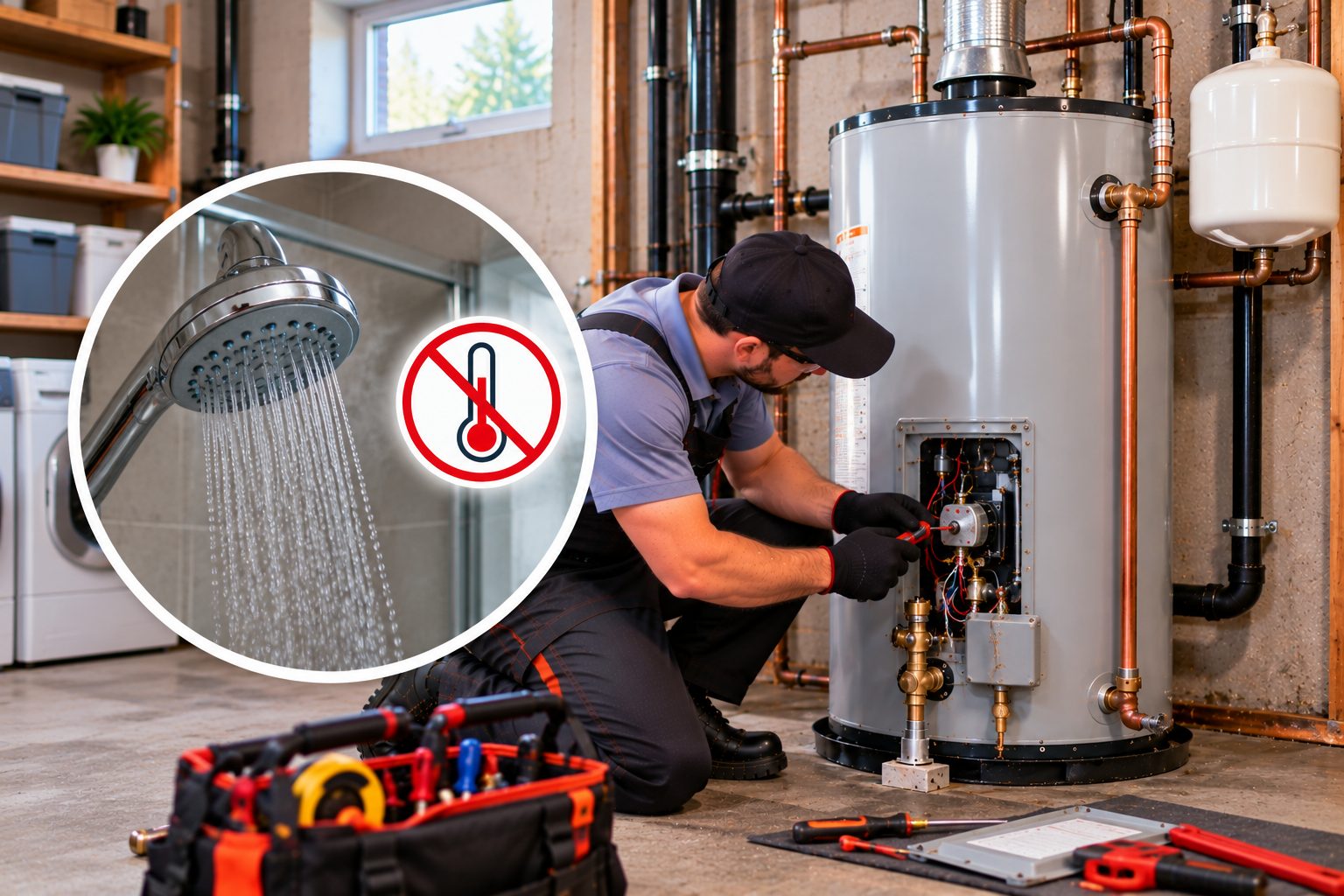
What Should Calgary Homeowners Check When There Is No Hot Water?
Some initial observations can help clarify a hot water problem without opening the appliance or handling hazardous components.
The purpose of these checks is to gather information, not to replace professional diagnosis or encourage unsafe repairs.
Check Whether Every Fixture Is Affected
Determine whether the kitchen sink, bathroom sinks, and showers all have the same temperature problem.
If every fixture is affected, the central water heating system becomes a more likely source.
If only one shower or faucet is affected, a fixture-specific problem may be responsible.
Consider Whether Hot Water Was Recently Used
Conventional storage tanks need time to recover after significant hot water use.
Several consecutive showers or simultaneous appliance use can temporarily reduce the available supply.
If the water returns to normal after a suitable recovery period, capacity or usage patterns may be contributing.
Observe Whether Other Household Equipment Has Power
A broader power interruption may affect an electric water heater.
Check whether household lighting and other appliances are operating normally without opening the heater or electrical panels.
If a circuit repeatedly trips or electrical equipment appears damaged, qualified electrical assessment is appropriate.
Look for Visible Water Around the Heater
Water near the appliance may indicate a leaking connection, valve, or tank.
Observe the area from a safe distance, especially if water is close to electrical components.
Do not assume the tank is leaking until the source has been identified.
Notice Unusual Sounds or Odours
Changes in operating noise can provide useful diagnostic information, although noise alone does not establish the cause.
A suspected gas leak is different and requires immediate attention. Leave the affected area and follow the gas utility’s emergency instructions; do not operate switches or attempt to investigate the leak.
Record Any Visible Error Messages
Some tankless and high-efficiency heaters display error codes or status messages.
Record the displayed information without opening equipment or changing internal settings.
Providing the code and appliance model to a technician can help guide the assessment.
Check Whether the Problem Is Intermittent
A heater that occasionally produces hot water may have a different problem from one that never heats.
Note when the issue occurs, whether it follows heavy water use, and whether multiple fixtures are affected.
These observations can help identify capacity limitations, control faults, or fixture-related conditions.
What If There Is Hot Water in the Kitchen but Not the Shower?
If the kitchen receives normal hot water but a shower remains cold, the heater may be operating correctly.
A mixing valve, cartridge, or fixture-specific plumbing issue may be involved.
Professional fixture diagnosis can help avoid replacing the water heater unnecessarily.
What If Hot Water Runs Out Too Quickly?
Short hot water duration may indicate increased household demand, reduced effective heating capacity, or a component problem.
For storage heaters, recovery performance and equipment sizing are relevant.
For tankless systems, simultaneous fixture flow and heating capacity deserve attention.
Should You Reset the Water Heater Yourself?
Reset procedures vary by appliance and can involve electrical or combustion-related safety systems.
Repeatedly resetting equipment without understanding why it stopped may conceal an underlying problem.
Follow manufacturer guidance for ordinary user controls only, and seek qualified assistance when a safety device trips or the fault returns.
Do not attempt hazardous troubleshooting: Avoid removing electrical covers, handling exposed wiring, modifying gas controls, relighting equipment contrary to manufacturer instructions, or disabling protective devices. Water heater repairs involving electricity, combustion, or pressure require qualified professionals.
Useful Information to Share With a Plumber
- Whether the heater is gas, electric, tankless, or another type.
- The approximate age and model, if known.
- Whether every hot-water fixture is affected.
- Whether the water is completely cold or only lukewarm.
- When the problem began and whether it is intermittent.
- Any visible leaks or appliance error messages.
- Whether the household recently experienced heavy hot water demand.
Safe troubleshooting takeaway: Identify the affected fixtures, observe visible symptoms, and note the appliance type. These steps can help a professional diagnose the problem without exposing homeowners to electrical, gas, or pressure-related hazards.
Homeowners looking for further company details can access the Calgary Electrical and Plumbing shared Google business profile.
When Does a Water Heater Need Professional Repair or Replacement?
A loss of hot water does not automatically mean the appliance must be replaced. Many problems can be corrected by repairing individual components.
However, recurring failures, significant deterioration, and storage tank damage can change the financial and practical decision.
When Is Water Heater Repair Appropriate?
Repair may be suitable when the fault is limited, the equipment is otherwise sound, and the necessary part is available.
Examples include certain thermostat failures, heating element problems, or repairable external connections.
A professional should confirm that the proposed repair addresses the underlying cause.
When Is Replacement More Practical?
Replacement may be appropriate when the storage tank itself leaks, significant corrosion is present, or major breakdowns occur repeatedly.
It may also make sense when the appliance no longer meets household hot water demand.
The decision should consider both current repair costs and expected future reliability.
Does Water Heater Age Matter?
Many conventional storage water heaters have service lives measured in roughly a decade, although actual longevity varies.
Installation quality, maintenance, usage, and operating conditions all influence performance.
An older appliance with a minor fault may still be repairable, while a newer unit with a failed tank may require replacement.
How Much Might Water Heater Repairs Cost in Calgary?
Repair pricing varies according to the fault, appliance type, labour, and replacement parts.
A straightforward component repair may cost substantially less than replacing the entire system, while complex work can become expensive.
The following broad estimates are for planning only and are not verified company quotations.
| Service | Illustrative Cost (CAD) | Main Cost Factors |
|---|---|---|
| Diagnostic assessment | $100–$250+ | Service scope, accessibility, and provider charges |
| Minor component repair | $200–$500+ | Part type, labour, and equipment design |
| Complex water heater repair | $400–$1,000+ | Specialized components, diagnostic work, and labour |
| Conventional storage-tank replacement | $1,500–$3,500+ | Equipment, installation, removal, and connections |
| Tankless water heater installation | $3,500–$7,500+ | Equipment, venting, fuel supply, and installation changes |
Pricing disclaimer: These are illustrative, nonbinding Canadian-dollar planning ranges, not verified current Calgary averages or Calgary Electrical and Plumbing prices. Actual quotes may be higher or lower. Taxes, permits, and installation modifications may affect the total.
How Do You Compare Repair and Replacement Costs?
Start with the confirmed repair expense and the condition of the existing heater.
Then compare a complete installed replacement estimate, including equipment, labour, removal, and any required modifications.
Warranty coverage, future maintenance, and expected energy consumption should also be considered.
What If the Water Heater Keeps Breaking Down?
Repeated service calls can make an aging appliance increasingly expensive to maintain.
Even if each individual repair seems affordable, cumulative costs may eventually make replacement more attractive.
Ask whether the failures are related and whether the proposed repair is likely to provide lasting improvement.
Could a New Water Heater Improve Efficiency?
Some modern water heaters use less energy than older equipment, depending on the technology and efficiency rating.
However, energy savings are influenced by household usage, fuel costs, and equipment specifications.
Higher purchase costs should be evaluated against realistic operating savings rather than assumed benefits.
Does Calgary’s Climate Affect Equipment Selection?
Calgary’s colder incoming water temperatures can influence the heating capacity required, particularly for tankless systems.
Equipment should be selected based on household demand and the temperature rise necessary to provide comfortable hot water.
For heat pump systems, installation space and surrounding air conditions are also important.
How Can Homeowners Prevent Future Hot Water Problems?
Follow the manufacturer’s maintenance recommendations and arrange professional attention when performance changes.
Regular assessment can help identify leaks, component problems, or deterioration before they become more disruptive.
Maintenance cannot prevent every failure, but it can support informed planning.
Why Do Different Calgary Homes Need Different Solutions?
A home in Seton may have a different heating system from an older property in Lake Bonavista or Riverbend.
Even neighbouring homes can have different equipment capacities, fuel sources, and maintenance histories.
The correct solution depends on the actual installation rather than the neighbourhood alone.
Should You Replace a Water Heater Before It Fails Completely?
Planned replacement may be worth considering when an older heater has recurring problems or shows significant deterioration.
However, a functioning appliance does not automatically require replacement because of age.
Condition, maintenance history, and the cost of potential repairs should guide the decision.
What Questions Should You Ask Before Authorizing Work?
- What is causing the loss of hot water?
- Can the problem be corrected by replacing a component?
- Is the storage tank structurally sound?
- What does the proposed repair include?
- Are replacement parts and labour covered by a warranty?
- Would replacement improve capacity or efficiency?
- Does the replacement estimate include removal and required modifications?
- Are permits or inspections required for the proposed work?
Practical recommendation: Have the water heater diagnosed before choosing between repair and replacement. A sound tank with a limited component fault may be worth repairing, while a leaking tank or repeated major failures may justify replacement.
Where Can You Learn More About Repair Versus Replacement?
For a detailed comparison of equipment age, repair expenses, and replacement decisions, read Water Heater Repair vs. Replacement: How Should You Decide?
Final takeaway: No hot water can result from a repairable component, an interrupted energy supply, insufficient capacity, or equipment failure. Professional diagnosis helps identify the cause and determine whether repair or replacement provides the better solution.
Request a water heater diagnosis and repair estimate in Calgary in just a few clicks.
Get My Free Estimate
Restore Reliable Hot Water in Your Calgary Home
A water heater that stops producing hot water may have a repairable component problem, an interrupted energy supply, or a more serious equipment failure. Identifying the actual cause is essential before spending money on repairs or replacement.
Whether the problem affects a gas, electric, or tankless system, a local calgary plumber can help assess the condition of your equipment and explain the available options. Call Calgary Electrical and Plumbing at (403) 421-1991 to discuss your hot water concerns.
Frequently Asked Questions about Water Heaters Not Producing Hot Water
Why is my water heater running but the water is still cold?
A water heater may appear to be operating while a heating element, thermostat, ignition component, or other control is malfunctioning. In some cases, fixture mixing problems affect delivered temperature. Professional diagnosis can determine whether the appliance is heating properly and where the fault originates.
Why does my electric water heater suddenly have no hot water?
An electric water heater may stop heating because of a power interruption, failed heating element, thermostat problem, or electrical control fault. If the problem persists, qualified assessment is recommended. Avoid opening electrical compartments or repeatedly resetting protective devices without identifying the underlying cause.
Why is my gas water heater not heating water in Calgary?
Gas water heaters can lose heating because of ignition faults, burner problems, defective controls, or other combustion-related conditions. The cause depends on the appliance design. Gas equipment should be assessed by qualified technicians, particularly when unusual odours, shutdowns, or safety concerns are present.
Can sediment buildup cause a water heater to stop producing hot water?
Sediment accumulation can contribute to reduced heating performance, unusual noises, and maintenance concerns in some storage heaters. However, complete loss of hot water may involve another fault. A technician should determine whether sediment is relevant before recommending cleaning, component repair, or replacement.
Should I repair or replace my water heater if it stops producing hot water?
Repair may be appropriate when the fault involves a replaceable component and the tank remains sound. Replacement may be more practical when the tank leaks, major failures recur, or repair costs are substantial. Compare a confirmed diagnosis with complete repair and replacement estimates.
Don’t wait for the problem to get worse.
Call (403) 421-1991 Now
Contact Our Calgary Plumbing Team