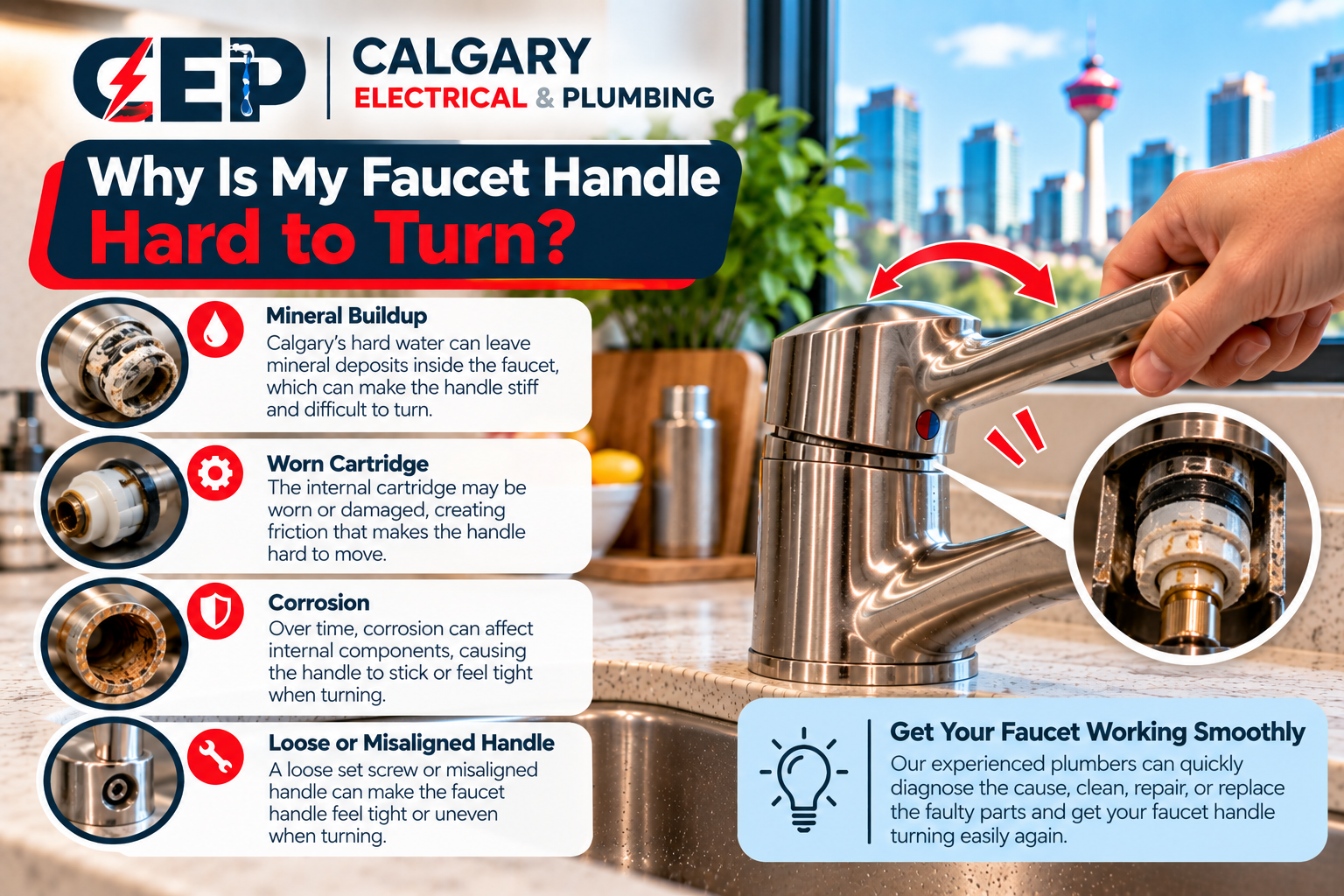

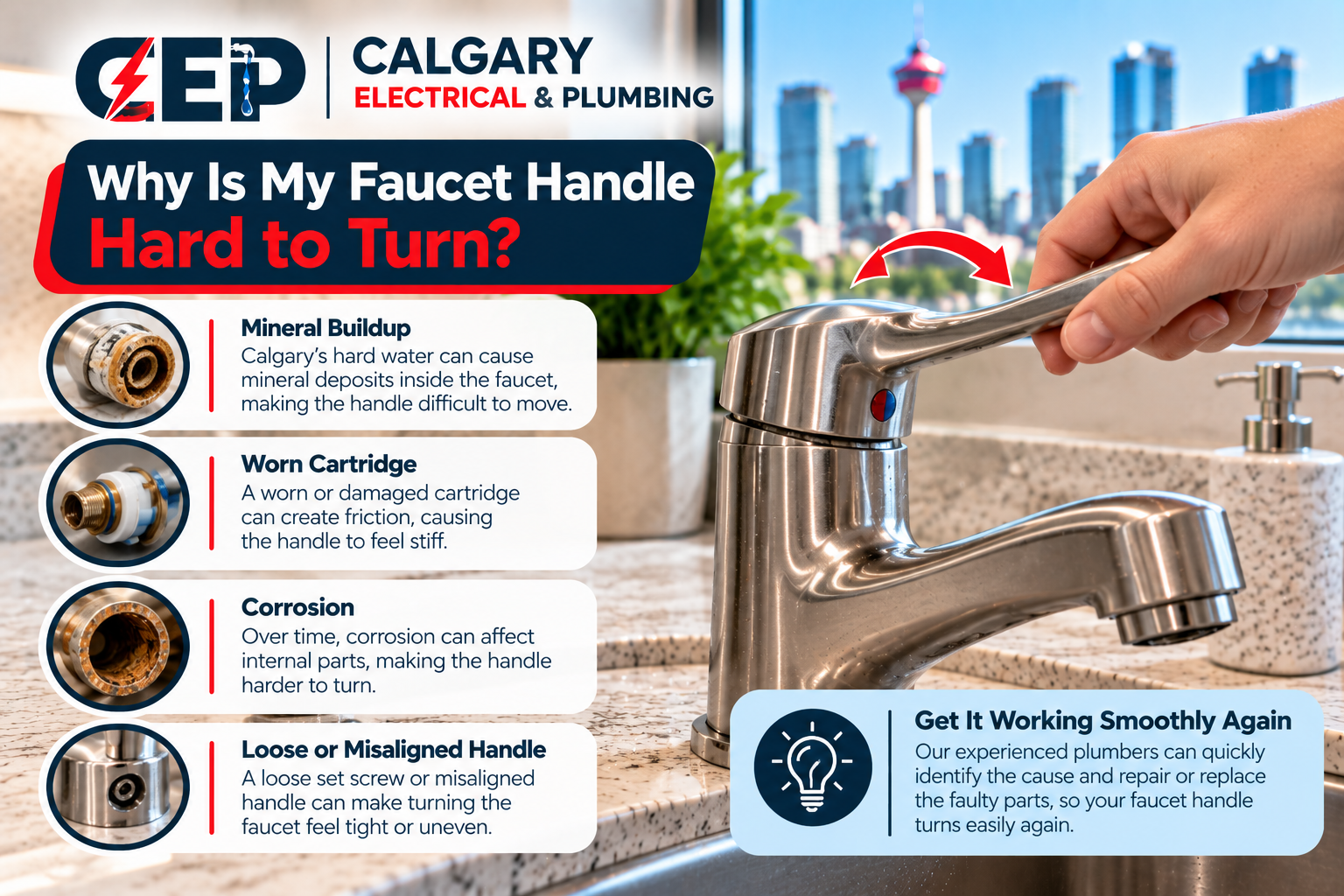
Why is my faucet handle hard to turn? When a kitchen or bathroom handle that once moved smoothly starts resisting your hand, forcing it is rarely the best answer. Mineral buildup, a worn cartridge, deteriorated seals, corrosion or internal friction may be making the faucet increasingly difficult to operate.
A stiff handle can begin as a minor inconvenience and gradually become a faucet that is difficult to open, close or control. Homeowners seeking professional faucet and plumbing service in Calgary can have the internal mechanism checked before excessive force damages the handle or other fixture components.
The symptom can appear in newer Southeast Calgary homes in Mahogany, Cranston and Seton or in established properties around Riverbend, Acadia and Ogden. The faucet’s design, age, frequency of use and condition of its internal parts all influence what is causing the resistance.
A faucet handle becomes hard to turn when mineral deposits, a worn cartridge, damaged seals, corrosion or overtightened components create resistance. Avoid forcing the handle. Identifying and correcting the underlying problem can restore smooth operation and help prevent additional faucet damage.
What Makes a Faucet Handle Hard to Turn?
A faucet handle is connected to components that control water flow and temperature. When you move the handle, the cartridge, stem or valve mechanism inside the fixture must move with it.
If one of those components develops excessive friction, the resistance transfers to the handle. The exact cause depends on the faucet type and where the internal movement has become restricted.
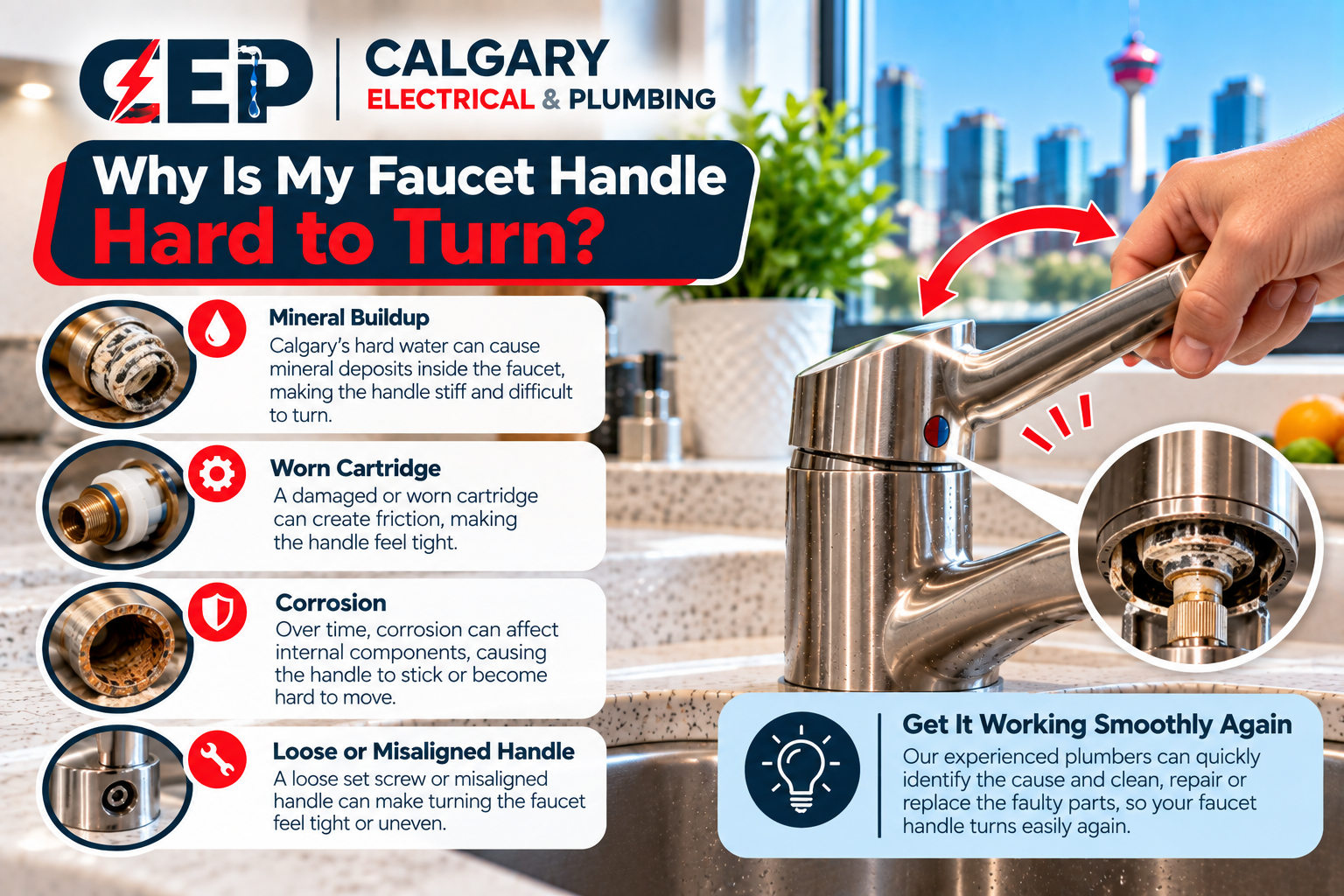
1. Mineral buildup inside the faucet
Mineral deposits can collect around cartridges, stems, seals and other moving surfaces. As deposits accumulate, components that once moved freely can become progressively harder to operate.
You may first notice that the handle feels slightly rough. Later, it may require more effort to move through its normal range or may seem to catch at certain positions.
2. A worn or failing cartridge
Many single-handle faucets use a cartridge to regulate flow and temperature. The handle moves the cartridge, so resistance inside this component can make the entire control feel stiff.
Cartridges contain moving surfaces and seals that can wear with repeated use. A deteriorating cartridge may cause stiffness, leaking, uneven temperature control or difficulty fully shutting the faucet off.
3. Dry or deteriorated internal seals
Rubber seals and O-rings help keep water inside the correct passages while allowing faucet components to move. Age, wear and mineral accumulation can affect their condition.
If a seal becomes damaged or creates excessive friction, the handle can lose its smooth movement. Using an unsuitable household lubricant is not a reliable fix because some products can damage plumbing seals or contaminate water-contact components.
4. Corrosion around internal parts
Older faucets may develop corrosion around stems, retaining hardware or internal components. This can make disassembly difficult and restrict normal handle movement.
Visible corrosion around the handle or base does not prove the internal mechanism is damaged, but it is a useful sign that the fixture deserves closer inspection.
5. An overtightened retaining nut or component
Some faucet designs use retaining hardware to hold the cartridge or valve assembly in position. If a component was overtightened during previous work, it can interfere with normal movement.
This is particularly relevant if the handle became stiff immediately after a cartridge replacement or another repair rather than gradually over months or years.
6. A damaged handle or connection
The resistance does not always originate deep inside the faucet. A damaged handle, set screw or connection between the handle and cartridge can create binding or uneven movement.
If the handle feels loose in one direction but difficult in another, the connection itself should be inspected rather than assuming the cartridge is automatically responsible.
7. Debris inside the faucet
Small particles can enter fixture passages after plumbing work or a water shutoff. If debris reaches a cartridge or moving surface, it may interfere with normal operation.
A sudden change after plumbing work deserves different consideration from a handle that has slowly become harder to turn over several years.
Homeowners arranging service can confirm the company’s local presence through its Calgary plumbing service location on Google Maps.
How to Diagnose a Stiff Faucet Handle
The way the handle behaves provides useful clues. Notice if the resistance affects the complete range of movement, appears only near the closed position or changes when you move from cold to hot.
Check if the stiffness developed suddenly or gradually
A gradual change often points toward wear, mineral accumulation or aging seals. A handle that becomes difficult immediately after repair work may involve installation, alignment or retaining hardware.
Write down when you first noticed the change. This simple detail can help narrow the possibilities during professional diagnosis.
Notice if the faucet is also leaking
A stiff handle combined with a dripping spout can point toward cartridge or valve wear. Water around the faucet body adds another clue because internal seals may also be deteriorating.
If moisture is appearing around the bottom of the fixture, this guide to finding the cause of a faucet base leak explains why cartridges, O-rings, mounting seals and connections should be distinguished from one another.
Observe the direction of resistance
With a single-handle kitchen faucet, determine if the control is difficult to lift, rotate or both. Different motions can operate different parts of the cartridge.
On a two-handle faucet, compare the hot and cold controls. If one turns smoothly while the other is stiff, the problem is probably localized to the affected side rather than the entire faucet.
Look for visible mineral deposits
White or chalky deposits around the handle, spout or other joints can indicate mineral accumulation. Deposits on the outside do not reveal the complete condition inside, but they can support other signs of buildup.
Heavy buildup around a moving joint may also make disassembly more difficult, especially if the fixture has not been serviced for years.
Check for corrosion or looseness
A stiff handle should not automatically be tightened. First check if it also wobbles, tilts or has visible corrosion near its attachment point.
A loose handle can bind against surrounding components and feel difficult even when the internal cartridge still moves reasonably well.
Do not use excessive force
Using pliers or another tool directly on a decorative handle can scratch the finish or break the control. More importantly, excessive force can damage the cartridge stem underneath it.
If ordinary hand pressure no longer operates the faucet comfortably, that is a sign to investigate the restriction rather than simply applying more force.
Homeowners who prefer visual service information can also visit the company’s Calgary plumbing video channel for additional home-service content.
Request a faucet repair estimate in Calgary in just a few clicks.
Get My Free Estimate
What Does a Stiff Faucet Handle Cost to Repair?
Repair cost depends on what is creating the resistance. A loose handle connection or serviceable seal can require less work than a seized cartridge in an older faucet with corrosion and mineral buildup.
The faucet brand matters as well. Common cartridges may be readily available, while specialty or discontinued fixtures can require additional time to identify and source compatible parts.
| Possible Faucet Problem | Approximate Calgary Planning Range | What Can Affect Cost |
|---|---|---|
| Minor handle adjustment or simple seal issue | $150–$250 | Fixture design, access and condition |
| Cartridge replacement | $180–$350 | Brand, cartridge price, buildup and labour |
| Complex internal faucet repair | $250–$450+ | Corrosion, seized components and uncommon parts |
| Standard faucet replacement | $250–$650+ | New fixture, installation and supply connections |
| Additional valve or supply work | $175–$400+ | Shut-off condition, accessibility and related plumbing |
Important: These figures are general Canadian-dollar planning ranges rather than fixed quotes. Labour, parts, taxes, faucet design, service timing, accessibility and additional plumbing problems can change the actual repair cost.
Scenario: a stiff kitchen faucet in Mahogany
Consider a single-handle kitchen faucet that has become progressively harder to rotate from cold to hot. It does not leak, the base is secure and the water flow remains normal.
Those symptoms make an internal movement problem more relevant than supply pressure. If the cartridge is worn or restricted by deposits, replacing the correct component may restore normal handle movement without replacing the entire fixture.
Scenario: one bathroom handle is stiff in Cranston
A two-handle bathroom faucet provides a useful comparison. If the cold handle moves smoothly but the hot handle requires noticeably more effort, the problem is likely associated with the hot-side valve mechanism.
This is different from both handles becoming stiff at approximately the same rate, which may encourage a broader look at fixture age and mineral accumulation.
Scenario: an older faucet in Riverbend
An older faucet may have a stiff handle along with corrosion, a loose base and occasional dripping. Repairing only the handle resistance could leave several other aging components in service.
In that situation, the cost of replacing individual parts should be compared with the price and expected service life of a complete new fixture.
Why forcing the handle can increase repair costs
A stiff cartridge can often be replaced. A cartridge stem broken inside the faucet can make the job more complicated, especially if the damaged component becomes difficult to remove.
The same applies to decorative handles and set screws. Damage caused by excessive force can create replacement needs that did not exist when the stiffness first appeared.
Can a stiff handle cause a faucet to drip?
The two symptoms can be related. A worn cartridge or valve mechanism may both resist movement and fail to seal completely when the handle is closed.
If you have to push or twist the handle into a particular position to stop dripping, the internal control mechanism deserves inspection rather than increasingly forceful operation.
Can the faucet become difficult to shut off completely?
Yes. A deteriorating internal mechanism may make it harder to reach the normal closed position. This can leave the faucet dripping even though the handle appears to have reached its stopping point.
Continually tightening or forcing the control can accelerate wear in some faucet designs. Restoring proper internal movement is the better solution.
Additional company information can be found through the Calgary Electrical and Plumbing Google business profile.
Should You Repair or Replace the Faucet?
A hard-to-turn handle does not automatically mean the complete faucet is finished. If the fixture is otherwise in good condition, a targeted internal repair may restore smooth operation.
Replacement becomes more attractive when stiffness is only one symptom among several. Faucet age, corrosion, leaks, damaged finish, unavailable parts and repeated repair history all matter.
Repair often makes sense for one failed component
A relatively new faucet with a worn cartridge is generally a better repair candidate than an old fixture with several deteriorating components.
If the body is secure, the finish is healthy and replacement parts remain available, correcting the specific internal fault can extend the useful life of the faucet.
Replacement may be better for an aging fixture
Suppose a kitchen faucet has a stiff handle, leaks around the body and has a worn pull-down hose. Repairing each problem separately can add up.
In that case, comparing the total repair cost with a complete replacement gives the homeowner a more useful picture than considering the stiff handle alone.
What should you do before calling a plumber?
Note how the handle behaves. Is it hard to lift, rotate or close? Does the resistance affect hot and cold positions equally? Does the faucet drip after you manage to close it?
Also look for water around the handle, base and cabinet below. Multiple symptoms can help identify the component involved.
Should you remove the cartridge yourself?
Some homeowners are comfortable servicing simple faucet components, but cartridges can become tightly seated because of mineral deposits or age. Removing them improperly can damage the faucet body.
DIY repair is also more complicated when the shut-off valves do not close properly. Water should be reliably isolated before internal faucet components are disassembled.
What lubricant is safe for a faucet?
Plumbing fixtures use materials that may not be compatible with general-purpose oils or sprays. Applying an unsuitable product can damage rubber components or create contamination concerns.
If lubrication is appropriate for a particular faucet, only a product compatible with potable-water plumbing and the manufacturer’s components should be considered. Lubrication also does not correct a damaged cartridge or corroded part.
Why is the handle stiff only in the morning?
Intermittent stiffness can occur when internal seals, temperature changes or deposits affect component movement differently after the faucet has been unused for several hours.
The timing alone does not identify the failed part. If the symptom repeatedly disappears after several movements and returns after periods of inactivity, mention that pattern during service.
Why does the faucet squeak when turning?
A squeak or grinding sensation can accompany friction inside the handle, cartridge or stem assembly. Mineral deposits, deteriorated seals and worn components are possible contributors.
Sound combined with increasing resistance is a stronger reason to investigate the fixture instead of continuing to operate it with additional force.
What if the handle suddenly becomes loose after being stiff?
A sudden change from stiff to unusually loose can indicate that a handle connection, screw, cartridge stem or another component has shifted or failed.
If the handle no longer controls water normally, avoid repeatedly moving it. The connection between the visible control and internal valve mechanism should be inspected.
Can mineral deposits be prevented completely?
Routine cleaning can reduce visible deposits around faucet outlets and exterior surfaces, but it cannot guarantee that internal components will remain free of buildup indefinitely.
Fixture design, water conditions and frequency of use all influence how internal parts age. Early attention when a handle begins feeling different can prevent the problem from progressing unnoticed.
Why faucet age matters
A newer fixture experiencing its first stiff cartridge is different from a faucet that has operated for many years and already required multiple repairs.
Parts availability also changes over time. A repair that is straightforward for a current faucet model may be less practical when compatible cartridges or handles have become difficult to source.
Check the shut-off valves before repair
Any internal faucet repair normally requires reliable water isolation. Older shut-off valves beneath a sink can become seized or fail to stop water completely.
If the valves are heavily corroded or difficult to operate, they may require attention before the faucet itself can be safely serviced.
Local considerations across Southeast Calgary
A busy family kitchen faucet in New Brighton or McKenzie Towne may experience frequent daily use, while a lightly used basement fixture in Douglasdale may age differently. Usage patterns influence wear just as much as fixture age.
Homes in Acadia, Riverbend and Ogden may also contain older faucets or shut-off valves, while newer properties in Seton and Mahogany can still experience premature cartridge or seal problems.
Homeowners can follow Calgary plumbing maintenance updates on Facebook or view shorter local plumbing updates on X for additional company information.
The company’s Calgary plumbing profile on Reddit provides another online reference point for people researching its digital presence.
Request a faucet repair estimate in Calgary in just a few clicks.
Request My Faucet Estimate
Do Not Let a Stiff Handle Become a Broken Faucet
A faucet handle that becomes difficult to turn is often an early warning that something inside the fixture needs attention. Mineral deposits, worn cartridges, damaged seals and corrosion can all increase resistance, and forcing the handle can create additional damage.
If the stiffness continues or is accompanied by leaking, a local Calgary plumber can identify the failed component and determine if repair or replacement makes more sense. Call (403) 421-1991 for help restoring smooth, controlled faucet operation.
Frequently Asked Questions about Stiff Faucet Handles
Why is my faucet handle suddenly hard to turn?
A faucet handle can suddenly become stiff because of a cartridge problem, debris, deteriorated seals, corrosion or binding around the handle mechanism. If the change appeared after plumbing work in your Calgary home, installation or debris-related issues may also deserve investigation.
Can mineral buildup make a faucet handle difficult to move?
Yes. Mineral deposits can collect around cartridges, stems and other moving surfaces, increasing friction and making a faucet harder to operate. Visible deposits can be a useful clue, but the fixture may need inspection to determine how much buildup exists internally.
Should I force a stiff faucet handle to turn?
No. Excessive force can damage the handle, cartridge stem or internal valve mechanism and may turn a straightforward repair into a more involved one. If normal hand pressure no longer operates the faucet comfortably, Calgary homeowners should investigate the cause instead.
Does a hard-to-turn faucet need a new cartridge?
Not always. A worn cartridge is a common cause, but handle hardware, mineral buildup, seals and corrosion can create similar resistance. Identifying the faucet model and inspecting its moving components helps determine if cartridge replacement is actually necessary.
When should I call a plumber for a stiff faucet in Calgary?
Call a plumber when the handle keeps getting harder to move, the faucet leaks, the control no longer closes properly or internal parts cannot be serviced safely. Professional diagnosis can also help when shut-off valves are seized or heavily corroded.
Don’t force the handle and risk damaging the fixture.
Call (403) 421-1991 Now
Local Help Available 24/7 in Calgary