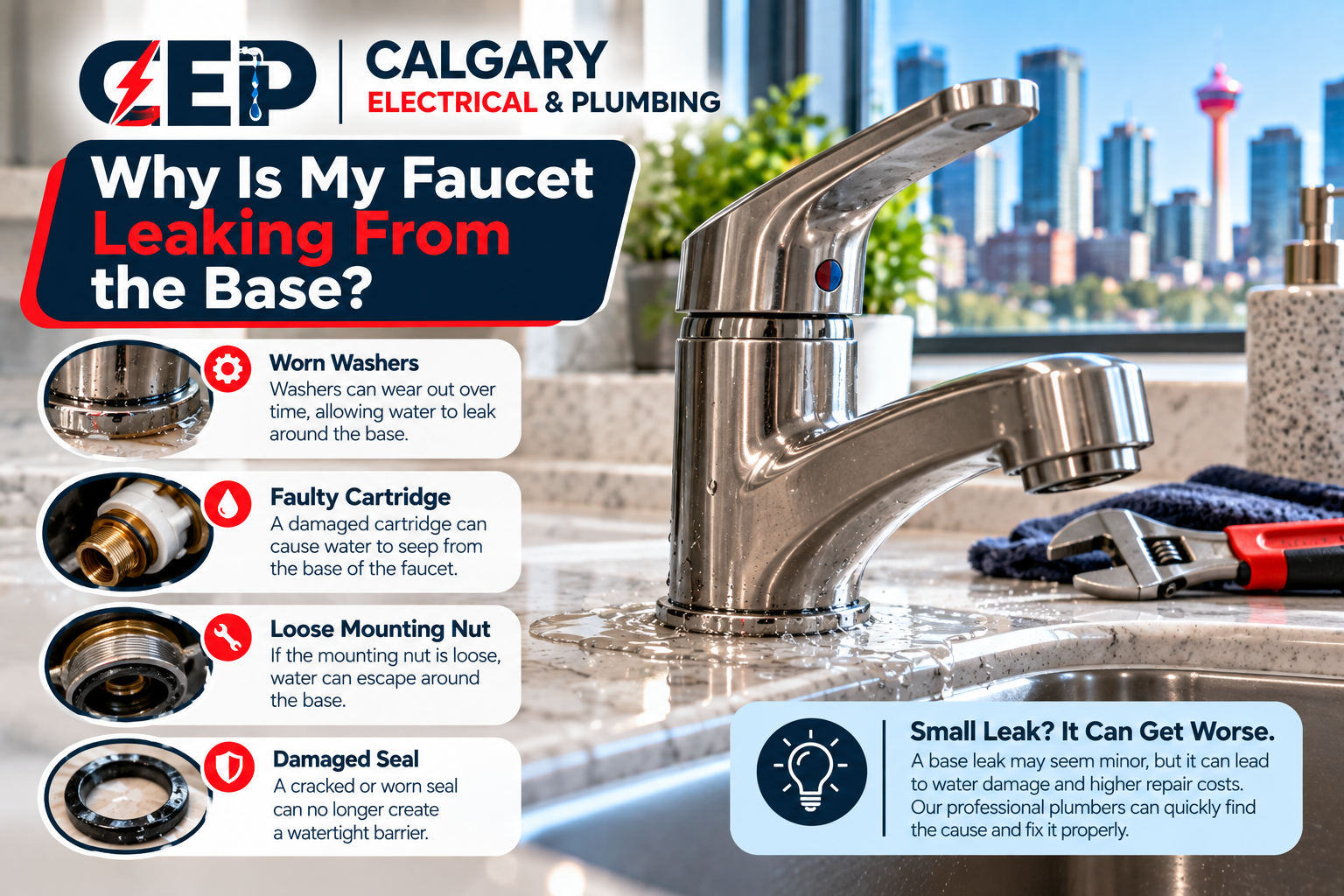

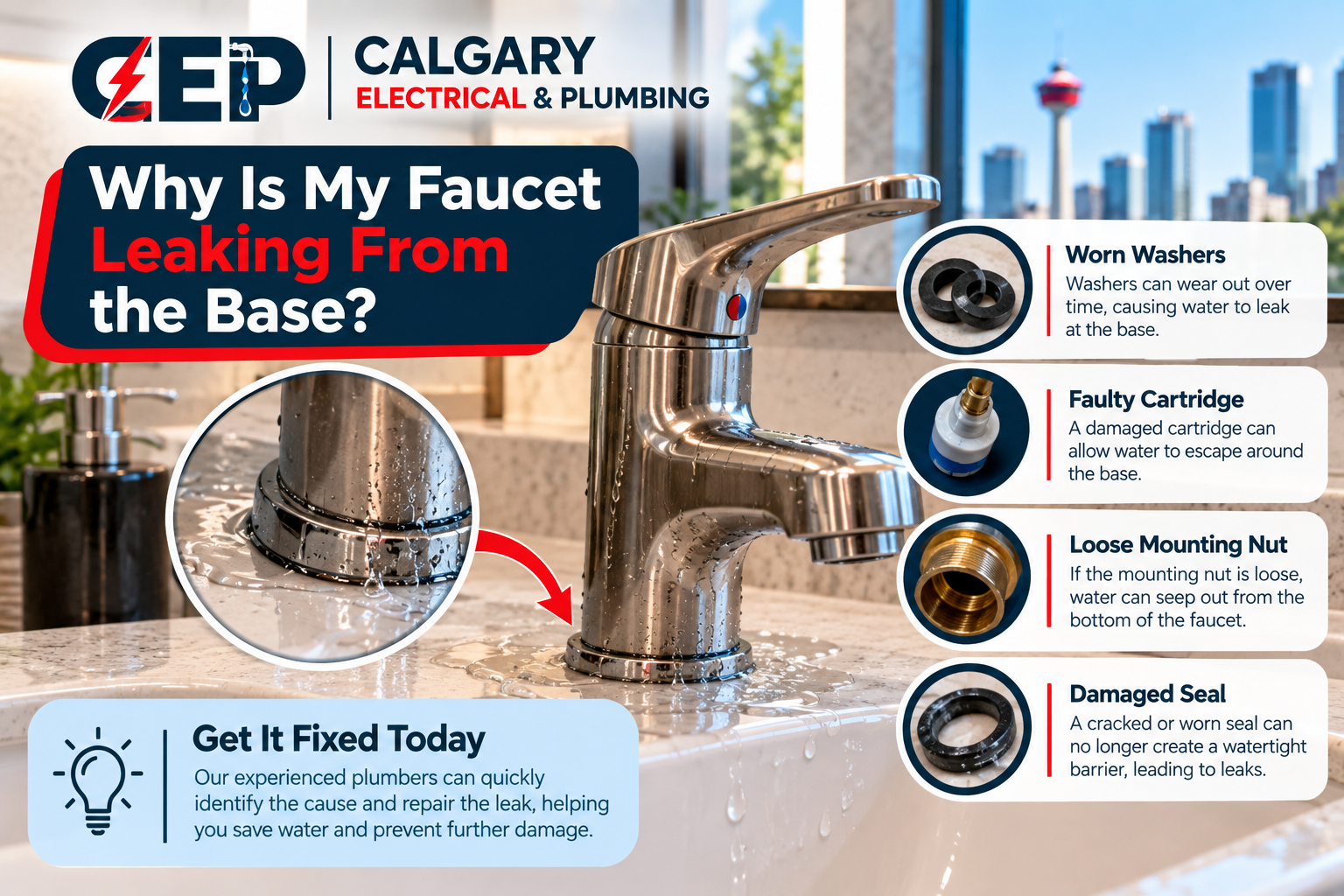
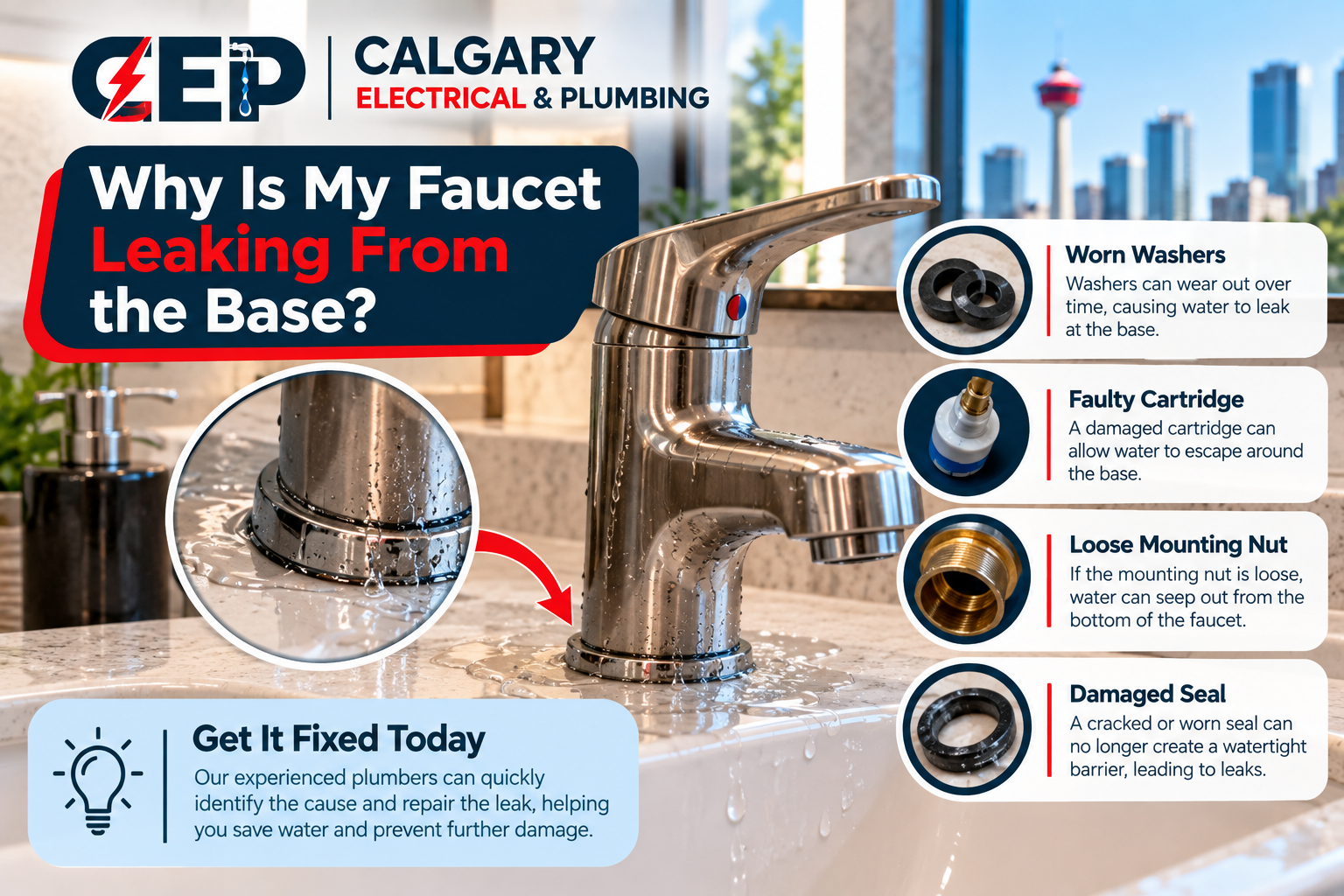
Why is my faucet leaking from the base? If you wipe the sink dry only to see water appear around the faucet again, something inside or beneath the fixture may no longer be sealing correctly. Common causes include worn O-rings, cartridges, loose mounting components, damaged seals and deteriorated connections.
The difficult part is determining where the water actually begins. Homeowners looking for trusted plumbing support for Calgary homes should have the source identified before replacing random parts, because water around the base can sometimes travel from the handle, spout or supply connections.
In Southeast Calgary homes from Mahogany and Cranston to Riverbend, Ogden and Douglasdale, the same symptom can have very different causes. A newer faucet may need one internal seal, while an older fixture can have corrosion, loose hardware and aging supply connections at the same time.
A faucet usually leaks from the base because an O-ring, cartridge, gasket, mounting seal or connection has worn or loosened. First identify exactly where the water starts. Persistent base leaks should be repaired before moisture damages the sink cabinet, countertop or surrounding materials.
What Causes a Faucet to Leak From the Base?
A faucet is made up of several sealing points. Water travels through pressurized supply lines, internal valves and the spout, so a failure at one location can allow moisture to appear somewhere else.
This is why seeing water around the base does not automatically identify the failed part. Correct diagnosis begins by drying the fixture and determining exactly where fresh water first becomes visible.
1. Worn O-rings around the faucet body
O-rings are small rubber seals used in many faucet assemblies. They help prevent water from escaping between moving or connected parts of the fixture.
With age, an O-ring can flatten, crack, harden or lose elasticity. Once it stops sealing properly, water may escape from the faucet body and collect around the base, especially while the fixture is running.
2. A deteriorated cartridge or cartridge seal
Cartridge faucets rely on an internal assembly to control water flow and temperature. If the cartridge or its seals deteriorate, water may leak into areas where it should not be travelling.
Some cartridge failures cause a drip from the spout. Others can allow moisture to appear near the handle or base. The exact symptom depends on the faucet design and which sealing surface has failed.
3. A loose faucet assembly
A faucet should be securely mounted to the sink or countertop. Years of handle movement, cleaning and normal use can sometimes loosen mounting hardware beneath the fixture.
Loose mounting does not always create a pressurized plumbing leak by itself, but movement can compromise seals and allow water from normal sink use to work beneath the faucet base.
4. A failed base gasket or mounting seal
Many faucets have a gasket or sealing material between the fixture and mounting surface. Its job includes limiting water intrusion beneath the faucet.
If that seal deteriorates or the faucet becomes loose, water splashed onto the countertop can travel underneath the fixture. This can look very similar to an internal faucet leak.
5. A leak from the handle that runs downward
Water follows gravity and surface contours. A small leak around a faucet handle may run down the fixture and pool at the base, making the bottom of the faucet appear to be the source.
Drying the complete fixture before testing it can reveal this pattern. Watch the handle and faucet body closely while the water is running instead of looking only at the countertop.
6. Supply-line or connection problems below the sink
Sometimes the visible moisture above the sink and the actual plumbing problem below it are separate issues. Flexible supply lines, threaded connections and shut-off valves can all develop leaks.
Check the cabinet beneath the sink whenever water appears around a faucet. Moisture underneath deserves faster attention because it can affect cabinetry and other materials without remaining visible from above.
Homeowners planning service can confirm the company’s presence through its Southeast Calgary service location on Google Maps.
How to Find Where the Water Is Coming From
Finding the starting point is more useful than simply noticing where the water ends up. A careful visual check can provide valuable information without dismantling the faucet.
Dry the faucet and surrounding sink completely
Start with a dry surface. Wipe the faucet body, handles, base, countertop and the area underneath the sink. Existing moisture makes it difficult to identify fresh water.
Once everything is dry, run the faucet normally and watch the fixture closely. Look for the first point where moisture develops rather than waiting for a puddle to form.
Watch the handle area first
Water emerging near the handle can indicate a cartridge, packing or seal problem. From there, it may travel down the faucet body and collect at the bottom.
This distinction matters because resealing the mounting surface will not correct water that is escaping from inside the fixture.
Check the base while the water is running
If the handle remains dry but water begins emerging directly where the faucet body meets the sink, an internal seal, swivel-spout O-ring or another base component may be involved.
The exact repair depends heavily on faucet design. A pull-down kitchen faucet does not necessarily use the same sealing arrangement as a widespread bathroom fixture.
Test carefully for splash-related water
Some apparent faucet leaks are actually water intrusion from everyday sink use. Water can splash onto the countertop and work beneath a loose or poorly sealed faucet base.
If the area stays dry while the faucet runs directly into the drain but becomes wet after water reaches the mounting area, the base seal deserves closer examination.
Inspect underneath the cabinet
Use a flashlight to look at the supply lines, faucet connections and shut-off valves. Touch a dry paper towel to suspicious connections; even a small amount of moisture can reveal a slow leak.
Do not ignore dampness because it seems minor. Enclosed cabinets can hold moisture against wood products and stored belongings for long periods.
Consider Calgary’s mineral-rich water
Mineral deposits can collect around faucet components and sealing surfaces. Visible white or chalky deposits may be a sign that water has been escaping slowly or that mineral buildup is affecting moving components.
Calgary’s water conditions do not mean every base leak is caused by scale. However, deposits and corrosion can complicate disassembly and should be considered when an older fixture has multiple symptoms.
For homeowners who prefer visual service information, the company’s Calgary plumbing videos on YouTube provide additional home-service and plumbing content.
Request a faucet repair estimate in Calgary in just a few clicks.
Get My Free Estimate
How Much Does a Faucet Base Leak Cost to Repair?
The cost depends on what is actually leaking. Replacing an accessible O-ring is different from repairing a cartridge, correcting damaged mounting hardware or dealing with a deteriorated shut-off valve beneath the sink.
For planning purposes, many straightforward professional faucet repairs fall within the low hundreds of dollars. More complicated work can cost more when parts are difficult to source, components are corroded or additional plumbing repairs are required.
| Possible Problem | Approximate Calgary Planning Range | What Can Affect the Cost |
|---|---|---|
| O-ring, gasket or minor seal repair | $150–$250 | Faucet design, access, parts and labour |
| Cartridge or internal component repair | $180–$350 | Brand, cartridge availability, deposits and corrosion |
| Mounting or connection correction | $175–$350+ | Access below sink, hardware condition and related components |
| Standard faucet replacement | $250–$600+ | New fixture, installation, supply connections and modifications |
| Complex leak with additional plumbing work | $350–$700+ | Shut-off valves, supply lines, corrosion or multiple defects |
Important: These are approximate budgeting ranges in Canadian dollars, not fixed prices. Fixture type, replacement parts, labour, taxes, accessibility, service timing and other plumbing defects can change the final estimate.
Why diagnosis affects the price
Two faucets can create nearly identical puddles while requiring completely different repairs. That makes quoting from the visible water alone unreliable.
A plumber may need to run the fixture, inspect the handles, examine the base, check beneath the sink and test connections before determining which component is responsible.
Scenario: a kitchen faucet in Cranston
Imagine a pull-down kitchen faucet that leaks only while water is flowing. The countertop stays dry when the fixture is off, and inspection shows moisture emerging where the rotating spout meets the body.
If worn O-rings are responsible and the rest of the faucet remains in good condition, a targeted repair may restore the fixture without replacing it.
Scenario: an older faucet in Riverbend
Now consider an older kitchen faucet with visible corrosion, a loose base and moisture inside the cabinet. The shut-off valves are also difficult to operate.
Although the homeowner first noticed water around the faucet base, the complete repair may involve more than one component. Comparing the cost of restoring the old fixture with replacement becomes much more important.
Scenario: water around a bathroom faucet in Mahogany
A bathroom faucet may appear to leak around its mounting point even when the plumbing is sound. Water from wet hands and routine sink use can collect around a loose or deteriorated base seal.
In this situation, testing the fixture on a completely dry countertop helps distinguish pressurized leakage from surface water entering beneath the faucet.
Can a base leak damage the cabinet?
Yes, particularly if water is reaching the underside of the sink. Cabinet materials can absorb moisture, and repeated wetting can cause swelling, staining or deterioration.
The risk is greater when the leak is hidden. Water around the top of the sink is usually noticed quickly; a slow connection leak inside a dark cabinet can continue much longer before discovery.
Homeowners can find additional company and home-service information through Calgary plumbing updates on Facebook while learning more about maintenance and repair options.
Should You Repair or Replace a Leaking Faucet?
A base leak does not automatically mean the faucet needs replacement. Many fixtures can be repaired successfully when the problem is limited to an O-ring, cartridge, gasket or other serviceable component.
The better question is how healthy the rest of the faucet is. Age, corrosion, previous repairs, parts availability and additional problems all influence the value of another repair.
Repair makes sense when the fixture is otherwise sound
A relatively new faucet with good finish, solid mounting and one identifiable failed seal is usually a strong repair candidate. Replacing the complete fixture could create unnecessary material and installation costs.
This is particularly true when the manufacturer still supplies replacement components and the faucet has not developed a history of recurring problems.
Replacement becomes attractive when failures accumulate
A faucet with a leaking base, corroded body, loose handle, deteriorated hose and previous repair history presents a different calculation. Correcting one component may simply leave several other aging parts in service.
When repair costs begin approaching a meaningful portion of replacement cost, compare both options before proceeding.
Do not simply apply caulk around the faucet
Sealing around the outside of the fixture can hide water temporarily without repairing an internal leak. If pressurized water is escaping from inside the faucet, exterior caulk does not correct the failed component.
First identify the source. Sealing the mounting surface only makes sense when the plumbing is sound and the problem genuinely involves surface water entering around the fixture.
What should you do when you notice water at the base?
Dry the fixture and countertop, then observe when the moisture returns. Check the faucet while it is off, while cold water runs, while hot water runs and immediately after the handle is closed.
Look beneath the sink as well. If water is actively escaping into the cabinet, move stored belongings away from the wet area and address the leak rather than continuing normal faucet use.
What if the leak appears only when the faucet swivels?
Some kitchen faucets use O-rings around a rotating spout. If water appears when the spout moves from side to side, worn or damaged seals around that assembly may be involved.
Mineral deposits can also affect the movement and sealing surfaces. Correct repair depends on the exact faucet model and condition of the components after disassembly.
What if water leaks only when the handle is on?
A leak that occurs exclusively while water is running often suggests that pressure is exposing a failed internal seal, cartridge, connection or O-ring.
That pattern is useful information for a plumber. It helps separate an active plumbing leak from water that simply splashes onto the faucet during ordinary sink use.
Why checking below the sink matters
The visible faucet is only the top portion of the assembly. Mounting hardware, supply connections and shut-off valves are located below, where leaks may remain hidden.
Use a flashlight rather than reaching blindly around wet plumbing. If significant water is present or electrical equipment is nearby, avoid unnecessary contact and have the problem assessed safely.
Do loose faucets cause base leaks?
A loose faucet can contribute to leakage by allowing movement at gaskets and mounting surfaces. The movement may also permit ordinary sink water to work underneath the fixture.
Simply tightening hardware is not always enough. The seal should be inspected because a damaged gasket may continue allowing water through even after the faucet is secured.
Can mineral buildup damage faucet seals?
Mineral deposits can interfere with moving and sealing surfaces. They can make cartridges harder to operate, restrict aerators and accumulate around joints where small leaks have been present.
Heavy deposits can also make older fixtures more difficult to disassemble without damaging components. This is one reason the condition of the complete faucet matters when comparing repair with replacement.
How urgent is a faucet base leak?
A small amount of water confined to the sink deck is different from active leakage into a cabinet. The second situation deserves quicker attention because surrounding materials may be exposed continuously.
If water is spreading rapidly, a supply connection has failed or the fixture cannot be isolated, the priority is controlling the water and preventing property damage.
Local considerations in Southeast Calgary homes
Plumbing conditions vary across Southeast Calgary. Newer homes in Seton, Auburn Bay, Mahogany and Cranston can still experience failed cartridges, seals and loose connections even though their fixtures are comparatively recent.
Established communities such as Acadia, Ogden and Riverbend may also contain older fixtures, shut-off valves and supply connections. The age of the faucet and the plumbing underneath it should therefore be considered separately.
Homeowners looking for shorter service updates can also follow local plumbing information on X as an additional source of company information.
Request a faucet repair estimate in Calgary in just a few clicks.
Request My Faucet Estimate
Find the Source Before the Leak Spreads
Water around a faucet base can come from an O-ring, cartridge, mounting seal, loose fixture, handle leak or connection beneath the sink. Finding where fresh water first appears is the key to avoiding unnecessary repairs and protecting the surrounding cabinet and countertop.
If you need a local Calgary plumber to diagnose a leaking kitchen or bathroom faucet, call (403) 421-1991. A proper inspection can determine if a targeted repair will solve the problem or if replacement offers better long-term value.
Frequently Asked Questions about Faucet Base Leaks
Why is water leaking around the base of my faucet?
Water around a Calgary faucet base can come from a worn O-ring, cartridge, gasket, loose mounting seal or another internal component. Water may also travel down from the handle, so drying the fixture and identifying where fresh moisture first appears is important.
Why does my faucet leak from the base only when it is turned on?
A leak that appears only while the faucet is running can indicate a worn internal seal, cartridge, O-ring or connection exposed to water pressure. Calgary homeowners should also check beneath the sink because supply connections can leak while the fixture is operating.
Can I seal a leaking faucet base with caulk?
Caulk should not be used to hide an internal plumbing leak. It may help prevent surface water from entering beneath a properly functioning fixture, but a failed cartridge, O-ring or pressurized connection must be repaired rather than sealed from the outside.
Should I replace a faucet that is leaking from the base?
Not necessarily. A Calgary faucet in good condition may only need an O-ring, cartridge or gasket. Replacement becomes more practical when the fixture is heavily corroded, structurally damaged, repeatedly repaired or has several worn components that make another isolated repair poor value.
When should I call a plumber for a faucet base leak in Calgary?
Arrange plumbing service when the source is unclear, the leak persists, shut-off valves do not work or water is reaching the cabinet below. Faster attention is sensible when moisture could damage cabinetry, countertops, flooring or other materials surrounding the sink.
Don’t wait for hidden moisture to damage the surrounding sink area.
Call (403) 421-1991 Now
Local Help Available 24/7 in Calgary