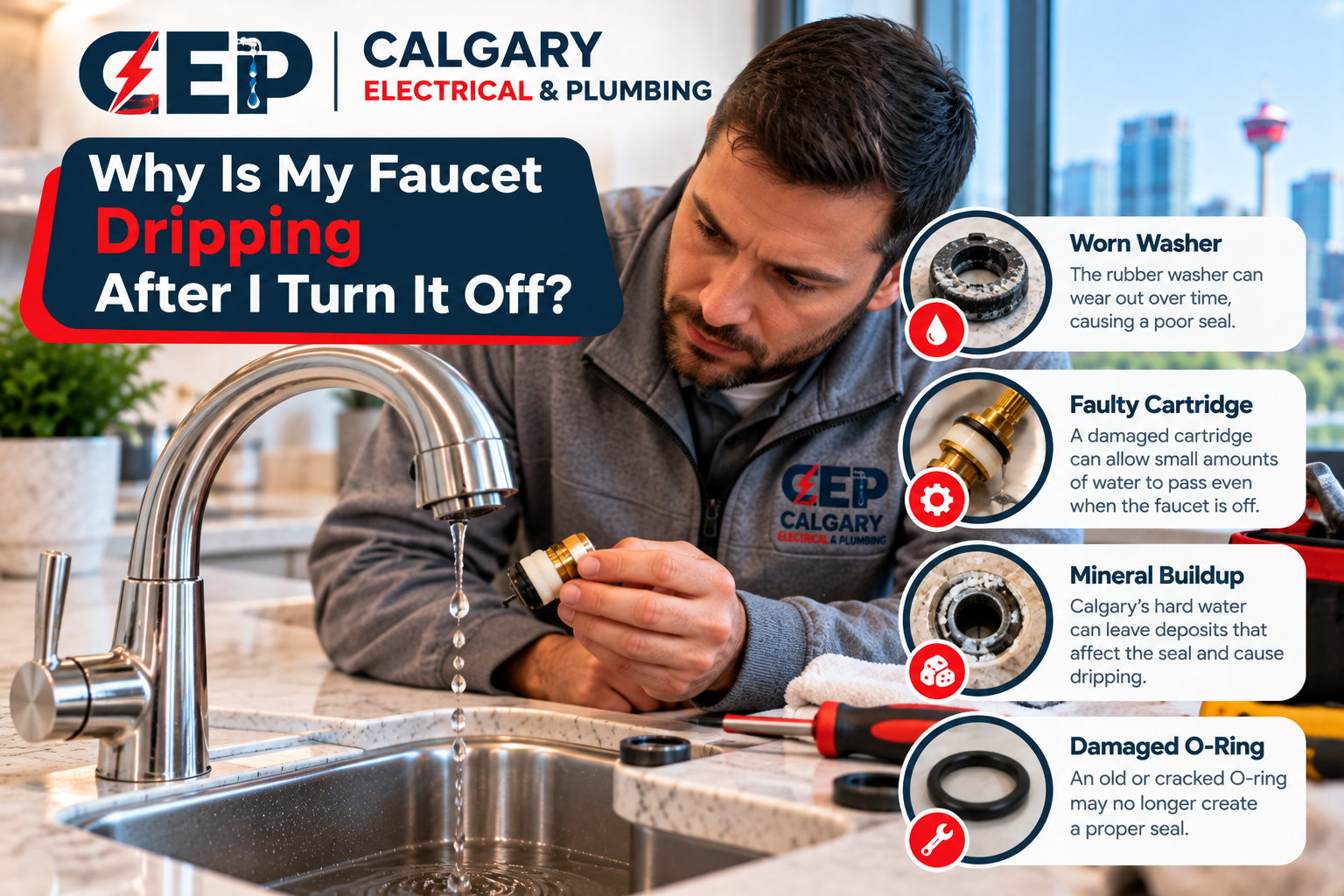

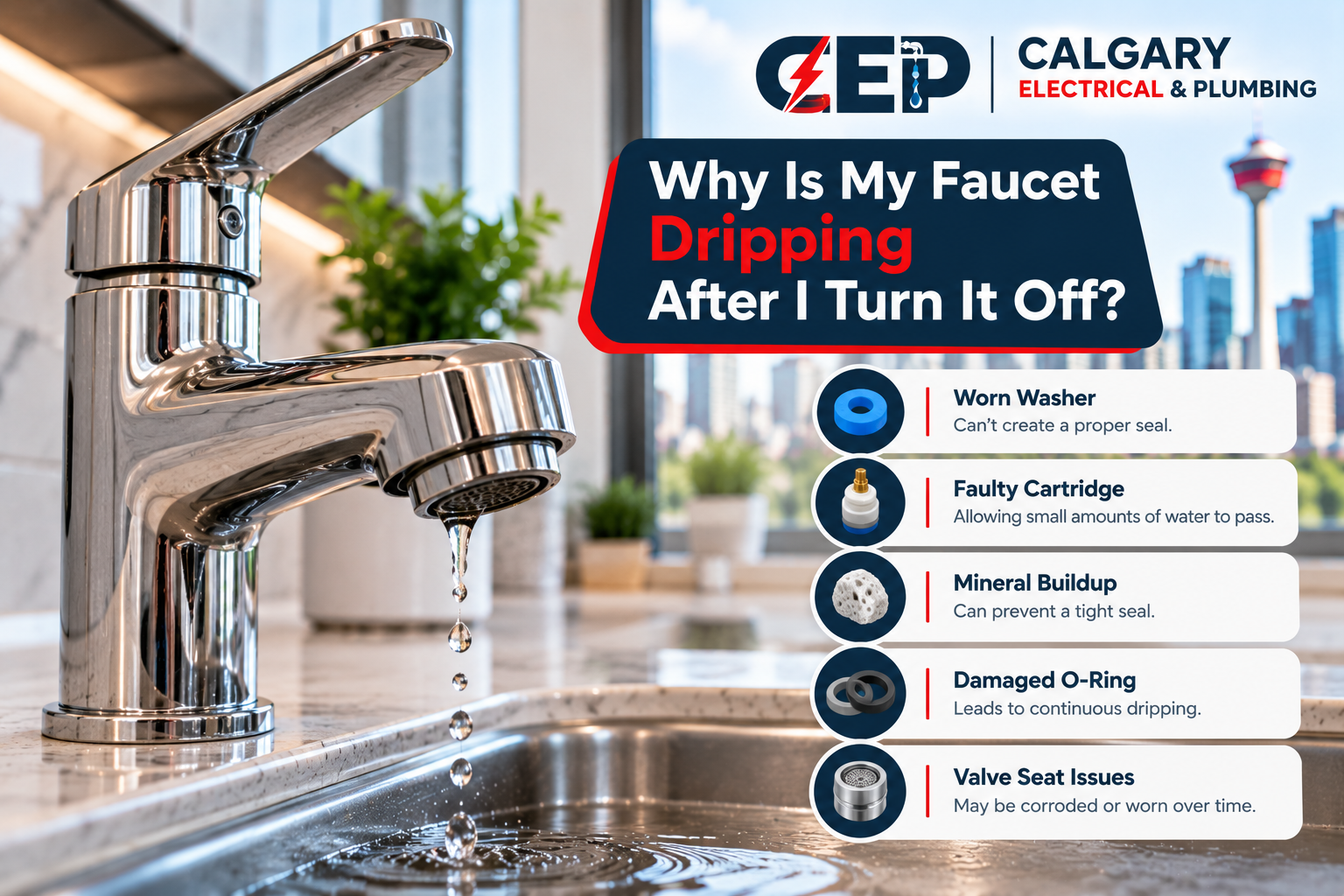
Why is my faucet dripping after I turn it off? It is a frustrating question when the handle is firmly closed but another drop keeps forming at the spout. In Calgary homes, this commonly points to a worn cartridge, washer, seal, valve seat, mineral buildup or another internal component that is no longer sealing correctly.
A persistent drip should not be dismissed simply because the amount of water looks small. Homeowners who need experienced plumbing help for Calgary properties can have the faucet inspected to identify the actual failed component instead of replacing parts by guesswork.
The cause can differ between homes in Cranston, Mahogany, Riverbend, New Brighton, Douglasdale and other Southeast Calgary communities. A newer faucet may have a worn cartridge, while an older fixture can combine mineral deposits, deteriorated seals and corrosion that make the repair more involved.
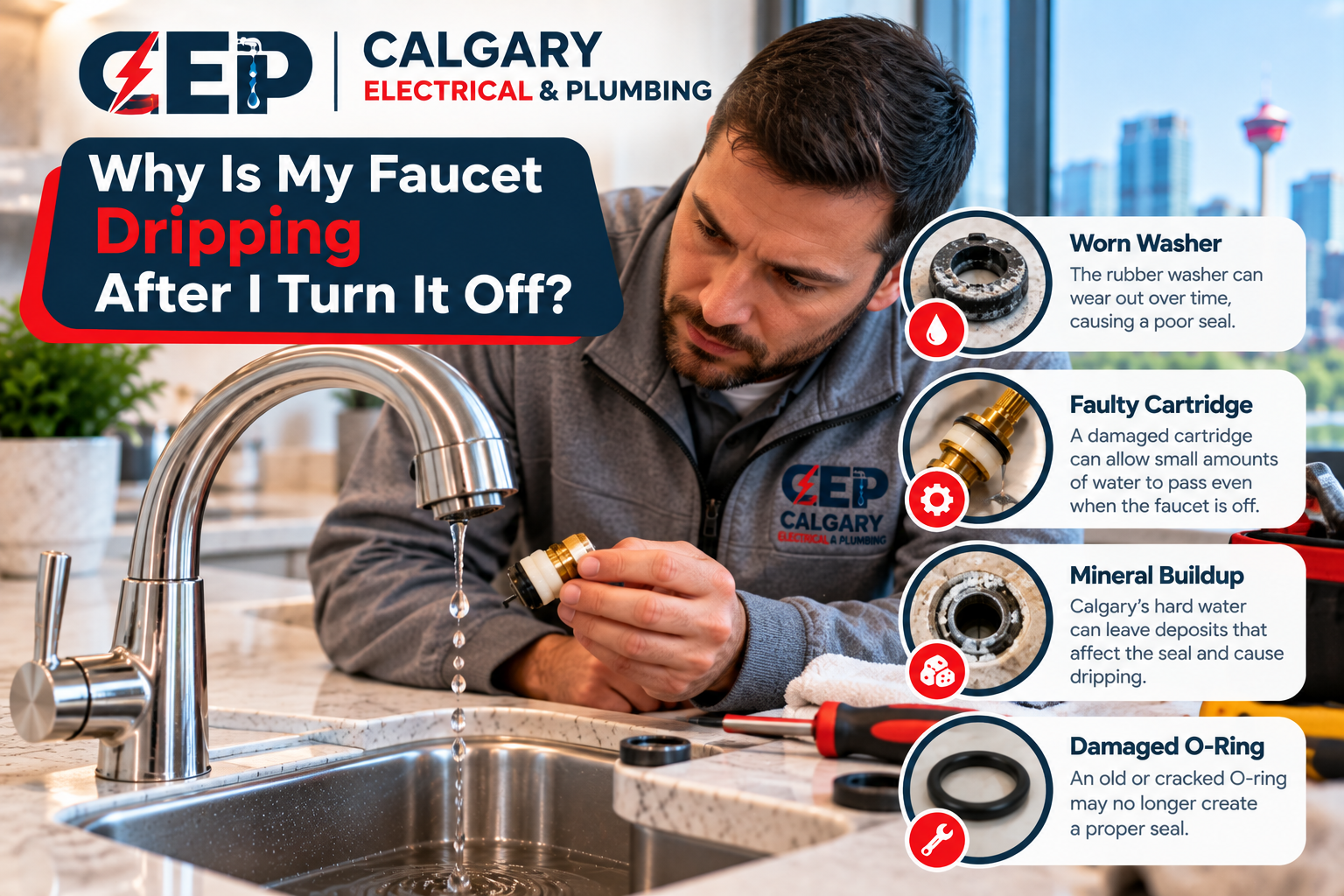
A faucet that drips after being turned off usually cannot form a complete internal seal. Common causes include worn cartridges, washers, O-rings, valve seats, mineral buildup or excessive wear. A few residual drops can be normal, but continuous dripping usually needs repair.
Why a Faucet Keeps Dripping After Shutoff
Inside every faucet is a mechanism designed to stop pressurized water when you move the handle into the closed position. The exact mechanism depends on the faucet design, but the basic principle is the same: internal components must create a watertight seal.
When that seal becomes worn, damaged, dirty or obstructed by mineral deposits, a small amount of water can continue passing through. That water travels toward the spout and appears as the familiar drip even though the handle looks completely closed.
1. A worn faucet cartridge
Cartridge failure is one of the most common reasons modern faucets continue dripping. The cartridge controls water flow and, in many single-handle designs, helps regulate the mixture of hot and cold water.
As internal seals wear, the cartridge may no longer shut the water off completely. You may notice a steady drip, a handle that feels different from normal, difficulty finding the fully closed position or leaking that becomes gradually worse.
2. A worn washer or seal
Older compression-style faucets often depend on rubber washers pressing against a valve seat. Every time the handle is tightened, the washer experiences pressure and friction.
Eventually it can harden, crack, deform or wear down. Once it can no longer sit evenly against the valve seat, water finds a small pathway through the faucet even after you close the handle.
3. A damaged or dirty valve seat
The valve seat is another important sealing surface. If it becomes rough, corroded or covered with mineral deposits, a new washer alone may not create a proper seal.
This is one reason repeatedly changing washers without inspecting the surrounding components can fail to solve a drip. The new part may be fine while the surface it presses against remains damaged.
4. Worn O-rings
O-rings are small sealing components used at different points inside faucets. Depending on the faucet design, a deteriorated O-ring may contribute to leaking around the handle, faucet body or internal assembly.
Because these components are hidden, the visible location of the water matters. A drip from the end of the spout can have a different cause from moisture collecting around the base of the fixture.
5. Calgary mineral buildup
Calgary’s water naturally contains dissolved minerals. Over time, deposits can collect on aerators, cartridges, valve seats and other internal surfaces.
Mineral buildup can prevent sealing surfaces from meeting correctly or make internal components difficult to move. In older fixtures, deposits may occur alongside corrosion, making disassembly and diagnosis more complicated.
Homeowners can verify the company’s local service presence through its Calgary plumbing location on Google Maps when planning a service visit.
How to Identify the Likely Faucet Problem
You do not need to dismantle a faucet to gather useful information. Watching where the water appears, how often it drips and how the handle behaves can help distinguish one problem from another.
Watch where the water is coming from
A continuous drip directly from the spout generally suggests that an internal water-control component is failing to close completely. A cartridge, washer, valve seat or related seal may be involved.
Water around the base of the faucet points toward a different set of possibilities, such as worn seals or loose connections. Moisture inside the cabinet can involve faucet connections, supply lines, shut-off valves or water travelling down from the fixture above.
Check if the faucet drips hot or cold water
With some two-handle faucets, the temperature of the dripping water can help indicate which side has the problem. If the drip is clearly warm or hot, the hot-side valve may deserve closer inspection; cold water can point toward the opposite side.
This observation is only a clue, not a complete diagnosis. Mixing and faucet design can make the situation less obvious, so components should still be properly inspected before replacement.
Pay attention to handle movement
A faucet handle should operate smoothly and reach its closed position without excessive force. A handle that suddenly feels loose, unusually stiff or difficult to position can indicate internal wear or mineral buildup.
Do not repeatedly force the handle tighter in an attempt to stop a drip. Excessive force can damage internal components and, in some designs, make the eventual repair more complicated.
Listen to the pattern of the leak
A slow drop every few seconds and a thin continuous stream are both leaks, but they suggest different levels of water loss. If the leak is becoming faster over days or weeks, an internal component may be deteriorating further.
The company’s Calgary plumbing video resources provide additional service and homeowner information for people who prefer visual explanations of common plumbing concerns.
Consider the age of the fixture
A newer faucet that develops its first drip may simply have one faulty component. An older faucet with a history of leaks, stiff handles, corrosion and deteriorating finish deserves a broader assessment.
For example, a homeowner in Auburn Bay with a relatively recent kitchen faucet may only need a cartridge. A homeowner in an established Ogden property may discover that the faucet, shut-off valves and supply connections all show signs of age.
Request a faucet repair estimate in Calgary in just a few clicks.
Get My Free Estimate
What Does a Dripping Faucet Cost to Repair?
There is no single Calgary price for every dripping faucet because the visible symptom can come from several different components. The cost depends on the faucet type, replacement part, accessibility, condition of the fixture and amount of labour required.
A common cartridge in an accessible bathroom faucet can be relatively straightforward. A corroded specialty faucet with seized hardware, difficult access and an uncommon replacement component can require considerably more work.
| Faucet Problem | Approximate Calgary Planning Range | What May Affect the Price |
|---|---|---|
| Minor washer, seal or O-ring repair | $150–$250 | Faucet design, accessibility and standard parts |
| Cartridge replacement or internal repair | $180–$350 | Cartridge cost, brand, mineral buildup and labour |
| More complex faucet repair | $250–$450+ | Corrosion, seized components, uncommon parts or related plumbing issues |
| Standard faucet replacement | $250–$600+ | New fixture, installation, connections and accessibility |
| After-hours or urgent service | Varies | Service timing, urgency and scope of the plumbing problem |
Important: These are approximate budgeting ranges in Canadian dollars rather than fixed quotes. The actual cost can change according to the fixture, replacement parts, labour, taxes, accessibility and any additional plumbing defects discovered during service.
Why can such a small leak cost more than expected?
The replacement component may be small, but professional repair involves more than the part itself. The plumber has to diagnose the fault, isolate the water, access and disassemble the fixture, remove the failed component, install the correct replacement and test the faucet afterward.
If mineral deposits or corrosion have seized the old component, removal can take additional time. Likewise, a shut-off valve that no longer closes properly may need attention before work on the faucet can proceed safely.
Can a dripping faucet increase your water use?
Yes. A persistent leak adds up because it continues around the clock. A slow drip may look insignificant when viewed for a few seconds, yet thousands of individual drops can pass through the fixture over a month.
That is why correcting the problem is not simply about eliminating an annoying sound. Repair can also reduce unnecessary household water consumption and prevent the leak from progressing into a faster flow.
Does a faucet drip always require an emergency plumber?
A slow drip confined to the sink is generally different from an uncontrolled leak beneath the fixture. If the water is safely draining into the basin and there is no sign of cabinet or property damage, the repair can often be scheduled normally.
If water is escaping beneath the sink, spraying from a connection, soaking cabinetry or cannot be controlled, the situation deserves faster attention. The location and volume of the water matter more than the irritating sound of the drip itself.
Homeowners can also follow Calgary plumbing and maintenance updates on Facebook for additional service information and local home-maintenance content.
When Should You Repair or Replace the Faucet?
Once the cause of the drip is known, the next decision is usually straightforward: repair the existing faucet or replace it. The cheapest option depends on the condition of the complete fixture, not simply the price of one component.
Repair usually makes sense when the faucet is otherwise healthy
A sound fixture with one worn cartridge, washer, seal or O-ring is often worth repairing. This is especially true when the faucet is relatively new, replacement components remain readily available and there are no other signs of deterioration.
Suppose a five-year-old bathroom faucet in McKenzie Towne develops a steady drip but remains firmly mounted, corrosion-free and easy to operate. If one standard cartridge is responsible, replacing the complete fixture may add unnecessary expense.
Replacement may make sense when problems are accumulating
Now consider an older kitchen faucet in Acadia. The fixture has been repaired previously, the handle is loose, corrosion is visible around the base and the pull-out hose is deteriorating.
Another cartridge might stop today’s drip, but it will not restore the rest of the aging fixture. In that situation, comparing the complete replacement cost can be more useful than automatically authorizing another isolated repair.
What should you do when you first notice the drip?
Start by observing the faucet rather than forcing the handle. Confirm that the water is coming from the spout and check beneath the sink for any separate moisture.
If you know the faucet manufacturer and model, keep that information available. A clear photograph of the fixture can also help identify its design and prepare for the possibility that a specific cartridge or repair kit is required.
Check underneath the sink
A dripping spout is usually visible, but homeowners should also look beneath the sink. Check the cabinet floor, supply connections and shut-off valves for signs of moisture.
Finding water below the fixture changes the urgency because cabinetry and nearby materials can be damaged. A hidden leak also means the spout drip may not be the only plumbing problem present.
Avoid overtightening the faucet handle
When a compression faucet drips, it can be tempting to turn the handle harder. That may temporarily reduce the drip in some cases, but excessive pressure can damage washers, valve components or handles.
The correct solution is to restore the sealing component rather than continually increasing force. Modern cartridge faucets in particular are not designed to be stopped by aggressive tightening.
What about DIY faucet repair?
Some homeowners are comfortable replacing accessible faucet components. The important part is correctly identifying the faucet and shutting off the water before disassembly.
DIY becomes less attractive when shut-off valves do not operate properly, parts are seized, the fixture is heavily corroded or the leak extends into supply connections. Incorrect disassembly can turn a controlled drip into a more serious leak.
Why Calgary homes can experience recurring faucet issues
Fixture quality, frequency of use, age and water conditions all influence wear. A busy family kitchen faucet in Seton can experience far more daily operation than a faucet in a lightly used basement bathroom.
Mineral accumulation also develops gradually. Aerators may become restricted, moving components can feel stiff and sealing surfaces may no longer meet cleanly. Routine attention to small changes can help identify problems before they become severe.
Can the aerator cause dripping?
An aerator primarily controls and shapes the stream at the end of the spout. Water trapped inside it can sometimes produce a few drops shortly after shutoff, particularly with certain faucet designs.
However, an aerator does not normally explain a drip that continues indefinitely. If fresh water keeps appearing long after the faucet is closed, the source is more likely upstream within the faucet’s water-control mechanism.
Why does the faucet drip only at certain handle positions?
A worn cartridge or internal seal can behave differently as the handle moves. The faucet may stop leaking when the handle is pushed slightly beyond its normal closed position or may drip only after hot water has been used.
These symptoms can be useful during diagnosis. Tell the plumber what you have noticed rather than repeatedly manipulating the handle in an attempt to find a temporary stopping point.
Do not forget the shut-off valves
Fixture shut-off valves beneath the sink are important during faucet repairs. If they are seized, corroded or unable to stop the water fully, additional plumbing work may be required before the faucet can be serviced properly.
Older Southeast Calgary properties may have aging shut-offs even when the visible faucet was replaced more recently. The age of the fixture therefore does not always reflect the age of the plumbing beneath it.
When a drip becomes more than a faucet problem
A drip from the spout is usually a fixture issue. Water staining around the sink, swelling cabinetry, dampness inside the vanity or unexplained moisture on the floor suggests the problem should be investigated more broadly.
In homes around Douglasdale, Riverbend, Ogden, Cranston and Mahogany, the same principle applies: identify where the water begins before deciding which component needs repair.
For shorter company and service updates, homeowners can also view Calgary plumbing information on X while researching professional service options.
Request a faucet repair estimate in Calgary in just a few clicks.
Request My Faucet Estimate
Stop the Drip by Finding the Real Cause
A faucet that continues dripping after shutoff is usually telling you that an internal component is no longer creating a complete seal. Cartridges, washers, O-rings, valve seats, mineral deposits and general fixture wear are all possible causes, and identifying the right one prevents unnecessary parts replacement.
If you need a local Calgary plumber to diagnose a persistent kitchen or bathroom faucet drip, call (403) 421-1991. A proper inspection can determine if a targeted repair is enough or if the condition of the fixture makes replacement more practical.
Frequently Asked Questions about Dripping Faucets
Why does my faucet keep dripping after I turn it off?
A Calgary faucet that keeps dripping after shutoff commonly has a worn cartridge, washer, seal, valve seat or another component that is not sealing completely. Mineral deposits can also interfere with internal surfaces and allow small amounts of water to continue passing through.
Is it normal for a faucet to drip a few times after shutoff?
A few drops immediately after shutoff can simply be residual water draining from the spout or aerator. If fresh drops continue for several minutes or indefinitely, Calgary homeowners should treat that as a likely leak rather than normal drainage.
Can Calgary’s mineral-rich water make a faucet drip?
Mineral deposits can contribute to faucet problems by collecting around cartridges, valve seats and other sealing surfaces. Buildup may prevent components from fitting together properly and can make older parts harder to remove when a Calgary faucet needs professional repair.
Should I replace a faucet that will not stop dripping?
Not automatically. A sound faucet may only need a cartridge, washer or seal. Replacement becomes more reasonable when the fixture is badly corroded, damaged, repeatedly repaired or dependent on unavailable parts. Comparing both options can help Calgary homeowners avoid unnecessary expense.
When should I call a plumber for a dripping faucet in Calgary?
Call a plumber when the drip persists, repairs have already failed, shut-off valves do not work or water appears beneath the sink. Faster attention is important when the leak can reach cabinetry, flooring or other materials instead of draining safely into the basin.
Don’t wait for a persistent leak to become a larger plumbing problem.
Call (403) 421-1991 Now
Local Help Available 24/7 in Calgary